Personal Finance Glossary: 50 Money Terms Explained Simply
This personal finance glossary explains 50 common money terms in plain English, grouped by topic. Bookmark it and come back whenever a bank statement, loan offer or retirement plan uses a word you are not sure about.
Quick answer
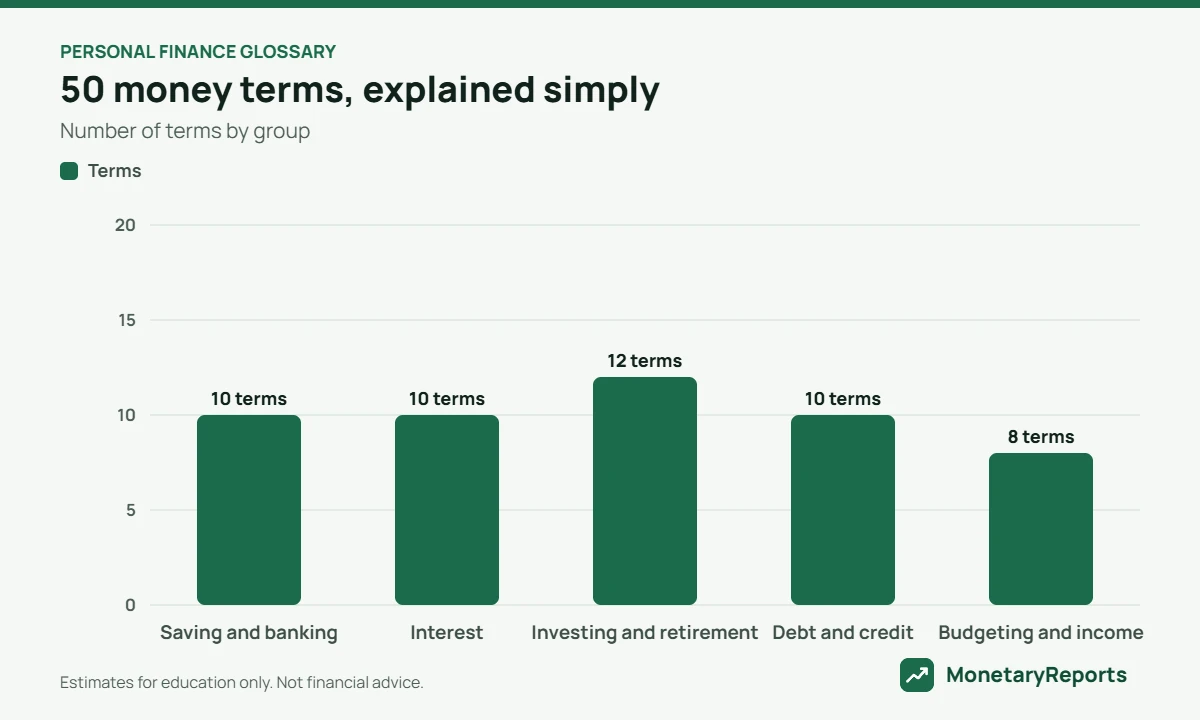
This personal finance glossary covers 50 terms in five groups: saving and banking, interest, investing and retirement, debt and credit and budgeting and income. Each has a one-line definition and, where useful, a link to a full guide or calculator.
Personal finance glossary: saving and banking
- Emergency fund: cash set aside for unexpected costs, often 3 to 6 months of essential expenses.
- High-yield savings account: a savings account that pays a higher APY than the traditional average.
- Certificate of deposit (CD): a deposit that pays a fixed rate for a fixed term.
- CD ladder: several CDs with staggered maturity dates.
- Money market account: a deposit account similar to savings, sometimes with check-writing.
- FDIC insurance: government protection for bank deposits up to $250,000 per depositor, per bank, per ownership category.
- Liquidity: how quickly you can turn an asset into cash without losing value.
- Sinking fund: money saved monthly for a known future expense.
- Treasury bill: short-term U.S. government debt, sold at a discount.
- Pay yourself first: saving automatically before spending.
Interest
- Interest: the price of using money: paid to savers, charged to borrowers.
- Simple interest: interest calculated only on the original amount.
- Compound interest: interest earned on the original amount plus earlier interest.
- APR: annual percentage rate, the yearly rate without compounding (may include fees on loans).
- APY: annual percentage yield, the yearly return including compounding.
- Compounding frequency: how often interest is added: daily, monthly, yearly.
- Principal: the original amount deposited or borrowed.
- Rule of 72: divide 72 by the rate to estimate years to double.
- Real interest rate: the rate after subtracting inflation.
- Federal funds rate: the Federal Reserve’s target rate for overnight bank lending.
Investing and retirement
- 401(k): an employer retirement plan with tax advantages.
- Employer match: money your employer adds when you contribute.
- IRA: an individual retirement account with tax advantages.
- Roth IRA: an IRA funded with after-tax money; qualified withdrawals can be tax-free.
- Index fund: a fund that tracks a market index, usually with low fees.
- Expense ratio: a fund’s yearly fee as a percentage of your investment.
- Diversification: spreading money across many investments to reduce risk.
- Dollar-cost averaging: investing a fixed amount on a regular schedule.
- CAGR: compound annual growth rate, the steady yearly growth rate.
- 4% rule: a guideline for retirement withdrawals.
- FIRE: financial independence, retire early.
- Vesting: the schedule that decides when employer contributions become fully yours.
Debt and credit
- Amortization: paying off a loan with equal payments over time.
- Minimum payment: the smallest payment a card issuer accepts each month.
- Balance transfer: moving debt to another card, often with a 0% intro APR.
- Credit utilization: how much of your available credit you use.
- Credit score: a number that summarizes your credit history for lenders.
- Debt avalanche: paying the highest-APR debt first.
- Debt snowball: paying the smallest balance first.
- Grace period: the time before interest applies on new card purchases if you pay in full.
- Daily periodic rate: APR divided by 365 (or 360), used to charge interest daily.
- Down payment: the part of a purchase price you pay upfront.
Budgeting and income
- Gross income: pay before taxes and deductions.
- Net income: take-home pay after taxes and deductions.
- 50/30/20 rule: needs, wants and savings split for a budget.
- Zero-based budget: a budget where every dollar is assigned a job.
- Net worth: assets minus debts.
- Inflation: the general rise in prices over time.
- Time value of money: the idea that money today is worth more than money later.
- Lifestyle creep: spending more as income rises, leaving savings flat.
How to use this personal finance glossary
- Bookmark it and look up terms as you meet them.
- Follow the links for full guides and calculators.
- Learning a few terms each week adds up quickly.
Frequently asked questions
What are the most important personal finance terms to know?
APR, APY, compound interest, emergency fund, net worth, 401(k), Roth IRA and credit utilization are a great start.
What is the difference between APR and APY?
APR does not include compounding; APY does. See our APY vs APR guide.
What does liquidity mean?
How quickly you can turn something into cash without losing value. Cash is the most liquid; a house is not.
What is an index fund?
A fund that holds the investments in a market index, offering broad diversification, usually at low cost.
Will you add more terms?
Yes, we update this personal finance glossary as we publish new guides.
Related guides and calculators
Sources
- Investor.gov (U.S. SEC): Compound interest calculator
- Consumer Financial Protection Bureau (CFPB)
- FDIC: Deposit insurance
- MonetaryReports: How we calculate
This guide is for educational purposes only and is not financial advice. The figures are estimates before taxes, fees and inflation, and real rates, returns and rules change over time.