Dollar-Cost Averaging: What It Is, Pros, Cons and Examples
Dollar-cost averaging (DCA) means investing a fixed amount on a regular schedule, no matter what the market is doing. When prices are high, your money buys fewer shares; when prices are low, it buys more. It is how most people invest through a 401(k) without even thinking about it.
Quick answer
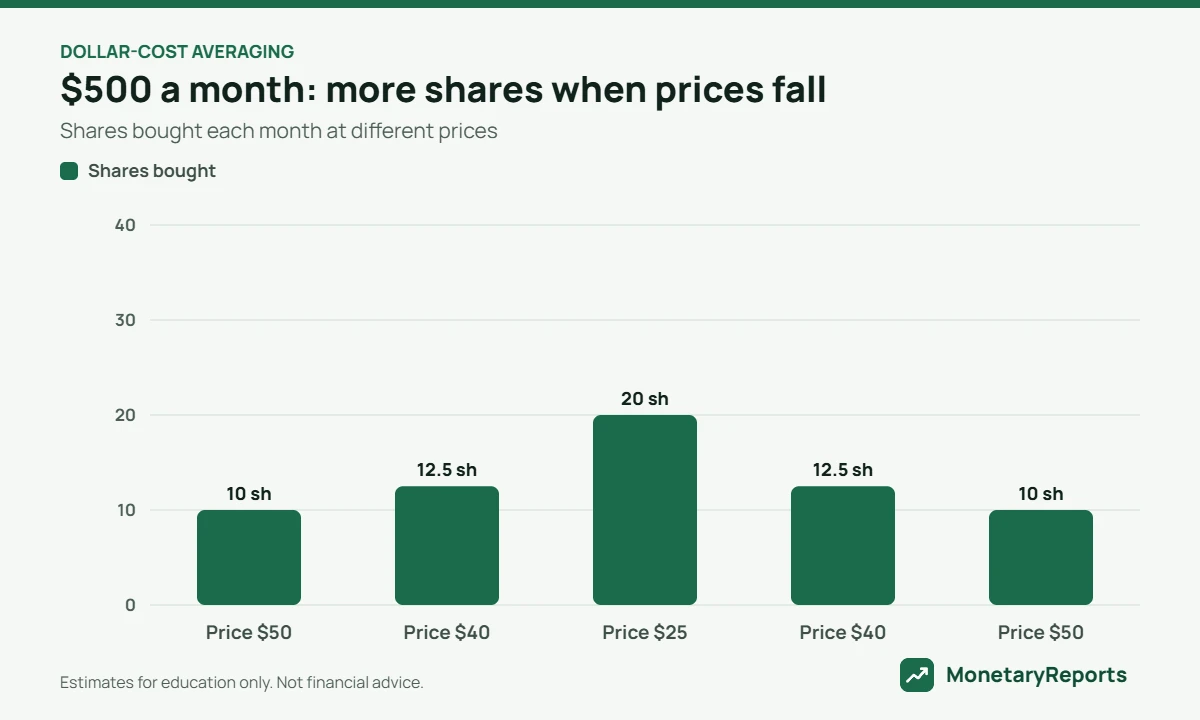
With dollar-cost averaging, you invest the same amount at regular intervals. Example: $500 a month for 5 months at prices of $50, $40, $25, $40 and $50 buys 65 shares for $2,500, an average cost of $38.46 per share, below the average price of $41.
How dollar-cost averaging works
- Choose a fixed amount, such as $500.
- Choose a schedule, such as every month or every paycheck.
- Invest automatically, regardless of market news.
- Keep going through ups and downs.
Worked example
| Month | Price per share | Amount invested | Shares bought |
|---|---|---|---|
| 1 | $50 | $500 | 10.0 |
| 2 | $40 | $500 | 12.5 |
| 3 | $25 | $500 | 20.0 |
| 4 | $40 | $500 | 12.5 |
| 5 | $50 | $500 | 10.0 |
| Total | Average price $41 | $2,500 | 65.0 |
The price ended where it started ($50), but the investor owns 65 shares worth $3,250, because the low-price month bought extra shares. Real markets are less tidy, but the principle holds.
DCA vs lump sum
If you already have a large amount to invest, research on historical data suggests that investing it all at once has more often come out ahead, because markets have tended to rise over time. DCA can still make sense if it helps you invest without fear of bad timing. For most people investing from each paycheck, DCA is simply the natural way to invest.
Pros and cons
| Pros | Cons |
|---|---|
| Removes the stress of timing the market | Can lag a lump sum when markets rise steadily |
| Builds a consistent habit | Does not prevent losses in a falling market |
| Buys more shares when prices are low | Some brokers charge fees per purchase |
What DCA means for you
- Automatic monthly investing in a 401(k) or IRA is dollar-cost averaging.
- Stick with the plan in down markets; that is when DCA buys the most shares.
- Choose low-cost, diversified funds so fees do not eat the benefit.
Frequently asked questions
What is dollar-cost averaging in simple words?
Investing the same amount on a regular schedule, so you buy more shares when prices are low and fewer when they are high.
Does DCA guarantee a profit?
No. It does not protect against losses in a market that keeps falling.
Is DCA better than investing a lump sum?
Historically, lump sums have often done better, but DCA reduces the risk of investing everything right before a drop.
How often should I invest this way?
Monthly or every paycheck is common and easy to automate.
Is my 401(k) dollar-cost averaging?
Yes, contributions from each paycheck are a form of dollar-cost averaging.
Related guides and calculators
- Investing $500 a month for 30 years
- Historical stock market returns
- 401(k) growth calculator
- Pay yourself first
Sources
- Investor.gov: Dollar-cost averaging
- Investor.gov (U.S. SEC): Compound interest calculator
- MonetaryReports: How we calculate
This guide is for educational purposes only and is not financial advice. The figures are estimates before taxes, fees and inflation, and real rates, returns and rules change over time.