Inflation-Adjusted Return: How to Calculate Your Real Return
An inflation-adjusted return (also called a real return) tells you how much your money really grew in buying power, after rising prices are taken into account. A 7% return sounds great, but with 3% inflation your buying power grows by only about 3.9% a year. This guide shows the formula and what it means for your plans.
Quick answer
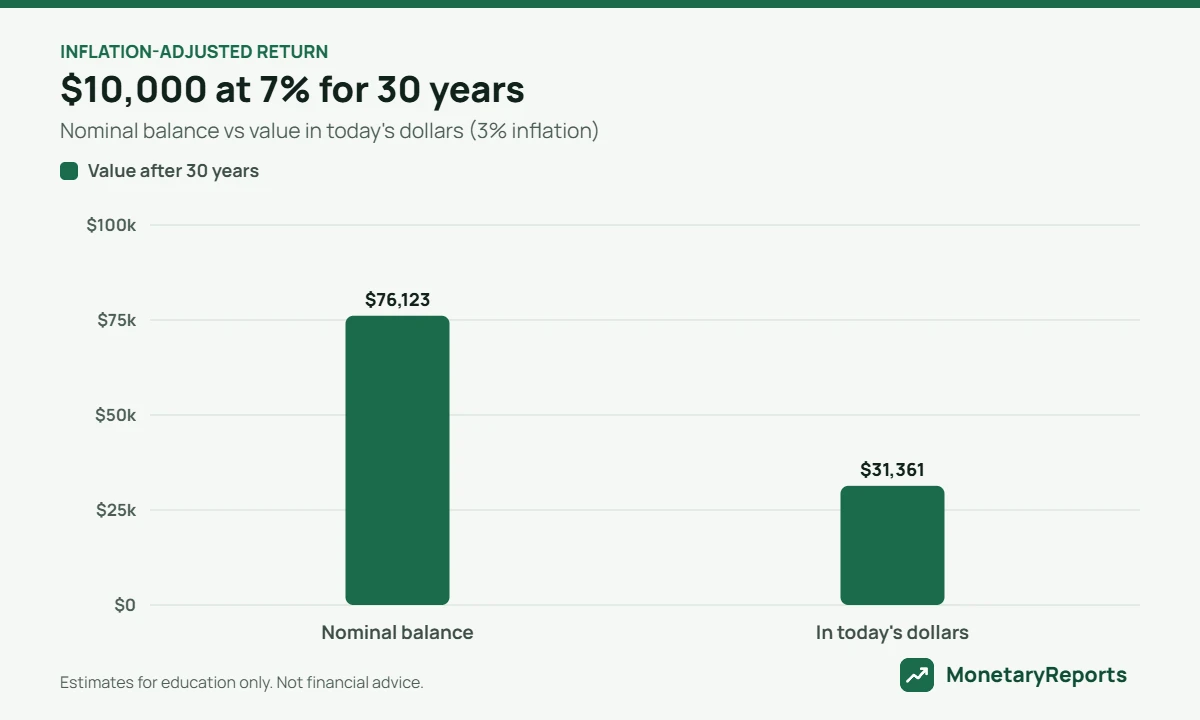
Inflation-adjusted return = (1 + nominal return) ÷ (1 + inflation) − 1. A 7% return with 3% inflation is a real return of about 3.88%. $10,000 at 7% for 30 years becomes about $76,123, which buys roughly what $31,361 buys today.
The inflation-adjusted return formula
Real return = (1 + nominal return) ÷ (1 + inflation) − 1
Quick estimate: nominal return − inflation
Examples
| Nominal return | Inflation | Inflation-adjusted return |
|---|---|---|
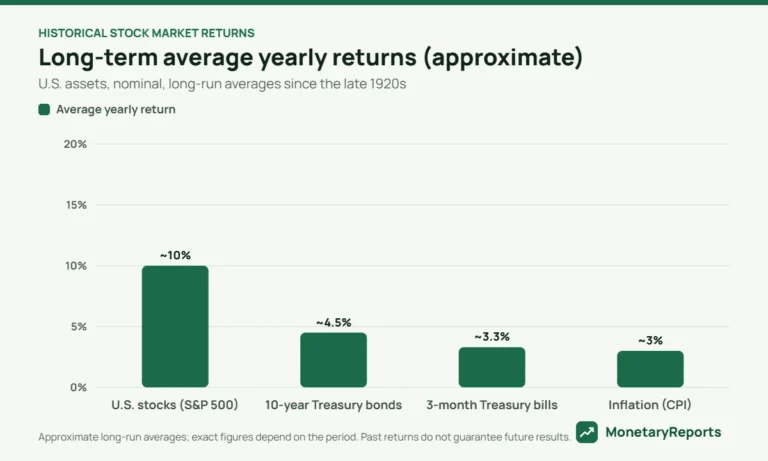
| 4.5% (savings) | 3% | 1.46% |
| 7% (stocks, planning rate) | 3% | 3.88% |
| 10% (stocks, strong decade) | 3% | 6.80% |
Why it matters for planning
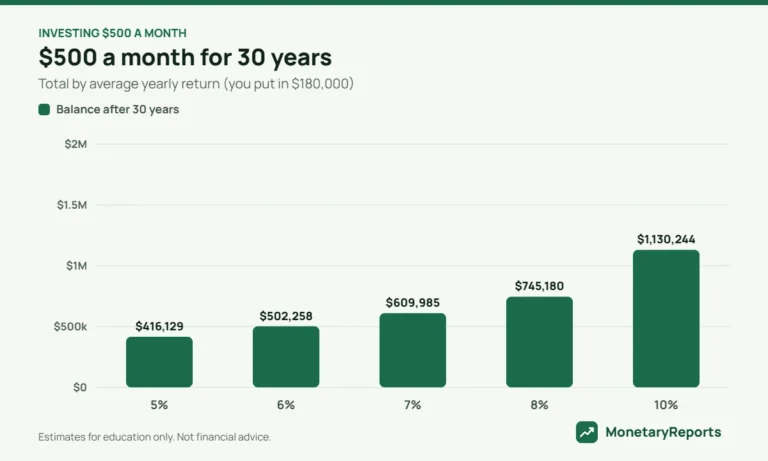
Retirement goals are about what your money can buy, not the number on a statement. $500 a month for 30 years at 7% grows to about $609,985 in nominal dollars, but only about $339,878 in today’s dollars at a 3.88% real return. Both numbers are correct; they answer different questions.
How to use real returns in calculators
- If your goal is in today’s dollars (for example “$40,000 a year of today’s spending”), use a real return.
- If your goal is a future dollar amount, use a nominal return and adjust the goal for inflation.
- Never mix the two: a nominal return with a goal in today’s dollars makes the plan look too easy.
What inflation-adjusted return means for you
- Check that your savings at least keep up with inflation.
- For long-term plans, many people use a real return of about 3% to 5% for a stock-heavy portfolio, as a conservative assumption.
- Taxes and fees reduce real returns further.
Frequently asked questions
What is an inflation-adjusted return?
The return after subtracting the effect of inflation, showing the growth in buying power.
How do you calculate real return?
Divide (1 + nominal return) by (1 + inflation) and subtract 1. 7% and 3% give about 3.88%.
Can a real return be negative?
Yes, when inflation is higher than your return, for example cash earning 0.5% with 3% inflation.
What inflation rate should I use?
Many people use around 2% to 3% for long-term planning and check the latest CPI from the Bureau of Labor Statistics.
Should retirement calculators use real or nominal returns?
Either, as long as your goal uses the same basis.
Related guides and calculators
- Nominal vs real interest rate
- Inflation calculator
- Historical stock market returns
- Coast FIRE calculator
Sources
- U.S. Bureau of Labor Statistics: Consumer Price Index
- Investor.gov (U.S. SEC): Compound interest calculator
- MonetaryReports: How we calculate
This guide is for educational purposes only and is not financial advice. The figures are estimates before taxes, fees and inflation, and real rates, returns and rules change over time.