
This free compound interest calculator works for savings, CDs and long-term investing. Choose compound or simple interest, pick how often you add money (every week, every 2 weeks, every month, every 3 months or every year) and see how your savings could grow. Change any number and the chart updates instantly.
| Year | Deposits | Interest | Balance |
|---|
How to use the compound interest calculator
| Field | What to enter | Tip |
|---|---|---|
| Interest type | Compound or simple | Savings accounts, CDs and investments use compound interest. |
| Currency | USD, GBP, EUR or CAD | Only changes the symbol; the math is the same. |
| Starting amount | Money you have today | Can be $0 if you start from nothing. |
| Regular deposit | How much you add each time | Use 0 to see only the starting amount grow. |
| Deposit frequency | Weekly, every 2 weeks, monthly, quarterly or yearly | Match how you get paid if you save every payday. |
| Yearly interest rate | The rate or expected return, in % | For a savings account use its APY. |
| Compounding | Daily, weekly, monthly, quarterly or yearly | Check your account disclosure; monthly is a good default. |
| Years | How long you will save | Try 10, 20 and 30 years to see the difference. |
Example: $5,000 plus $200 a month
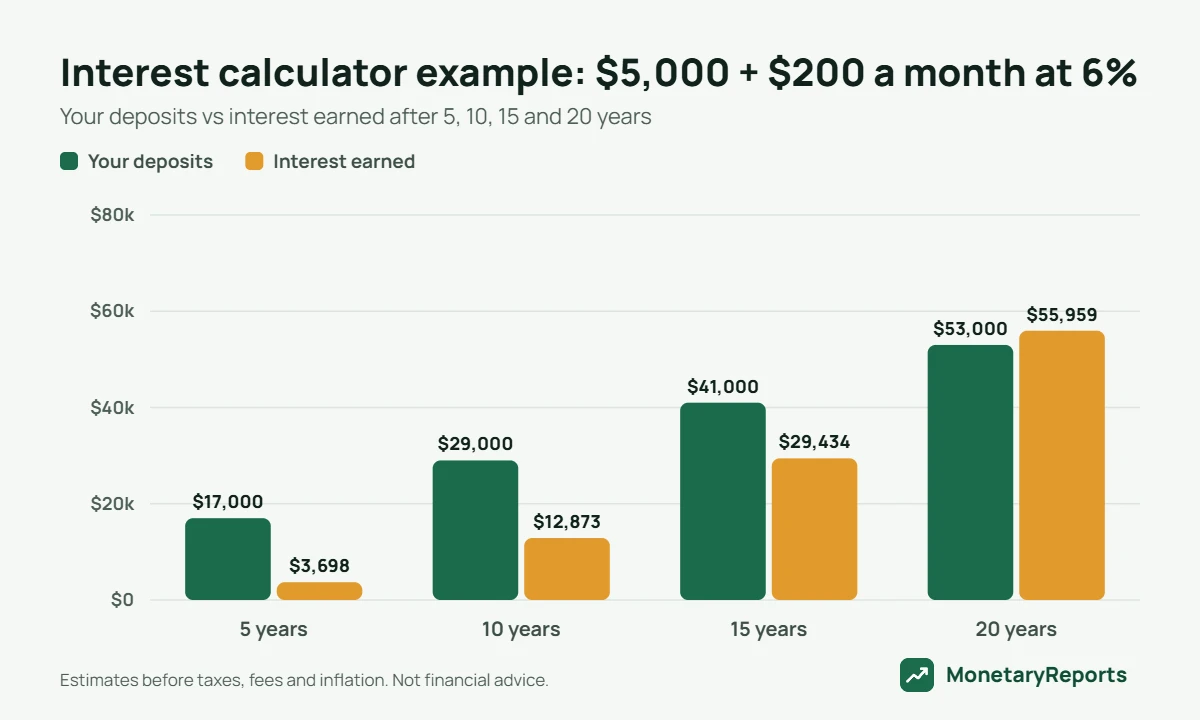
Say you have $5,000 and can save $200 a month at 6% a year, compounded monthly, for 20 years. The calculator shows a final balance of about $108,959: $53,000 of your own deposits and about $55,959 of interest. In the last years, interest earns more than your deposits each year.
Compound interest calculator examples for 3 common goals
The same compound interest calculator answers very different questions. Here are three common ones, run with the numbers below. Change them to your own figures in the compound interest calculator above.
| Goal | Inputs | Final balance | Interest earned |
|---|---|---|---|
| Emergency fund in a high-yield savings account | $1,000 start, $100 a month, 4%, monthly compounding, 5 years | $7,851 | $851 |
| CD with no extra deposits | $10,000, 4.5%, daily compounding, 3 years | $11,445 | $1,445 |
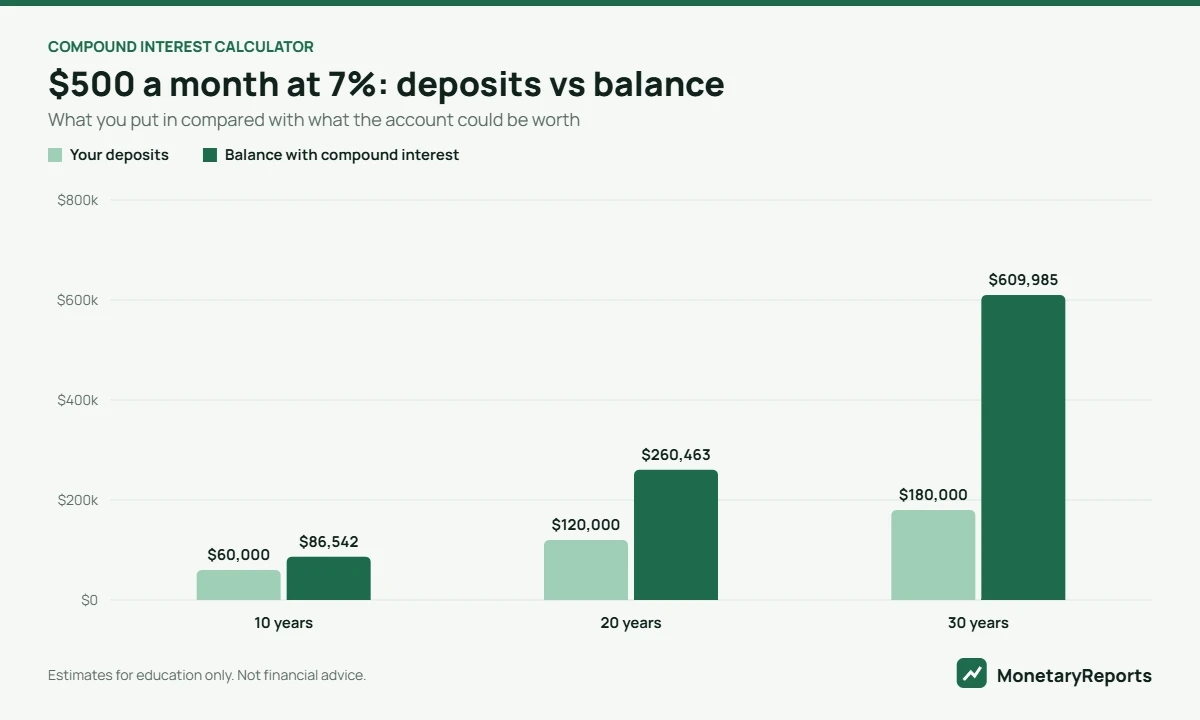
| Retirement investing | $0 start, $500 a month, 7%, monthly compounding, 30 years | $609,985 | $429,985 |
The pattern is the same in all three: the longer the money stays put, the bigger the share that comes from interest. Over 5 years, interest is about 11% of the final balance. Over 30 years, it is about 70%.
What this means for you: for short goals (under about 5 years), the amount you deposit matters far more than the rate. For long goals, time and the rate do most of the work, so starting early is the biggest advantage you can give yourself.
How the rate and time change your result
Small differences in the rate look minor in year one and huge in year thirty. Here is $200 a month in the compound interest calculator at three different rates:
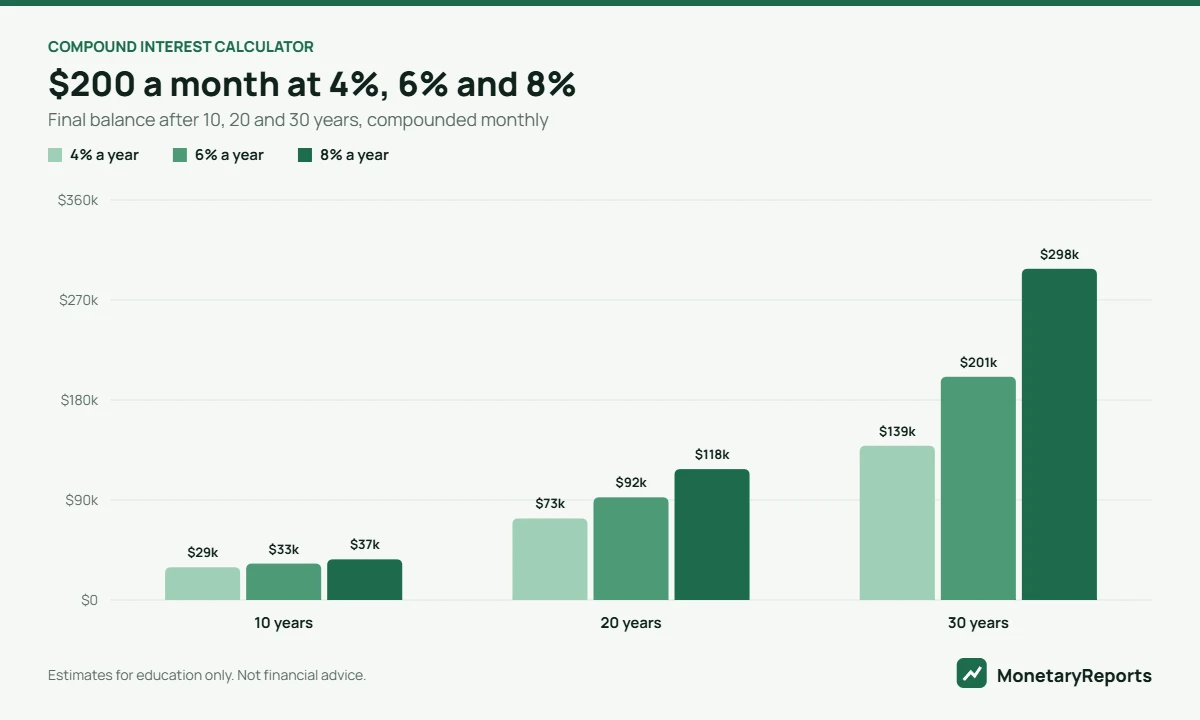
After 10 years, the gap between 4% and 8% is about $7,100. After 30 years, it is about $159,000. Time is what turns a small rate difference into a large amount.
Deposits scale in a straight line: $400 a month at 6% for 20 years grows to about $184,816, exactly twice the $92,408 you get with $200 a month. Rates, on the other hand, compound, which is why a 2-point difference matters so much over decades.
How to read the compound interest calculator results
- Final balance: what you could have at the end, before taxes, fees and inflation.
- Total deposits: all the money you put in, including the starting amount.
- Interest earned: the difference. This is the part compound interest adds.
- Chart: the green part is your money and the orange part is interest. Hover or tap to see any year.
- Year-by-year table: the exact balance at the end of each year.
Assumptions
Deposits are added at the end of each period. The rate stays the same every year. Results do not include taxes, fees or inflation. Real savings rates change and investments can lose value. See how we calculate for details.
6 common mistakes with a compound interest calculator
- Counting compounding twice. A savings account’s APY already includes compounding. If you enter the APY and also choose monthly compounding, the result comes out slightly too high. Use the APY with yearly compounding, or the stated rate with the account’s real compounding.
- Assuming today’s savings rate lasts 20 years. Savings and CD rates move with the Federal Reserve. Use a lower rate for long periods, or run a few scenarios.
- Using stock market returns for money you need soon. A 7% or 8% average only makes sense for money you can leave invested for many years. Money for next year belongs in savings, at savings rates.
- Forgetting inflation. At 3% inflation, $100,000 in 30 years buys about what $41,199 buys today. Use the inflation calculator to turn a future balance into today’s dollars.
- Ignoring fees and taxes. $500 a month for 30 years grows to about $609,985 at 7% but about $502,258 at 6%. A 1% yearly fee can cost more than $100,000 over that time.
- Waiting to start. The calculator shows how much the last years add. Every year you wait removes one of those big years from the end. See starting at 25 vs 35.
What this means for you: a compound interest calculator is only as good as the numbers you give it. Use a realistic rate, check the result in today’s dollars, and treat it as an estimate, not a promise.
How compound interest works
Compound interest means you earn interest on your deposits and also on the interest you already earned. Each year the base gets bigger, so the growth speeds up. That is why the orange part of the compound interest calculator chart grows faster in the later years.
How often interest is added matters much less than most people think. Here is $10,000 at 5% for 10 years in the compound interest calculator with four compounding schedules:
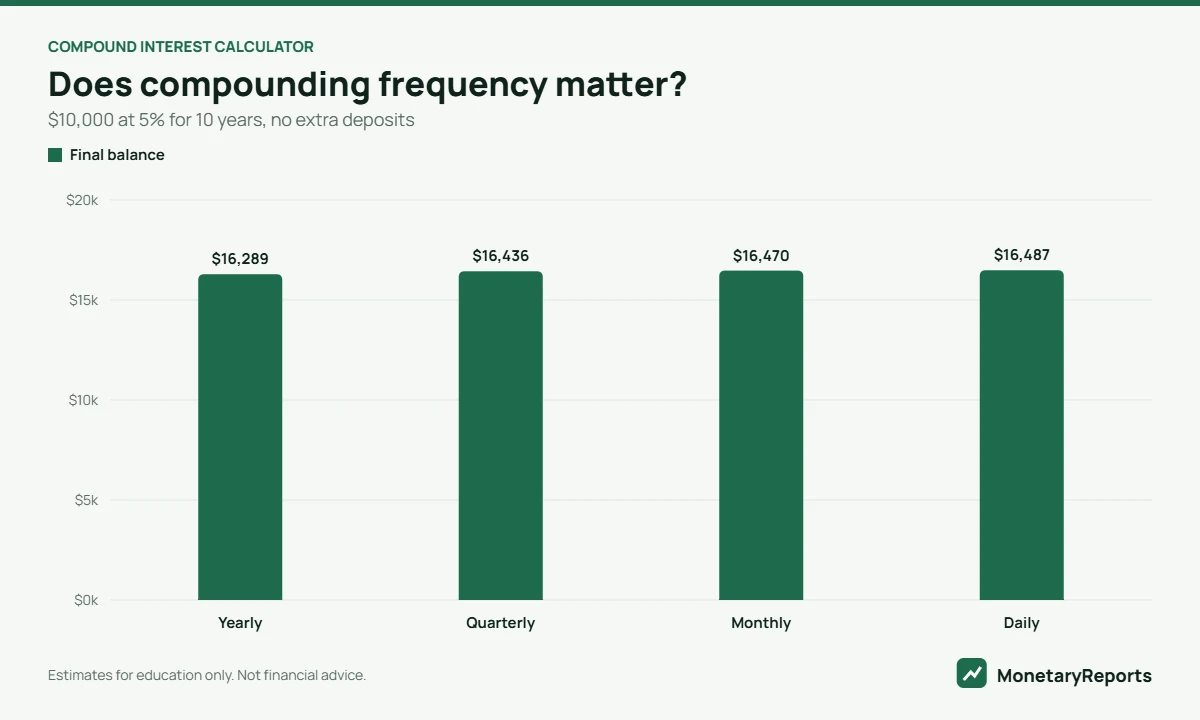
The difference between yearly ($16,289) and daily ($16,487) compounding is about $198 over 10 years. The rate, the deposits and the number of years matter far more.
The formula
A = P × (1 + r/n)^(n × t)
P is the starting amount, r the yearly rate as a decimal, n how many times per year interest is added and t the number of years. Regular deposits are added on top, one by one, which is what the calculator does for you.
Simple vs compound interest: $10,000 at 7%
| After | Simple interest | Compound interest (monthly) |
|---|---|---|
| 10 years | $17,000 | $20,097 |
| 20 years | $24,000 | $40,387 |
| 30 years | $31,000 | $81,165 |
Frequently asked questions
Does it matter if I save every week or every month?
A little. In the compound interest calculator, saving weekly puts money to work slightly earlier, so the result is a bit higher, but the total you deposit matters much more than how often you deposit it.
Is daily compounding much better than monthly?
Only slightly. Run both in the compound interest calculator: at 7% over 20 years, daily compounding changes the final balance by well under 1% compared with monthly.
Does this include taxes or inflation?
No. The compound interest calculator shows growth before taxes and before inflation (in future dollars). What that money can buy will be lower once you account for inflation.
What rate should I use?
Use the APY of your savings account or CD. For long-term investing, try a few different rates to see a range instead of a single number.
What is a realistic interest rate to use?
For cash, use the current APY of your account; national averages are published by the FDIC. For long-term investing, try a cautious rate and a more optimistic one (for example 5% and 7%) to see a range.
Why is my result different from my bank statement?
Banks may compound daily, credit interest on a specific day or round each month. Rates can also change over time. Small differences are normal.
Can I use it for debt?
It shows how a balance grows at a given rate, which helps you understand why unpaid debt grows. For paying debt down with monthly payments, a loan payoff calculator is more accurate.
How much will $1,000 grow with compound interest?
At 7% compounded monthly, with no extra deposits, $1,000 grows to about $2,010 in 10 years. Enter your own rate in the compound interest calculator above, or see how much $1,000 grows at 5%, 7% and 10%.
How long does it take to double my money?
Divide 72 by the yearly rate. At 6%, money doubles in about 12 years; at 8%, in about 9 years. The Rule of 72 calculator does it for any rate.
Is a compound interest calculator accurate for stocks?
It assumes the same return every year. Stocks rise and fall, so the real path is bumpier and the final result can be higher or lower. Treat the result as an estimate of an average path, and try a cautious and an optimistic rate to see a range.
Related guides and calculators
- What is compound interest?
- Compound interest formula explained
- Compound vs simple interest
- Daily vs monthly vs annual compounding
- Rule of 72 calculator
- Investment growth (CAGR) calculator
- How much will $10,000 grow?
Sources
- Investor.gov (U.S. SEC): Compound interest calculator
- FDIC: National rates and rate caps
- U.S. Bureau of Labor Statistics: Consumer Price Index
- MonetaryReports: How we calculate
Last updated: November 2026. Results are estimates for educational purposes only and are not financial advice.