Compound Interest Formula Explained Step by Step
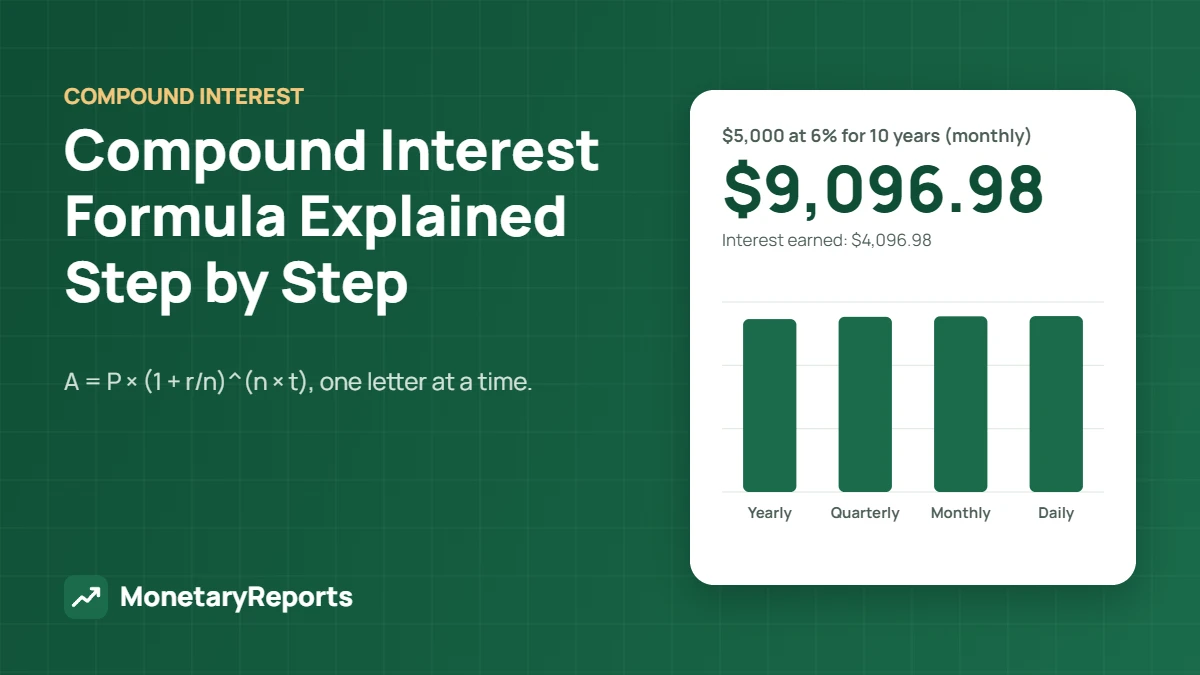
The compound interest formula looks intimidating the first time you see it, but every letter has a simple meaning. Once you understand it, you can check any savings account, CD or investment projection yourself, on a phone calculator or in a spreadsheet. This guide walks through it one step at a time, with worked examples you can verify.
Quick answer
The compound interest formula is A = P × (1 + r/n)^(n × t). P is the starting amount, r the yearly rate as a decimal, n how many times a year interest is added and t the number of years. Example: $5,000 at 6% compounded monthly for 10 years grows to $9,096.98.
The compound interest formula
A = P × (1 + r/n)^(n × t)
In words: take the yearly rate, split it into the number of compounding periods, grow your money by that small amount once per period, and repeat for every period in the time frame.
What each letter means
| Letter | Meaning | Example |
|---|---|---|
| A | Final amount (what you end with) | The answer |
| P | Principal: the starting amount | $5,000 |
| r | Yearly interest rate as a decimal | 6% → 0.06 |
| n | Times interest is added per year | Monthly → 12 |
| t | Number of years | 10 |
Worked example, step by step
Let us find out what $5,000 becomes at 6% a year, compounded monthly, after 10 years.
- Rate per period: r ÷ n = 0.06 ÷ 12 = 0.005.
- Growth per period: 1 + 0.005 = 1.005.
- Number of periods: n × t = 12 × 10 = 120.
- Total growth factor: 1.005^120 ≈ 1.8194.
- Final amount: $5,000 × 1.8194 ≈ $9,096.98.
- Interest earned: $9,096.98 − $5,000 = $4,096.98.
Tip: on a phone calculator, turn the phone sideways and use the x^y button for step 4.
How n changes the result
The same compound interest formula gives slightly different answers depending on n. Here is the same $5,000 at 6% for 10 years:
| Compounding | n | Final amount | Interest earned |
|---|---|---|---|
| Yearly | 1 | $8,954.24 | $3,954.24 |
| Quarterly | 4 | $9,070.09 | $4,070.09 |
| Monthly | 12 | $9,096.98 | $4,096.98 |
| Daily | 365 | $9,110.14 | $4,110.14 |
| Continuous | ∞ | $9,110.59 | $4,110.59 |
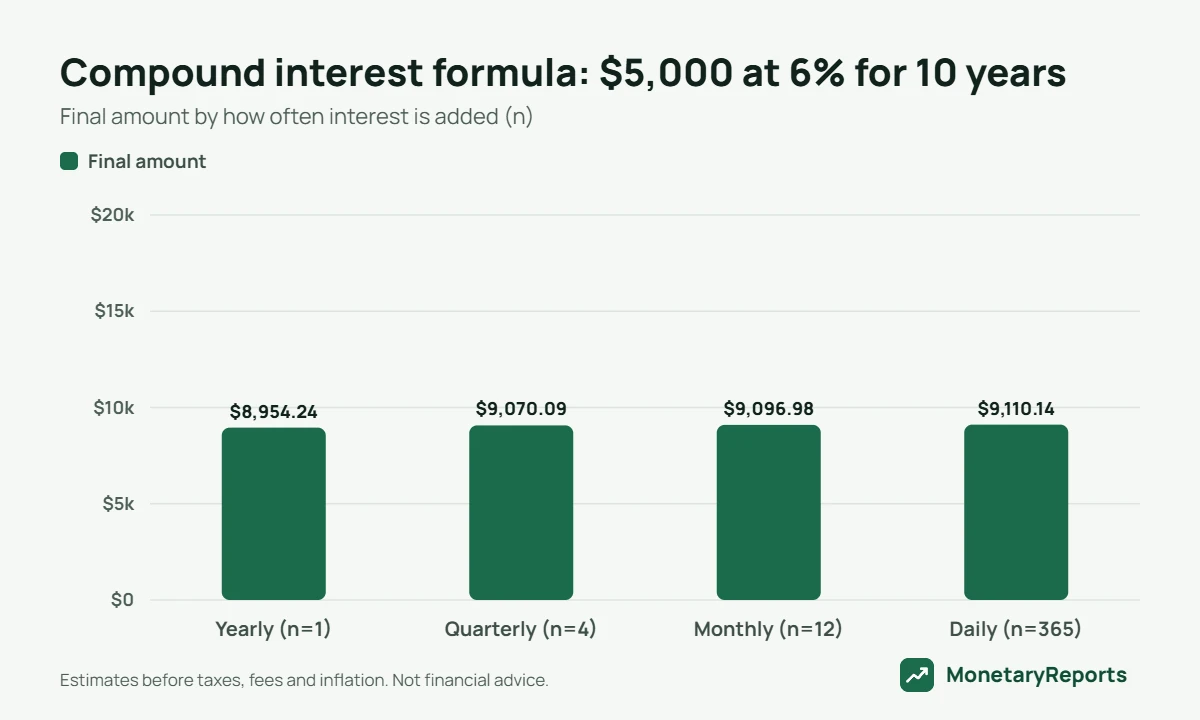
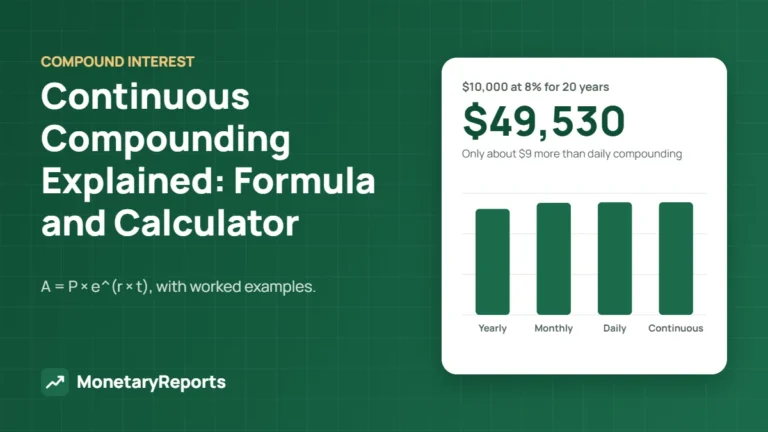
Going from yearly to monthly adds about $143. Going from monthly to daily adds only about $13. For the limit case, see continuous compounding.
Adding regular deposits
The basic compound interest formula covers one starting amount. If you also add money every period, there is a second formula for the deposits (the future value of an annuity):
FV of deposits = PMT × [((1 + r/n)^(n × t) − 1) ÷ (r/n)]
PMT is the deposit each period. With $100 a month at 6% for 10 years: ((1.005^120 − 1) ÷ 0.005) × $100 ≈ $16,387.93. Add the $9,096.98 from the starting amount and the total is about $25,484.92.
| Part | Result |
|---|---|
| Starting $5,000 | $9,096.98 |
| $100 a month for 10 years | $16,387.93 |
| Total | $25,484.92 |
| Money you put in | $17,000.00 |
| Interest earned | $8,484.92 |
The compound interest formula in Excel or Google Sheets
Spreadsheets have the formula built in. Type either of these in a cell:
=5000*(1+0.06/12)^(12*10)→ 9,096.98 (only the starting amount).=FV(0.06/12, 120, -100, -5000)→ 25,484.92 (starting amount plus $100 a month). FV stands for future value; the minus signs mean money you pay in.
Solving for time or rate
- How many years (t)? t = ln(A ÷ P) ÷ (n × ln(1 + r/n)). Example: $5,000 doubles to $10,000 at 6% compounded monthly in ln(2) ÷ (12 × ln(1.005)) ≈ 11.6 years. For a quick estimate, use the Rule of 72.
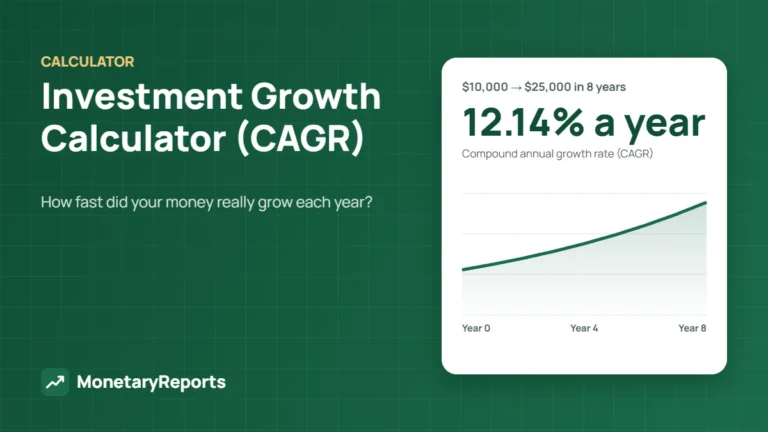
- What rate (r)? With yearly compounding, r = (A ÷ P)^(1 ÷ t) − 1. Example: if $5,000 became $9,000 in 10 years, the rate was 1.8^0.1 − 1 ≈ 6.05% a year. This is the CAGR.
What the compound interest formula means for you
- Checking an offer: plug the APY and the term into the formula to see the real dollar result before you open an account.
- Comparing two options: the formula shows that a higher rate beats more frequent compounding almost every time.
- Planning a goal: solve for t or r to see how long a goal will take, or what return it would need, and whether that is realistic.
Common mistakes
- Using 6 instead of 0.06 for the rate. Always convert the percentage to a decimal.
- Forgetting to divide the rate by n. A 6% yearly rate is 0.5% per month, not 6% per month.
- Multiplying instead of using a power. 1.005 × 120 is not the same as 1.005^120.
- Compounding an APY again. APY already includes compounding. If a bank quotes 5% APY, the balance after one year is simply P × 1.05.
- Rounding too early. Keep at least 4 decimals in the growth factor, or the final amount can be off by several dollars.
Try it with your own numbers
Skip the math: enter your numbers and get the result with a chart and a year-by-year table.
Frequently asked questions
What is n for daily compounding?
Use n = 365 for daily compounding. For weekly use 52, for monthly 12, for quarterly 4 and for yearly 1. Some banks use 360 days for certain products, so if your result differs slightly from a statement, check the account disclosure.
Does the compound interest formula include monthly deposits?
No. The basic formula only covers one starting amount. For regular deposits you use the annuity formula shown above and then add both results together. Our interest calculator does both parts automatically and also supports weekly or every-two-weeks deposits.
What is the formula for continuous compounding?
When interest is added constantly, the formula becomes A = P × e^(r × t), where e is about 2.71828. It gives the maximum growth possible at a given rate, but the result is only a little higher than daily compounding. See our continuous compounding guide.
Why does my bank show a slightly different number?
Banks may compound daily but credit interest monthly, round each month, use 360 or 365 days, or change the rate during the year. Small differences of a few cents or dollars are normal. The APY on your statement is the most reliable summary of what you earned.
How do I calculate compound interest for months instead of years?
Convert the time to years first. For 18 months, t = 1.5. With monthly compounding, n × t = 12 × 1.5 = 18 periods, so you raise (1 + r/12) to the power of 18.
Is the compound interest formula the same for loans?
The growth part is the same, which is why unpaid debt grows quickly. Loans with fixed monthly payments, like mortgages and car loans, use an amortization formula that also accounts for the payments reducing the balance.
What is the difference between the compound interest formula and APY?
APY is the result of the compound interest formula for exactly one year, expressed as a percentage: APY = (1 + r/n)^n − 1. Once you know the APY, you can skip n and simply use A = P × (1 + APY)^t for whole years.
Related guides and calculators
- What is compound interest?
- Daily vs monthly vs annual compounding
- How much will $10,000 grow in 10, 20 and 30 years?
- Interest calculator
Sources
This guide is for educational purposes only and is not financial advice. The figures are estimates before taxes, fees and inflation, and real savings rates and investment returns change over time.