Continuous Compounding Explained (Formula and Calculator)
Continuous compounding is what happens when interest is added not daily, not every second, but constantly. It sounds abstract, yet it is easy to calculate, and it shows the upper limit of how fast money can grow at a given rate. It is also the math behind many finance textbooks and pricing models, so it is worth understanding even if your bank never uses it.
Quick answer
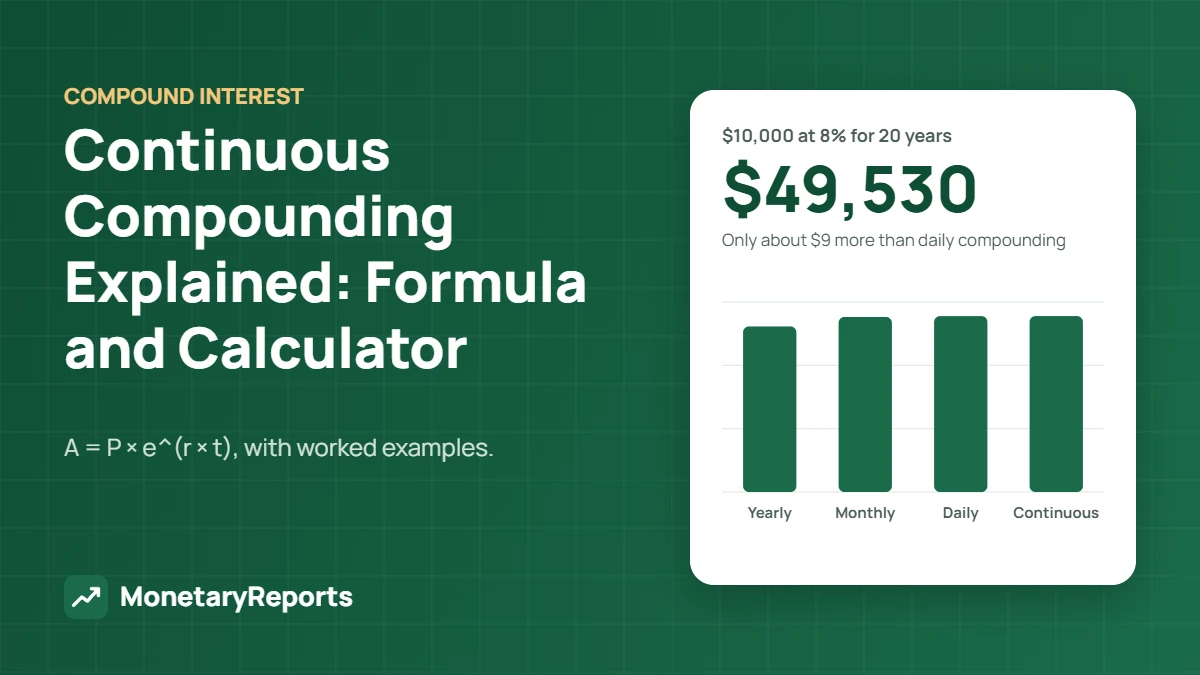
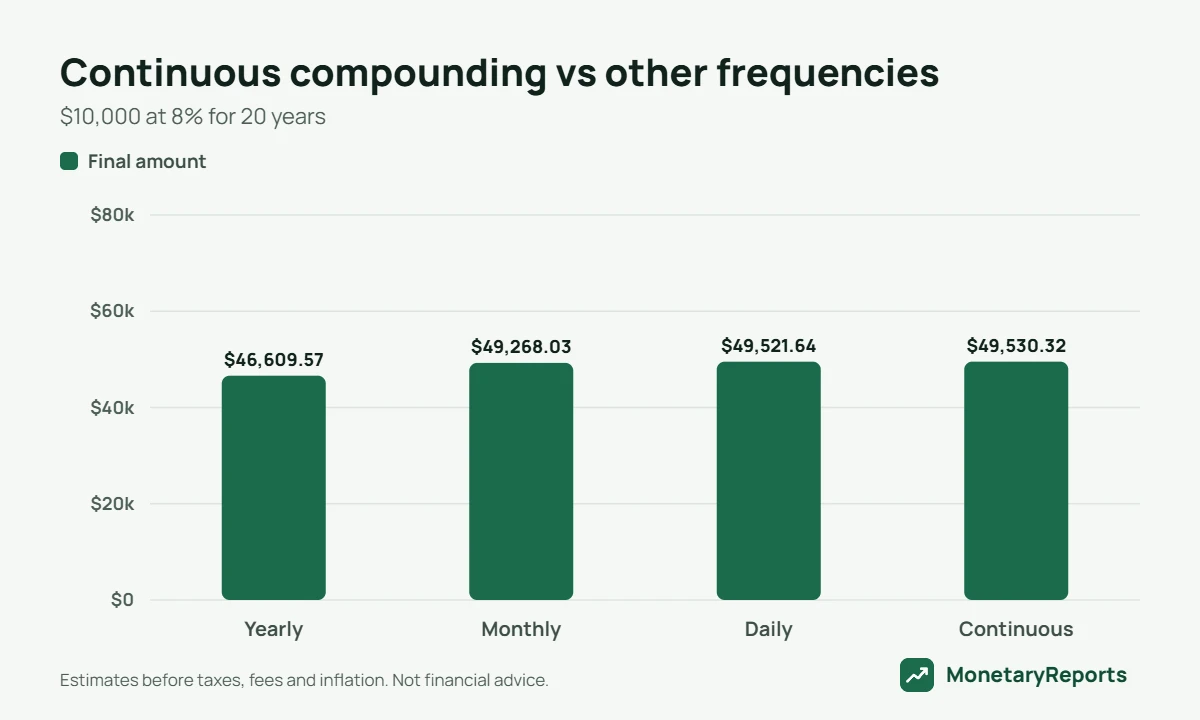
The continuous compounding formula is A = P × e^(r × t), where e ≈ 2.71828. $10,000 at 8% for 20 years becomes about $49,530 with continuous compounding, only about $9 more than daily compounding ($49,522). At 5%, continuous compounding equals an APY of about 5.127%.
In this guide
- The continuous compounding formula
- Worked example
- Where the number e comes from
- $1,000 over time when interest is added constantly
- Compare it with other frequencies
- Continuous compounding vs daily, monthly and yearly
- Solving for time, rate or starting amount
- Where continuous compounding is used
- Common mistakes
- FAQ
The continuous compounding formula
A = P × e^(r × t)
| Letter | Meaning |
|---|---|
| A | Final amount |
| P | Starting amount (principal) |
| e | A mathematical constant, about 2.71828 |
| r | Yearly rate as a decimal (5% → 0.05) |
| t | Number of years |
It comes from the normal compound interest formula, A = P × (1 + r/n)^(n × t), when n (the number of compounding periods per year) becomes infinitely large. As n grows, (1 + r/n)^n gets closer and closer to e^r.
Worked example
What does $1,000 become at 5% compounded continuously for 10 years?
- Multiply the rate by the years: 0.05 × 10 = 0.5.
- Raise e to that power: e^0.5 ≈ 1.64872 (use the e^x button on a calculator, or =EXP(0.5) in a spreadsheet).
- Multiply by the starting amount: $1,000 × 1.64872 ≈ $1,648.72.
For comparison, daily compounding gives $1,648.66 and yearly compounding $1,628.89.
Where the number e comes from
The constant e was discovered through a question about interest. In 1683 the Swiss mathematician Jacob Bernoulli asked: if a bank paid 100% interest a year, how much would $1 become if the interest were added more and more often? The answers get closer and closer to a limit, and that limit is e.
| Interest added | Calculation | $1 becomes |
|---|---|---|
| Once a year | (1 + 1/1)^1 | $2.00 |
| Twice a year | (1 + 1/2)^2 | $2.25 |
| Monthly | (1 + 1/12)^12 | $2.61 |
| Daily | (1 + 1/365)^365 | $2.71 |
| Constantly | e^1 | $2.72 |
The jumps get smaller and smaller. Adding interest more often always helps, but only up to a ceiling, which is why the gap between daily and constant compounding is so tiny in real accounts.
$1,000 over time when interest is added constantly
| Years at 5% | Balance | Growth factor e^(r × t) |
|---|---|---|
| 1 | $1,051.27 | 1.0513 |
| 5 | $1,284.03 | 1.2840 |
| 10 | $1,648.72 | 1.6487 |
| 20 | $2,718.28 | 2.7183 |
| 30 | $4,481.69 | 4.4817 |
Notice the 20-year row: when r × t equals 1, the growth factor is exactly e. That is a nice way to remember what the constant means.
Compare it with other frequencies
This tool shows the result with yearly, quarterly, monthly, daily and continuous compounding side by side. Change the numbers to see how small the gap is.
| Interest added | Final balance | vs. annually |
|---|
Continuous compounding vs daily, monthly and yearly
| Compounding | $10,000 at 8% for 20 years |
|---|---|
| Yearly | $46,609.57 |
| Monthly | $49,268.03 |
| Daily | $49,521.64 |
| Continuous | $49,530.32 |
| Stated rate | Effective yearly rate |
|---|---|
| 3% | 3.045% |
| 5% | 5.127% |
| 8% | 8.329% |
| 10% | 10.517% |
Solving for time, rate or starting amount
- Years needed: t = ln(A ÷ P) ÷ r. Example: $5,000 to $8,000 at 6% takes ln(1.6) ÷ 0.06 ≈ 7.8 years.
- Rate needed: r = ln(A ÷ P) ÷ t. Example: to double money in 10 years you need ln(2) ÷ 10 ≈ 6.93% a year.
- Starting amount needed (present value): P = A × e^(−r × t). Example: to have $50,000 in 15 years at 5%, you need about $23,618 today.
- Doubling time: t = ln(2) ÷ r ≈ 0.693 ÷ r. At 5% that is about 13.9 years, which is why some people use a “Rule of 69” for continuous compounding, while the Rule of 72 works well for yearly compounding.
Where continuous compounding is used
- Finance theory and textbooks, because the math is cleaner and easier to work with.
- Pricing of options and some bonds, where models such as Black-Scholes assume continuously compounded rates.
- Economics and science, for anything that grows or decays smoothly, such as population models or radioactive decay.
- Not usually in your bank account. U.S. banks typically compound daily or monthly. Since the difference is tiny, daily compounding is very close to continuous anyway.
What continuous compounding means for you
- For everyday savings, it is a theoretical maximum: daily compounding already gets you almost all of it.
- If an offer advertises constant compounding, compare its APY with other accounts; the label alone is not a reason to choose it.
- If you study finance or economics, learning e^(r × t) makes many formulas much simpler.
Common mistakes
- Using the percentage instead of the decimal: e^(5 × 10) is a huge number; e^(0.05 × 10) is correct.
- Confusing ln and log: the formulas above use the natural logarithm (ln), not log base 10.
- Expecting a big difference: it beats daily compounding by only a few dollars on typical balances.
Try it with your own numbers
For everyday savings and investments, use our main calculator with daily or monthly compounding.
Frequently asked questions
Is continuous compounding the maximum?
Yes. For a given stated rate, no compounding schedule grows faster than continuous compounding. It is the mathematical limit you approach as interest is added more and more often.
What is e in the continuous compounding formula?
e is a mathematical constant, about 2.71828. It appears naturally whenever something grows in proportion to its current size, which is exactly what interest on interest does.
Do any banks offer continuous compounding?
It is rare. Most U.S. accounts compound daily or monthly, and the APY tells you the real yearly result. Because daily compounding is so close to continuous, the practical difference is a few cents or dollars.
How do I calculate e^x without a scientific calculator?
Most phone calculators show the e^x button when you turn the phone sideways. In Excel or Google Sheets, type =EXP(x), for example =EXP(0.5) for e^0.5.
What is the difference between continuous and daily compounding?
Daily compounding adds interest 365 times a year; continuous compounding adds it constantly. On $10,000 at 8% for 20 years, daily gives $49,521.64 and continuous $49,530.32, a difference of about $9.
How long does it take to double money with continuous compounding?
Divide 0.693 by the rate as a decimal, or 69.3 by the rate as a percentage. At 7% it takes about 9.9 years; at 10% about 6.9 years.
Is continuous compounding used for APY?
Banks normally calculate APY from their actual compounding schedule, such as daily or monthly. Continuous compounding gives the maximum possible APY for a given rate, e^r − 1, which is only slightly above the daily figure.
Related guides and calculators
- Daily vs monthly vs annual compounding
- Compound interest formula
- Rule of 72 calculator
- Interest calculator
Sources
This guide is for educational purposes only and is not financial advice. The figures are estimates before taxes, fees and inflation, and real savings rates and investment returns change over time.