How Much Will $1,000 Grow in 10 Years at 5%, 7% and 10%?

How much will $1,000 grow in 10 years? You do not need a lot of money to see compound interest at work, and $1,000 is a realistic first step for many people. This guide shows exactly what $1,000 becomes at common rates, how a small monthly deposit changes the picture and where people usually keep it.
Quick answer
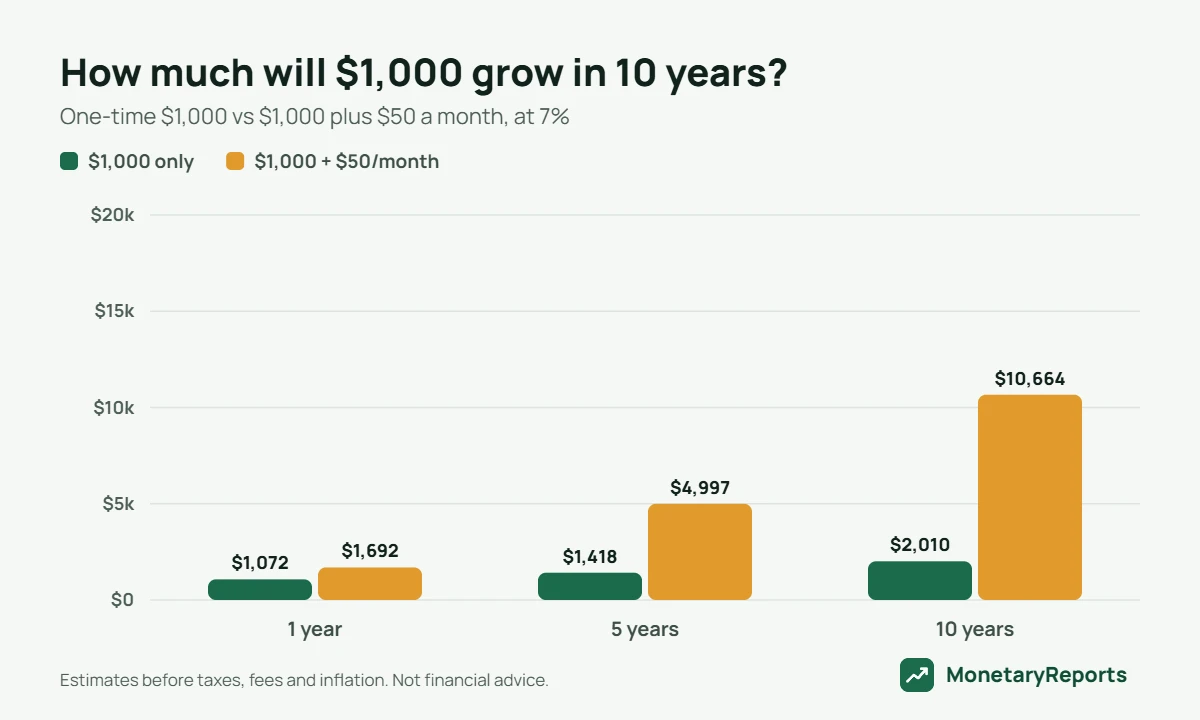
Short answer to “how much will 1000 grow”: compounded monthly for 10 years, $1,000 grows to about $1,647 at 5%, $2,010 at 7% and $2,707 at 10%. Add $50 a month at 7% and you end with about $10,664.
How much will $1,000 grow in 1, 5, 10 and 20 years?
| Yearly rate | After 1 year | After 5 years | After 10 years | After 20 years |
|---|---|---|---|---|
| 3% | $1,030 | $1,162 | $1,349 | $1,821 |
| 5% | $1,051 | $1,283 | $1,647 | $2,713 |
| 7% | $1,072 | $1,418 | $2,010 | $4,039 |
| 10% | $1,105 | $1,645 | $2,707 | $7,328 |
At 7%, your money roughly doubles in 10 years and doubles again by year 20. That matches the Rule of 72: 72 ÷ 7 ≈ 10.3 years.
Interactive chart
Interactive chart: hover or tap to see each year. Estimates only, before taxes and inflation.
Monthly vs annual compounding
How often interest is added changes the result a little. Here is $1,000 after 10 years:
| Rate | Compounded yearly | Compounded monthly | Difference |
|---|---|---|---|
| 5% | $1,628.89 | $1,647.01 | $18.12 |
| 7% | $1,967.15 | $2,009.66 | $42.51 |
| 10% | $2,593.74 | $2,707.04 | $113.30 |
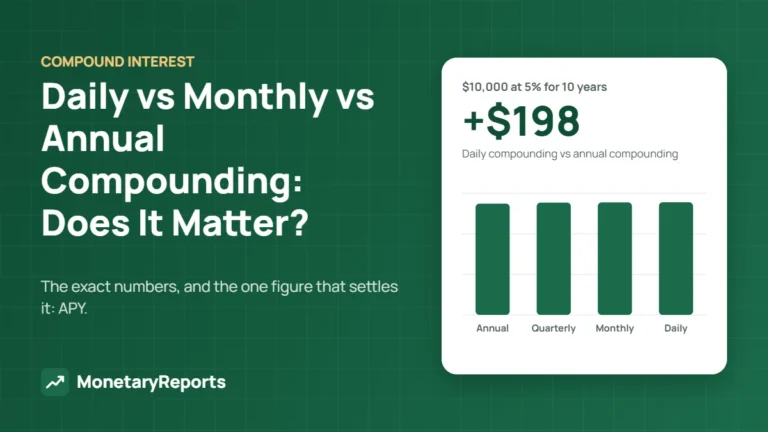
The rate and the time matter much more than the compounding frequency. More details in daily vs monthly vs annual compounding.
Adding a little every month
A one-time $1,000 is a good start, but regular deposits are what really build savings. Compare these three plans at 7% for 10 years:
| Plan | Money you put in | Balance after 10 years |
|---|---|---|
| $1,000 once | $1,000 | $2,010 |
| $1,000 + $50 a month | $7,000 | $10,664 |
| $1,000 + $100 a month | $13,000 | $19,318 |
Try your own plan with the mini calculator:
Why the account matters
The same $1,000 can end up very different depending on where it sits for 10 years:
| Where the $1,000 is | After 10 years | What it can buy (3% inflation) |
|---|---|---|
| Cash at home (0%) | $1,000 | about $744 in today’s money |
| Savings account at 0.4% APY | $1,041 | about $774 |
| High-yield savings at 4% APY | $1,480 | about $1,101 |
| Investments averaging 7% | $2,010 | about $1,495 |
Where you could put $1,000
- High-yield savings account: easy access and FDIC insurance at banks (up to the legal limit). The rate can change at any time.
- Certificate of deposit (CD): a fixed rate for a fixed term. You may pay a penalty if you take the money out early.
- Index funds: potentially higher long-term growth, but the value goes up and down, and you could lose money.
- Paying off high-interest debt: if you have a credit card at 20%+ APR, paying it down is like earning that rate with no risk.
This is general information, not a recommendation. The right choice depends on when you need the money and how much risk you can accept.
A realistic 10-year plan
Here is how a small start can turn into a solid safety net. Imagine someone in their mid-20s who receives a tax refund and decides to use it as the first brick of their savings:
- Year 0: the refund goes into a high-yield savings account, separate from everyday spending, so it is not spent by accident.
- Month 1: an automatic transfer of $50 is set for the day after payday. It is small enough not to hurt the monthly budget.
- Year 2: after a raise, the transfer goes up to $100. The emergency fund now covers an unexpected car repair without using a credit card.
- Year 5: once there are 3 to 6 months of expenses saved, new money starts going to long-term investments, such as an IRA.
- Year 10: the savings habit, not the first deposit, has done most of the work.
The exact numbers will be different for everyone, and the rate you earn will change over the years. What matters is the order: protect yourself against emergencies first, avoid high-interest debt, and then let compound interest work on the money you will not need for a long time.
What this means for you
- If you might need the money within a few years, focus on safety and access, not on the highest possible return.
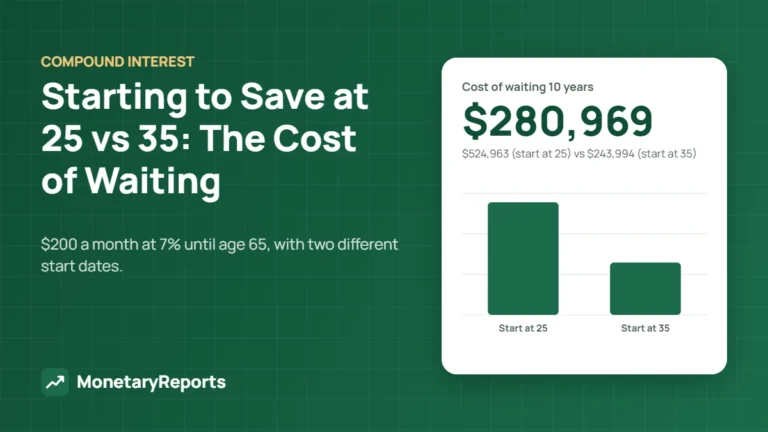
- If the money is for retirement, time is your biggest advantage, so starting now beats waiting for a bigger amount.
- If you have credit card debt, paying it off usually comes before investing.
Common mistakes
- Thinking $1,000 is too little to bother. It is enough to open most savings accounts and many brokerage accounts, and the habit matters more than the amount.
- Leaving it in checking. Many checking accounts pay almost nothing, so inflation slowly eats the value.
- Chasing very high promised returns. Guaranteed high returns are a classic sign of a scam. Check any offer at Investor.gov.
- Forgetting about it in a low-rate account. Review your rate once a year and move the money if a better FDIC-insured option exists.
Frequently asked questions
How much is $1,000 at 5% interest for 10 years?
About $1,628.89 if interest is compounded yearly, or $1,647.01 if it is compounded monthly. The difference comes from interest being added more often, so it starts earning interest sooner.
How long until $1,000 becomes $2,000?
At 7%, about 10 years. At 5%, about 14 years. At 10%, about 7 years. You can check any rate with the Rule of 72 calculator.
Can $1,000 make me rich?
On its own, not quickly. At 7% it would take about 33 years to reach $10,000 without adding anything. But $1,000 plus regular deposits over several decades can grow into a substantial amount, which is why starting matters.
How much will $1,000 grow in 20 years?
At 5% about $2,713, at 7% about $4,039 and at 10% about $7,328, compounded monthly with no extra deposits.
Does this include taxes?
No. Interest from savings accounts is usually taxable income, and investment gains may be taxed when you sell, unless the money is in a tax-advantaged account such as an IRA.
Is it worth investing only $1,000?
Yes, if you will not need the money for several years. Many brokers have no minimum and allow fractional shares. If you might need it soon, a high-yield savings account is usually the safer place.
What is the best way to grow $1,000?
For money you may need soon, a high-yield savings account or a short CD keeps it safe while earning interest. For money you will not touch for many years, a low-cost diversified index fund has historically grown faster, with more ups and downs. Adding a small amount every month usually matters more than where the first $1,000 goes.
How much will 1000 grow in 10 years at 7%?
About $2,010 if interest is compounded monthly, or $1,967 if it is compounded once a year. Your money roughly doubles, which matches the Rule of 72: 72 ÷ 7 ≈ 10 years.
Related guides and calculators
- How much will $10,000 grow?
- What $100 a month becomes in 30 years
- What is compound interest?
- Interest calculator
Sources
- Investor.gov (U.S. SEC): Compound interest calculator
- FDIC: National rates and rate caps
- U.S. Bureau of Labor Statistics: Consumer Price Index
- MonetaryReports: How we calculate
This guide is for educational purposes only and is not financial advice. The figures are estimates before taxes, fees and inflation, and real savings rates and investment returns change over time.