Compound Interest vs Simple Interest: The Real Difference
Compound vs simple interest is one of the most useful comparisons in personal finance. Both start out almost the same, but over time the gap becomes huge. Knowing which one applies to your savings account, your car loan or your credit card helps you earn more on what you save and pay less on what you borrow.
Quick answer
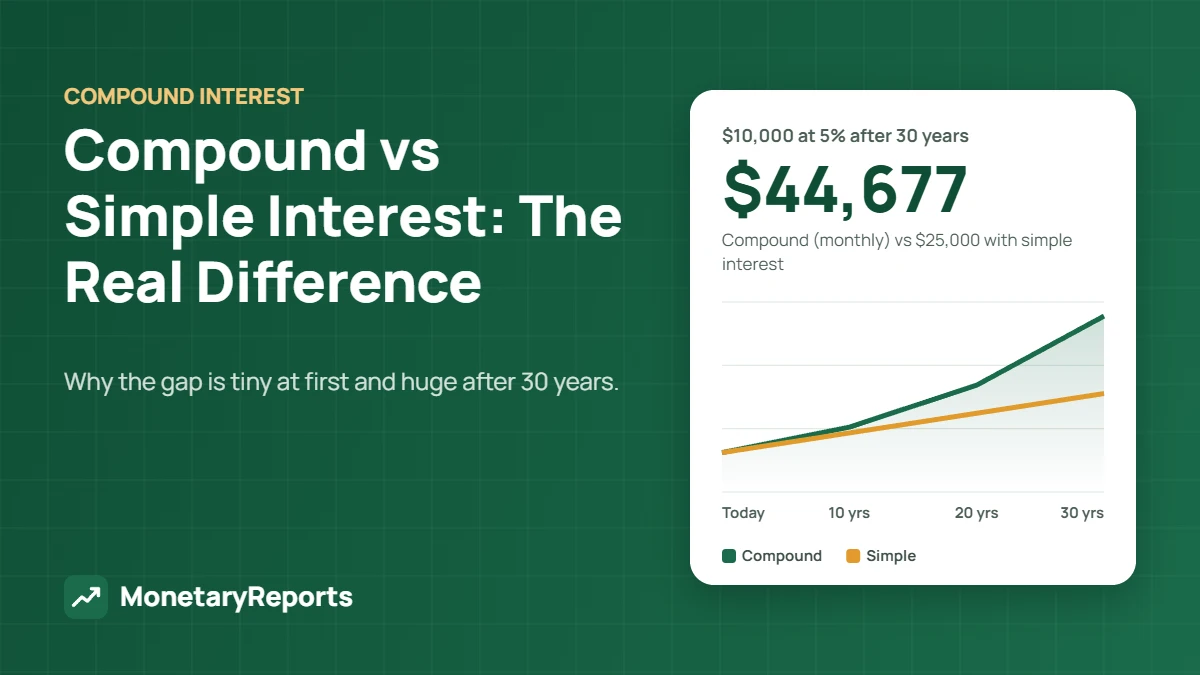
Simple interest is paid only on the original amount. Compound interest is paid on the original amount plus the interest already earned. $10,000 at 5% for 30 years becomes $25,000 with simple interest but about $44,677 with monthly compounding.
Compound vs simple interest in one table
| Simple interest | Compound interest | |
|---|---|---|
| Interest is earned on | Only the original amount | Original amount + earlier interest |
| Growth over time | Straight line (same every year) | Curve that gets steeper |
| Good for savers? | Less growth | More growth |
| Good for borrowers? | Usually cheaper | Usually more expensive |
| Common examples | Many auto loans, some personal loans | Savings accounts, CDs, credit cards, investments |
The two formulas
Simple:    A = P × (1 + r × t)
Compound:  A = P × (1 + r/n)^(n × t)
P is the starting amount, r the yearly rate as a decimal, t the years and n the number of times interest is added per year. With simple interest you multiply; with compound interest you raise to a power. That single difference explains everything else in this guide. The compound interest formula guide has a full walk-through.
Side-by-side example for savers
$10,000 left alone at 5% a year:
| After | Simple interest | Compound interest (monthly) | Extra from compounding |
|---|---|---|---|
| 1 year | $10,500 | $10,512 | $12 |
| 5 years | $12,500 | $12,834 | $334 |
| 10 years | $15,000 | $16,470 | $1,470 |
| 20 years | $20,000 | $27,126 | $7,126 |
| 30 years | $25,000 | $44,677 | $19,677 |
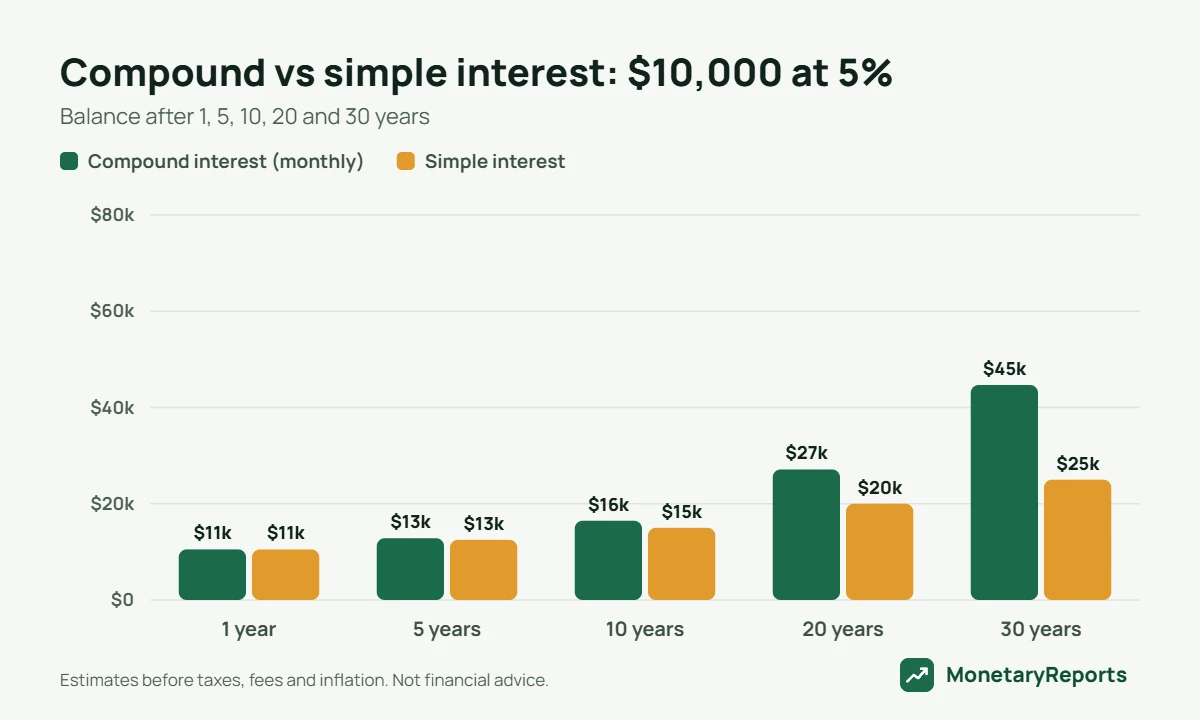
In the first year, the difference is only $12. After 30 years, compounding has earned more than twice as much interest ($34,677 vs $15,000). Use the interactive chart to see every year:
Interactive chart: hover or tap to see each year. Estimates only, before taxes and inflation.
Example for borrowers
For borrowers the comparison flips: simple interest is the friendlier option. Many U.S. auto loans are “simple interest loans”, where interest is charged on the remaining balance and is never added to it.
| $20,000 car loan at 7% for 60 months | Amount |
|---|---|
| Monthly payment | $396.02 |
| Total interest if you pay on schedule | about $3,761 |
| Total interest if you pay $50 extra each month | about $3,253 |
| Time to pay off with $50 extra | 53 months instead of 60 |
On a simple interest loan, paying early or paying extra lowers the balance sooner, so you pay less interest. Credit cards are different: unpaid interest is added to the balance and then charged interest too. At 22% APR, a $5,000 balance left unpaid grows to about $6,230 in one year.
Where you find each one
- Savings accounts and CDs: compound interest, usually daily or monthly. Banks show the effect as the APY.
- Credit cards: interest usually compounds daily on unpaid balances, which is why carrying a balance gets expensive fast.
- Auto loans and many personal loans: often simple interest on the remaining balance.
- Student loans: interest usually builds up as simple interest, but unpaid interest can be added to the balance (capitalized) in some situations, after which it also earns interest. For example, $7,200 of interest built up on a $30,000 loan over 4 years at 6% could be added to the balance, making it $37,200.
- Investments: there is no stated interest rate, but reinvested gains and dividends compound in the same way.
How to tell which one you are getting
- Look for the word APY on savings products: if it is higher than the stated rate, interest compounds.
- On a loan, search the agreement for “simple interest” or “daily simple interest”.
- Check whether unpaid interest is “capitalized” or “added to the principal”. If it is, that interest will be charged interest too.
- Ask the bank or lender directly how often interest is calculated and when it is added to the balance.
Common mistakes
- Assuming every loan compounds. Many auto loans use simple interest, so paying early saves money.
- Comparing an APR with an APY. APY includes compounding; APR usually does not, so the APY will look higher at the same rate.
- Letting student loan interest capitalize. Paying the interest while in school or during a grace period can stop it from being added to the balance.
- Ignoring the time factor. Over one or two years the difference is small; over decades it is large.
Which one is better for you?
A simple rule
- When you save or invest: you want compound interest, as often as possible, for as long as possible. Compare accounts using the APY.
- When you borrow: you want simple interest, a low rate and a short term. Pay extra when you can and avoid letting interest capitalize.
Try it with your own numbers
Our calculator switches between simple and compound interest so you can see the gap with your own numbers.
Frequently asked questions
Is simple interest ever better than compound interest?
Yes, when you are the borrower. A simple interest loan usually costs less than a loan where unpaid interest is added to the balance, because the interest itself never earns interest. Paying early on a simple interest loan also reduces the total cost.
Do banks pay simple or compound interest?
U.S. savings accounts, money market accounts and CDs normally pay compound interest, often calculated daily and credited monthly. The APY shown by the bank includes the effect of compounding, so it is the best number to compare.
What is the difference between APR and APY?
APR is the yearly rate without the effect of compounding. APY includes compounding, so it shows what you actually earn (or pay) over a year. For savings, look at the APY; for loans and credit cards, lenders usually quote the APR.
Why is the difference so small at first?
Because the interest-on-interest is tiny in the beginning. In year one, compounding on $10,000 at 5% adds only about $12. The extra grows every year as the balance grows, which is why the gap is large after 20 or 30 years.
How do I calculate simple interest?
Multiply the amount by the yearly rate and the number of years: interest = P × r × t. For $10,000 at 5% for 10 years that is $10,000 × 0.05 × 10 = $5,000, so the total is $15,000.
Does compound vs simple interest matter for short periods?
Not much. Over a few months the two give almost the same result. The difference matters for long-term savings, retirement accounts and debts you carry for years.
Related guides and calculators
- What is compound interest?
- Daily vs monthly vs annual compounding
- Compound interest formula
- Interest calculator
Sources
- Investor.gov (U.S. SEC): Compound interest calculator
- Federal Reserve: Consumer credit (G.19), including credit card interest rates
- FDIC: National rates and rate caps
- MonetaryReports: How we calculate
This guide is for educational purposes only and is not financial advice. The figures are estimates before taxes, fees and inflation, and real savings rates and investment returns change over time.