7 Real-Life Examples of Compound Interest
Looking at examples of compound interest is the fastest way to understand it. Compound interest is not just a math idea: it is working in your bank account, your retirement plan, your credit card and even the prices at the supermarket. Here are seven real-life examples, with numbers you can check, so you can see when it helps you and when it hurts.
Quick answer
Compound interest helps you in savings accounts, CDs, retirement accounts and reinvested dividends. It works against you on credit card debt, it makes long loans like mortgages expensive, and the same compounding effect lets inflation raise prices over time. The common factor is always growth on top of growth.
1. A high-yield savings account
You keep a $5,000 emergency fund in a savings account paying 4% APY. After one year you have $5,200. If the rate stayed the same and you left it alone, after 5 years you would have about $6,083 and after 10 years about $7,401. Savings rates change with the economy, so check current national rates (FDIC data in the sources).
What it means for you: an emergency fund in a 4% account grows on its own while it waits. The same money in a checking account paying close to 0% would lose value to inflation.
2. A certificate of deposit (CD)
You put $10,000 in a 1-year CD at 4.5%, compounded monthly. At the end of the year you get about $10,459.40. If you renew the CD, next year the interest is calculated on $10,459.40, not on $10,000.
What it means for you: CDs lock in a rate, which is useful when you know you will not need the money for a fixed period. Compare CDs using the APY and check the early withdrawal penalty.
3. A 401(k) or IRA
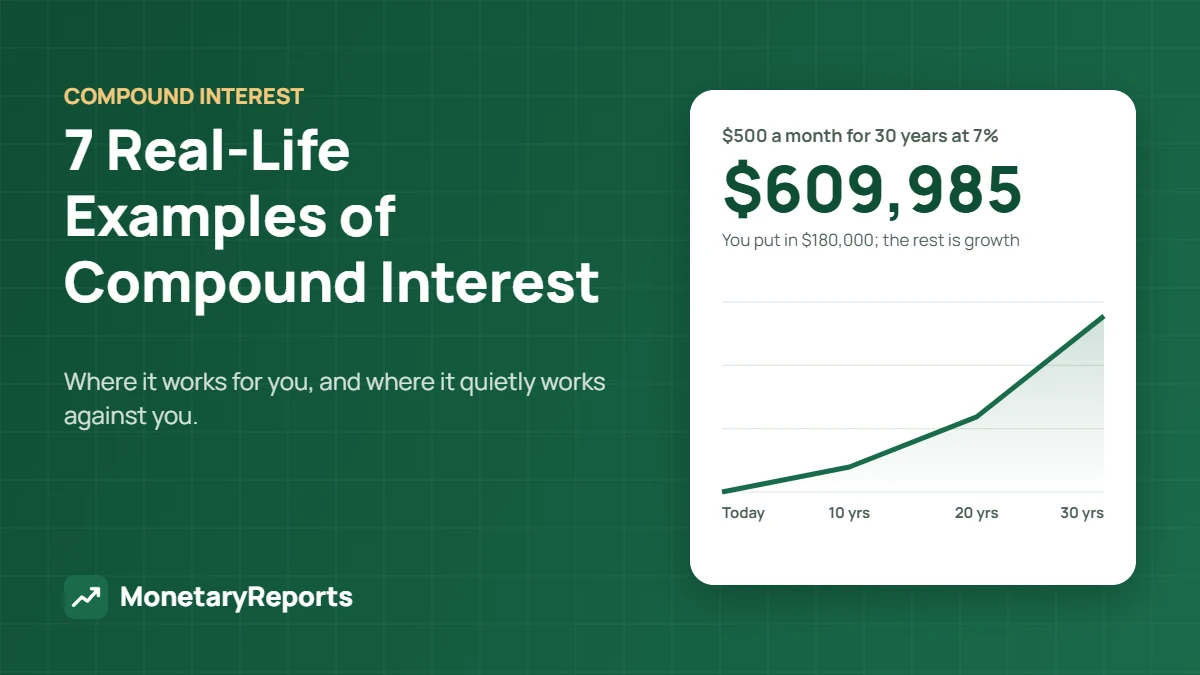
You invest $500 a month for 30 years and earn an average of 7% a year. You put in $180,000, and the account could grow to about $609,985. More than two-thirds of the final balance comes from growth, not deposits. At a more cautious 5% it would be about $416,129. Real returns vary from year to year.
Interactive chart: hover or tap to see each year. Estimates only, before taxes and inflation.
What it means for you: retirement accounts are where compound interest has the most time to work. An employer match adds extra money that compounds too.
4. Reinvested dividends
Many stock funds pay dividends. If you reinvest them, they buy more shares, which pay more dividends. Imagine a fund whose price rises 4% a year and pays 3% in dividends:
| $10,000 after 30 years | Result |
|---|---|
| Dividends reinvested (about 7% total, compounded monthly) | $81,165 |
| Dividends spent (only the 4% price growth compounds) | $33,135, plus the dividends you spent along the way |
What it means for you: if you do not need the income yet, turning on automatic dividend reinvestment lets compounding do more of the work.
5. Credit card debt
Here compound interest works against you. Credit cards often charge more than 20% APR (see the Federal Reserve data in the sources), and interest is usually calculated daily. With a $5,000 balance at 22% APR:
- If you pay nothing, the balance could grow to about $6,230 in one year.
- If you pay $150 a month, it takes about 52 months to pay off and you pay about $2,798 in interest.
- If you pay $300 a month, it takes about 21 months and you pay about $1,022 in interest.

6. A mortgage
A mortgage charges interest each month on the remaining balance. Because the loan is large and long, the total interest is big. A $300,000 mortgage at 6.5% for 30 years has a monthly payment (principal and interest) of about $1,896.20, and the total interest over 30 years is about $382,633.
Paying just $100 extra each month would pay the loan off in about 26 years instead of 30 and cut the total interest to about $321,639, a saving of roughly $61,000. Check first that your lender applies extra payments to the principal and does not charge a prepayment penalty.
7. Inflation
Prices also compound. If inflation averages 3% a year, something that costs $100 today would cost about $181 in 20 years and about $243 in 30 years. And $100,000 in cash would buy only about what $55,368 buys today after 20 years. That is why long-term money kept in cash that earns nothing slowly loses value. The U.S. Bureau of Labor Statistics publishes the Consumer Price Index (CPI).
Summary table of the examples of compound interest
| Example | For you or against you? | Numbers |
|---|---|---|
| Savings account | For you | $5,000 → $6,083 in 5 years at 4% APY |
| CD | For you | $10,000 → $10,459 in 1 year at 4.5% |
| 401(k) / IRA | For you | $500/month → $609,985 in 30 years at 7% |
| Reinvested dividends | For you | $10,000 → $81,165 in 30 years |
| Credit card | Against you | $5,000 at 22%: about $2,798 interest at $150/month |
| Mortgage | Against you (cost of borrowing) | $300,000: about $382,633 interest over 30 years |
| Inflation | Against you | $100 → $181 in 20 years at 3% |
How to spot compound interest in your own finances
- Look for APY on savings accounts and CDs: it already includes compounding.
- Look for APR and “daily periodic rate” on credit card statements: that is compounding working against you.
- Check whether dividends are reinvested in your brokerage or retirement account settings.
- Review the interest section of every loan agreement to see how interest is charged and whether unpaid interest is added to the balance.
Try it with your own numbers
See how compound interest affects your own savings goal.
Frequently asked questions
What is the most common example of compound interest?
A savings account. The bank adds interest to your balance, usually monthly, and that interest earns more interest the next month. Over years, the balance grows faster than with simple interest.
Is a mortgage compound interest?
Mortgage interest is charged each month on the remaining balance. As long as you make your payments, unpaid interest is not added to the loan, so it does not snowball like credit card debt. The long term and large balance are what make the total cost high.
How can I avoid compound interest on debt?
Pay credit cards in full each month to stay within the grace period, pay more than the minimum when you carry a balance, and pay the highest-rate debt first. Consolidating high-rate debt into a lower-rate loan can also help, as long as you do not run up new balances.
Do stocks earn compound interest?
Not interest in the strict sense, but growth that compounds in the same way when gains and dividends stay invested. Unlike a savings account, the value can also go down, so compounding works over long periods rather than every single year.
What is a good example of compound interest for kids?
Doubling a coin: if you start with 1 penny and double it every day, you have over $5 million after 30 days. Real accounts grow far more slowly, but the idea of growth on top of growth is the same. A simpler real example: $1,000 saved at birth at 5% becomes about $2,455 by age 18.
Which example of compound interest has the biggest effect?
Usually long-term retirement saving, because it combines regular deposits with decades of time. On the debt side, carrying a credit card balance for years has the biggest negative effect.
Related guides and calculators
- What is compound interest?
- How to make compound interest work for you
- Compound vs simple interest
- Interest calculator
Sources
- FDIC: National rates and rate caps
- Federal Reserve: Consumer credit (G.19), including credit card interest rates
- U.S. Bureau of Labor Statistics: Consumer Price Index
- Investor.gov (U.S. SEC): Compound interest calculator
- MonetaryReports: How we calculate
This guide is for educational purposes only and is not financial advice. The figures are estimates before taxes, fees and inflation, and real savings rates and investment returns change over time.