How to Make Compound Interest Work for You: 7 Simple Habits
You cannot control the stock market or interest rates, but you can control a few simple habits. If you want to make compound interest work for you, these seven habits give it more money, more time and fewer obstacles. Each habit gives compound interest a better chance, and for each one we show what it is worth in dollars and what you can do this week to start.
Quick answer
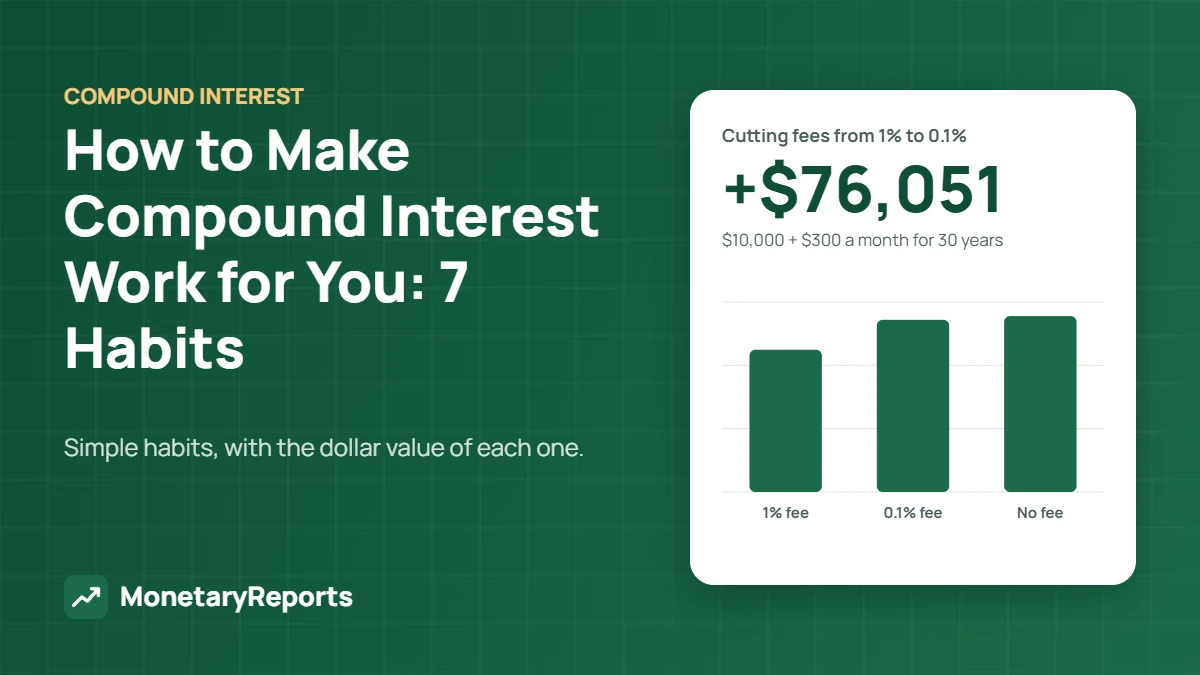
The habits that matter most are: start early, save automatically, increase your savings over time, keep fees low, reinvest and do not withdraw, pay off high-interest debt and use tax-advantaged accounts. For example, cutting fees from 1% to 0.1% a year can mean about $76,000 more after 30 years on $10,000 plus $300 a month.
In this guide
- 1. Start as early as you can
- 2. Make saving automatic
- 3. Increase your savings over time
- 4. Keep fees low
- 5. Reinvest and leave it alone
- 6. Pay off high-interest debt first
- 7. Use tax-advantaged accounts and your employer match
- What each habit is worth
- A one-page plan to make compound interest work for you
- Common mistakes
- FAQ
1. Start as early as you can
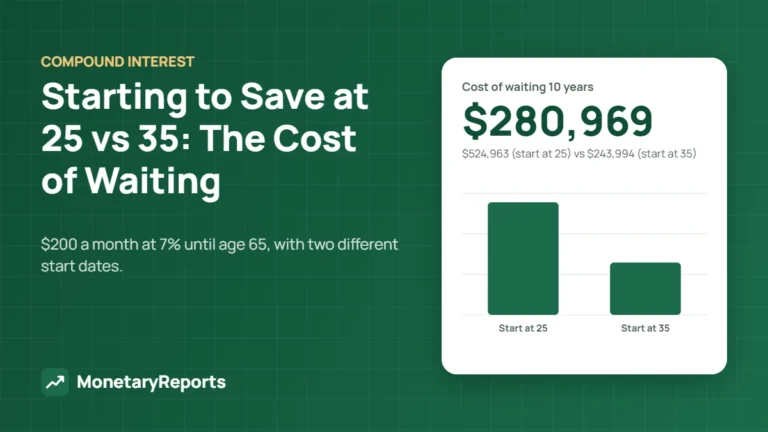
Time is the most powerful ingredient in compound interest. $200 a month at 7% from 25 to 65 can grow to about $524,963; starting at 35 gives about $243,994. Even a 25-year-old saving only $100 a month (about $262,481 by 65) ends up ahead of a 35-year-old saving $200. Read the full comparison in starting to save at 25 vs 35.
This week: open the account you will use (a high-yield savings account, an IRA or your workplace 401(k)) and make a first deposit, however small.
2. Make saving automatic
Compound interest needs a steady flow of new money. People who save automatically tend to save more, because they do not have to decide every month. Set up a transfer for the day after payday. If you are paid every two weeks, saving $150 every payday instead of $300 a month adds two extra deposits a year. At 7% for 30 years that is about $397,112 instead of $365,991.
This week: schedule a recurring transfer and treat it like a bill you must pay to your future self.
3. Increase your savings over time
Each raise is a chance to give compound interest more to work with, without feeling it in your budget. Saving $400 a month instead of $300 for 30 years at 7%:
| Monthly saving | Total after 30 years at 7% |
|---|---|
| $300 | $365,991 |
| $400 | $487,988 |
An extra $100 a month adds about $122,000. Windfalls help too: a $1,000 tax refund invested at 7% for 30 years can grow to about $8,116.
This week: decide now what share of your next raise goes to savings, for example half of it.
4. Keep fees low
Fees are taken out every year, so they work like compound interest in reverse. Here is $10,000 plus $300 a month for 30 years with a 7% return before fees:
| Yearly fee | Return after fees | Balance after 30 years |
|---|---|---|
| 0% | 7.0% | $447,156 |
| 0.1% | 6.9% | $437,631 |
| 1.0% | 6.0% | $361,580 |

Interactive chart: hover or tap to see each year. Estimates only, before taxes and inflation.
This week: look up the expense ratio of each fund you own and any account or advisory fee. Many broad index funds charge well under 0.2% a year.
5. Reinvest and leave it alone
- Choose to reinvest dividends and interest automatically.
- Avoid early withdrawals: each one removes money that would have kept compounding (and may come with taxes and penalties in retirement accounts).
- Keep an emergency fund in savings so you do not have to sell investments when something unexpected happens.
- Try not to react to short-term market drops; compounding needs time.
This week: check the dividend setting in your brokerage or retirement account and switch it to “reinvest” if you do not need the income.
6. Pay off high-interest debt first
Credit card debt is compound interest working against you: it often costs over 20% APR, and no savings account pays that much. Paying off a card at 22% is like earning a guaranteed 22% return. On a $5,000 balance, paying $300 a month instead of $150 clears it in about 21 months instead of 52 and saves about $1,776 in interest. A common approach is to pay the highest-rate debt first (the “avalanche” method) while making minimum payments on the rest.
This week: list every debt with its APR and balance, and pick the one with the highest rate as your target.
7. Use tax-advantaged accounts and your employer match
- Employer match: if your employer matches 401(k) contributions, contributing enough to get the full match is extra money that compounds for you.
- 401(k) and IRA: taxes on growth are deferred (traditional) or may be tax-free in retirement (Roth), so more of the growth stays invested and keeps earning compound interest. Contribution limits and rules are set by the IRS.
- High-yield savings: for money you need in the next few years, compare APYs and choose an FDIC-insured account.
This week: ask HR (or check your benefits portal) what your employer matches and make sure you contribute at least that much.
What each habit is worth
| Habit | Example | Approximate value |
|---|---|---|
| Start 10 years earlier | $200/month at 7%, from 25 instead of 35 | +$280,969 by 65 |
| Save every payday | $150 every 2 weeks vs $300 a month, 30 years | +$31,121 |
| Save $100 more a month | $400 vs $300 a month, 30 years | +$121,997 |
| Lower fees | 0.1% vs 1% on $10,000 + $300/month, 30 years | +$76,051 |
| Pay debt faster | $300 vs $150 a month on $5,000 at 22% | $1,776 less interest |
A one-page plan to make compound interest work for you
Your plan to make compound interest work for you
- Build an emergency fund in a high-yield savings account.
- Get the full employer 401(k) match.
- Pay off credit cards and other high-interest debt.
- Automate a monthly or per-paycheck investment.
- Choose low-cost, diversified funds.
- Increase your savings with every raise.
- Leave it alone and check once or twice a year.
Try it with your own numbers
Test each habit with your own numbers: change the deposit, rate and years.
Common mistakes
- Waiting until you “have enough”. Small amounts started early beat larger amounts started late.
- Investing while carrying 20%+ debt. The debt usually grows faster than the investments.
- Cashing out a 401(k) when changing jobs. Taxes and penalties can take a large bite, and the compounding stops. A rollover keeps it working.
- Checking your balance every day. Short-term swings lead to emotional decisions that break the compounding.
Frequently asked questions
What is the best way to make compound interest work for me?
Start as early as you can and save regularly. Time and consistency matter more than finding the perfect investment: a 25-year-old saving $100 a month at 7% can end up with more at 65 than a 35-year-old saving $200. Automate your deposits so they happen without effort, keep costs low with diversified, low-fee funds, reinvest your dividends and avoid withdrawing early. If you have high-interest debt, paying it off first is often the best “return” you can get.
Should I invest or pay off debt first?
Compare the interest rate on the debt with what you can reasonably expect to earn. High-interest debt such as credit cards (often above 20% APR) usually costs more than investments earn, so many people pay it off first while still contributing enough to get any employer match. For low-rate debt, such as some mortgages, many people do both at the same time.
How often should I check my investments?
Once or twice a year is enough for most long-term savers. Use that check-in to rebalance if needed, review fees and raise your contributions. Checking daily can lead to emotional decisions, such as selling after a drop, which stops compounding at the worst moment.
How much should I save each month?
There is no single right number. A common starting point is enough to get any employer match, then increasing over time. Our interest calculator shows what different monthly amounts could grow to, which can help you choose a target that fits your budget.
Does compound interest work in a regular savings account?
Yes, but the effect depends on the rate. At 4% APY it is meaningful over several years; at 0.01% it barely moves. For long-term goals, investments have historically grown faster, but they carry more risk.
Is this financial advice?
No. This guide is general education to help you understand how compound interest works. For decisions about your own situation, consider talking to a qualified, fee-only financial professional.
Related guides and calculators
- Starting to save at 25 vs 35
- 7 real-life examples of compound interest
- What $100 a month becomes in 30 years
- Interest calculator
Sources
- Investor.gov (U.S. SEC): Compound interest calculator
- Federal Reserve: Consumer credit (G.19), including credit card interest rates
- FDIC: National rates and rate caps
- IRS: Retirement plans
- MonetaryReports: How we calculate
This guide is for educational purposes only and is not financial advice. The figures are estimates before taxes, fees and inflation, and real savings rates and investment returns change over time.