Daily vs Monthly vs Annual Compounding: Does It Matter?
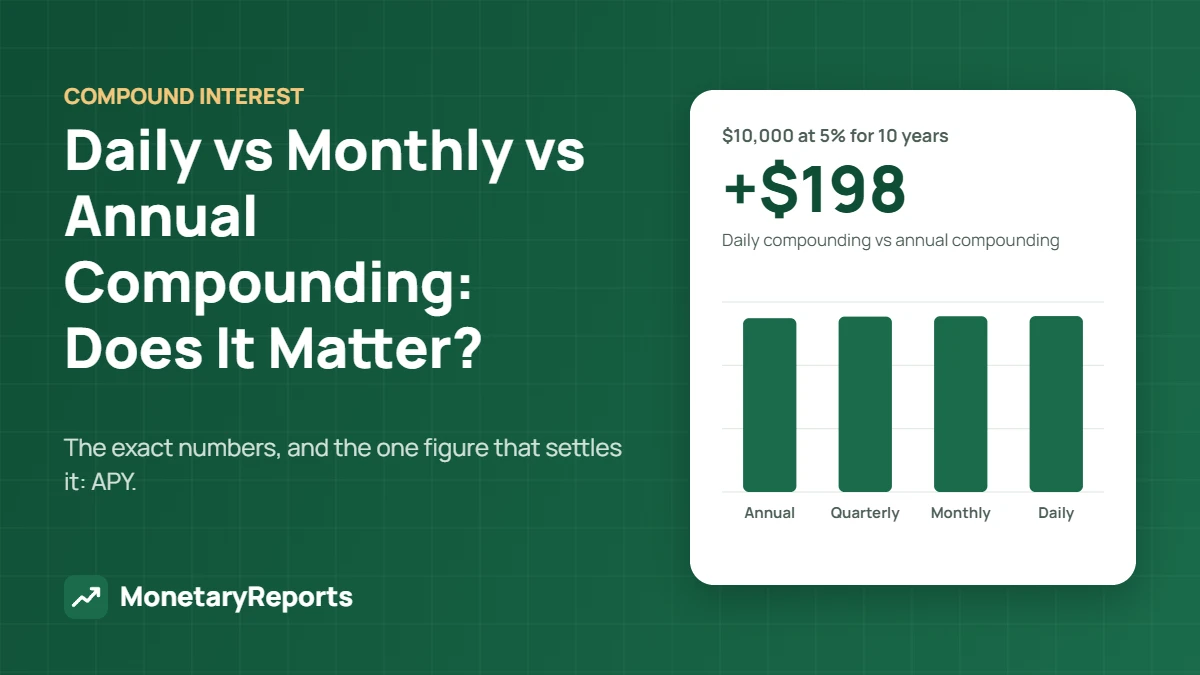
Daily vs monthly vs annual compounding: one bank compounds interest every day, another every month, a CD once a year. Does it really change how much you earn? The short answer is yes, a little, but much less than the interest rate itself. Here are the exact numbers, plus the one figure that makes comparing accounts easy.
Quick answer
$10,000 at 5% for 10 years becomes $16,288.95 compounded yearly, $16,470.09 monthly and $16,486.65 daily. Daily beats annual compounding by about $198 here, but a rate just half a point higher would add more. To compare accounts, use the APY.
In this guide
What compounding frequency means
Compounding frequency is how often the bank calculates interest and adds it to your balance. Once interest is added, it starts earning interest too. The more often that happens, the sooner your interest starts working.
| Frequency | Times per year (n) | Rate each time at 5% a year |
|---|---|---|
| Annually | 1 | 5% |
| Quarterly | 4 | 1.25% |
| Monthly | 12 | 0.4167% |
| Daily | 365 | 0.0137% |
Interactive comparison
Change the amount, rate and years to see how much each compounding frequency gives you. The table updates instantly.
| Interest added | Final balance | vs. annually |
|---|
Daily vs monthly vs annual compounding: the numbers
| Compounding | $10,000 at 5% for 10 years | APY |
|---|---|---|
| Annually | $16,288.95 | 5.000% |
| Quarterly | $16,436.19 | 5.095% |
| Monthly | $16,470.09 | 5.116% |
| Daily | $16,486.65 | 5.127% |
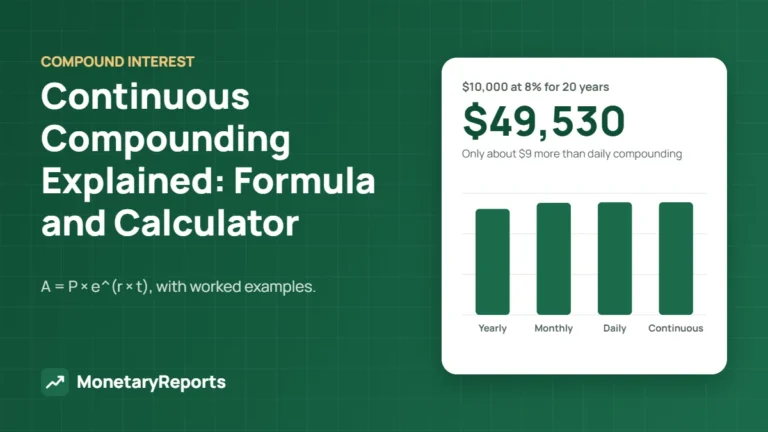
| Continuous (the limit) | $16,487.21 | 5.127% |
Going from annual to monthly compounding makes a noticeable difference ($181). Going from monthly to daily adds only about $17. Beyond daily there is almost nothing left to gain: even continuous compounding adds less than $1.
With bigger balances and longer periods
The gap grows with the balance and with time, but it stays small compared with the rate:

- $25,000 at 5% for 5 years: $31,907.04 annual, $32,083.97 monthly, $32,100.09 daily.
- $100,000 at 5% for 30 years: about $432,194 annual, $446,774 monthly and $448,123 daily. Daily beats monthly by about $1,348 over three decades.
- Rate vs frequency: $10,000 at 4.0% APY for 5 years gives about $12,167; at 4.5% APY about $12,462. Half a point of rate is worth more than any compounding schedule.
APY: the number that settles it
In the U.S., banks must show the annual percentage yield (APY) on deposit accounts under the Truth in Savings Act. APY already includes compounding, so you can compare accounts directly without doing any math.
| Stated rate 4.5%, compounded | APY | $10,000 after 1 year |
|---|---|---|
| Annually | 4.500% | $10,450.00 |
| Monthly | 4.594% | $10,459.40 |
| Daily | 4.602% | $10,460.25 |
Example
Account A: 4.90% compounded daily → APY about 5.02%.
Account B: 5.00% compounded yearly → APY 5.00%.
Account A pays slightly more, even though its stated rate looks lower.
Why it matters more for debt
Credit cards usually calculate interest daily. A card with a 22% APR compounded daily has an effective yearly rate of about 24.6%. On a $5,000 balance that is roughly $1,230 of interest in a year if nothing is paid, about $12 more than monthly compounding would charge. When you borrow, frequent compounding works against you, and the high APR is the real problem.
How common products compound interest
| Product | How interest is usually calculated | What to check |
|---|---|---|
| Savings and money market accounts | Often compounded daily, credited monthly | APY, fees, minimum balance |
| Certificates of deposit (CDs) | Varies: daily, monthly or quarterly | APY, term, early withdrawal penalty |
| Credit cards | Daily on the unpaid balance | APR, grace period, minimum payment |
| Auto loans | Often daily simple interest on the remaining balance | APR, prepayment rules |
| Mortgages | Calculated monthly on the remaining balance | APR, extra payment rules |
The pattern is the same across products: for anything you save, more frequent compounding is a small plus; for anything you owe, it is a small minus. In both cases, the rate is what moves the needle.
Common mistakes
- Choosing an account only because it compounds daily. A monthly account with a higher APY pays more.
- Comparing a savings APY with a loan APR. They measure different things; APY includes compounding, APR usually does not.
- Closing an account just before interest is credited. Some banks only pay accrued interest on the crediting date.
- Ignoring rate changes. A variable savings rate can drop, which matters far more than the compounding schedule.
What this means for you
When you compare accounts
- Look at the APY, not the compounding frequency. It already includes it.
- Check fees and minimum balances, which can wipe out a small APY advantage.
- Confirm FDIC insurance (or NCUA for credit unions).
- See whether the rate is fixed or variable. Savings rates usually change; CD rates are fixed for the term.
- For debt, focus on lowering the APR and paying the balance down; the compounding schedule is secondary.
Try it with your own numbers
The full calculator lets you choose daily, weekly, monthly, quarterly or yearly compounding.
Frequently asked questions
Is daily compounding better than monthly?
Yes, slightly. On $10,000 at 5% for 10 years, daily compounding gives about $17 more than monthly. It is a nice bonus, but a higher rate or lower fees will usually matter much more.
Do most U.S. savings accounts compound daily?
Many do, often with interest credited to your account once a month. The account disclosure explains both the compounding and the crediting schedule. Either way, the APY tells you the yearly result.
What is the difference between compounding and crediting?
Compounding is how often interest is calculated on your balance; crediting is when it is actually added to your account. A bank may compound daily but credit monthly. If you close the account before interest is credited, you may lose the interest that has built up, so check the terms.
Is monthly compounding better than annual compounding for a CD?
Yes, if the stated rate is the same. A 4.5% CD compounded monthly has an APY of about 4.594%, compared with 4.5% for annual compounding. On $10,000 that is about $9 more in the first year. Compare CDs using the APY to be sure.
Does compounding frequency matter for stocks?
Not in the same way. Investments do not have a stated compounding schedule. Returns compound when gains and dividends stay invested, so reinvesting dividends is what matters.
How do I calculate APY from the interest rate?
APY = (1 + r/n)^n − 1, where r is the stated rate as a decimal and n the number of compounding periods per year. For 5% compounded daily: (1 + 0.05/365)^365 − 1 ≈ 5.127%.
Should I move my savings to a bank that compounds daily?
Only if it also offers an equal or higher APY with no extra fees. The compounding schedule alone is worth a few dollars a year on most balances, so it is rarely a reason to switch by itself.
Related guides and calculators
- Continuous compounding explained
- Compound interest formula
- Compound vs simple interest
- Interest calculator
Sources
- Investor.gov (U.S. SEC): Compound interest calculator
- FDIC: National rates and rate caps
- Federal Reserve: Consumer credit (G.19), including credit card interest rates
- MonetaryReports: How we calculate
This guide is for educational purposes only and is not financial advice. The figures are estimates before taxes, fees and inflation, and real savings rates and investment returns change over time.