What Is Compound Interest? A Simple Explanation with Examples
What is compound interest? It is interest that you earn on your original money and on the interest you have already earned. That small detail is the reason a savings account, a 401(k) or an index fund can grow much faster than most people expect, and it is also why a credit card balance can get out of control. In this guide we explain it in plain English, with real numbers you can check in our calculator.
Quick answer
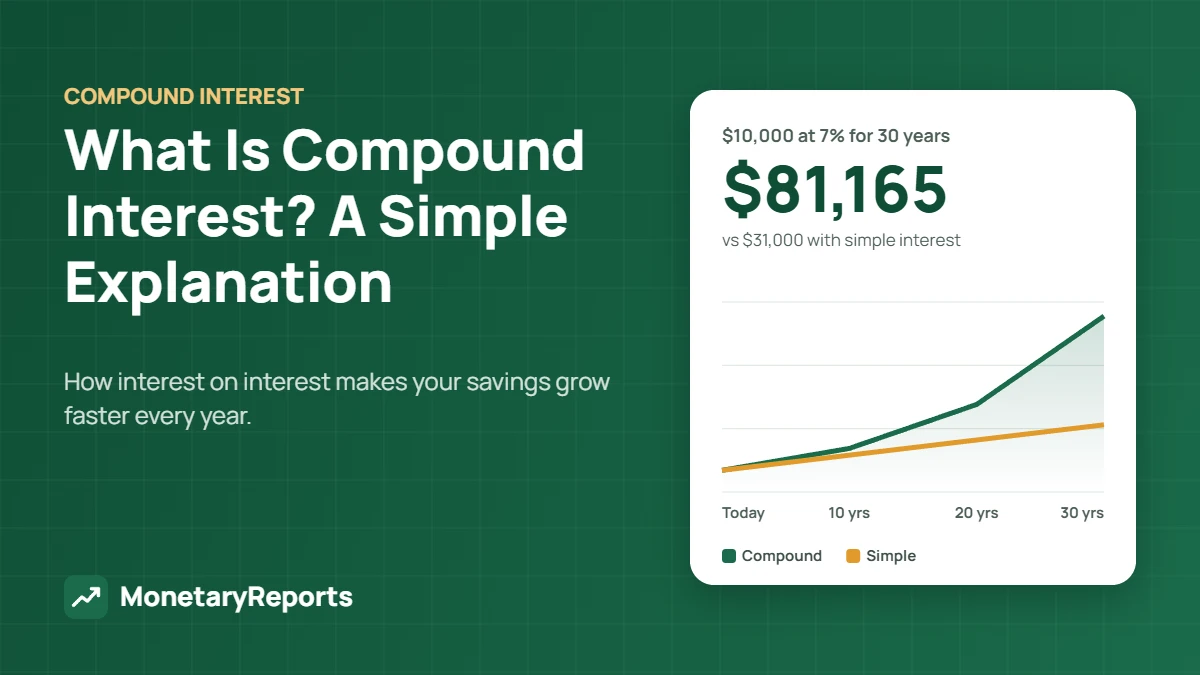
Compound interest means you earn interest on your money and on the interest you already earned, so your balance grows a little faster every year, like a snowball rolling downhill. For example, $10,000 at 7% a year grows to about $40,387 in 20 years with compound interest, compared with $24,000 with simple interest.
In this guide
What is compound interest? The short definition
Compound interest is interest on interest. Every time interest is added to your balance, it becomes part of the money that earns interest the next time. The bigger the balance gets, the more interest it produces, and that interest is added again.
The opposite is simple interest, where you only earn on the money you originally put in. With simple interest, the amount you earn each year stays the same. With compound interest, it keeps rising.
A simple example, year by year
Imagine you put $1,000 in a savings account that pays 5% a year, and you do not touch it.
| Year | Balance at the start | Interest earned (5%) | Balance at the end |
|---|---|---|---|
| 1 | $1,000.00 | $50.00 | $1,050.00 |
| 2 | $1,050.00 | $52.50 | $1,102.50 |
| 3 | $1,102.50 | $55.13 | $1,157.63 |
In year 1 you earn $50. In year 2 you earn $52.50, because the $50 from year 1 is now earning interest too. After 3 years you have $1,157.63, while simple interest would give you $1,150. The gap looks tiny, but it grows every single year.
Why compound interest speeds up over time
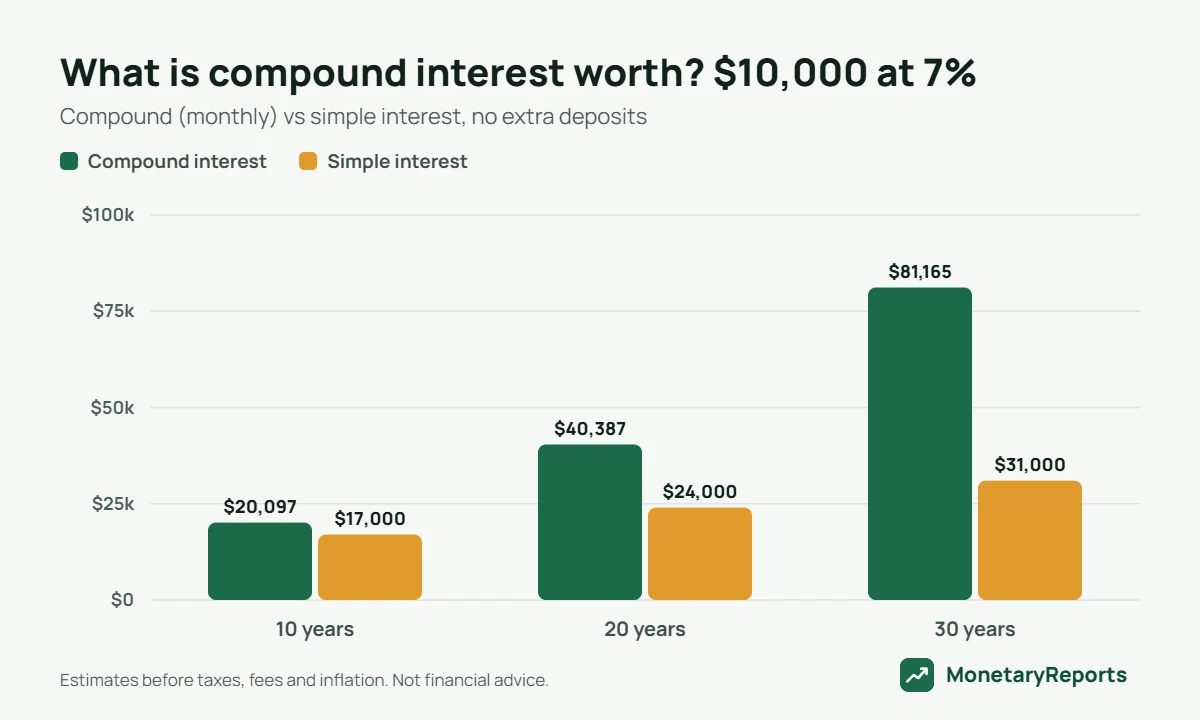
Compound growth starts slowly and then accelerates. The interactive chart below follows $10,000 at 7% a year. Hover over it or tap it to see each year: the green line gets steeper because more and more of the growth comes from earlier interest.
Interactive chart: hover or tap to see each year. Estimates only, before taxes and inflation.
| After | Simple interest | Compound interest (monthly) | Extra from compounding |
|---|---|---|---|
| 1 year | $10,700 | $10,723 | $23 |
| 5 years | $13,500 | $14,176 | $676 |
| 10 years | $17,000 | $20,097 | $3,097 |
| 20 years | $24,000 | $40,387 | $16,387 |
| 30 years | $31,000 | $81,165 | $50,165 |
Look at the last column. In the first year, compounding adds only $23. After 30 years it adds more than $50,000. Most of the benefit arrives in the later years, which is why starting early matters so much.
The 3 things that make it grow
- The interest rate. A higher rate means faster growth. At 4%, $10,000 becomes about $22,226 in 20 years; at 7% it becomes about $40,387.
- Time. The longer you leave the money alone, the bigger the snowball. Time often matters even more than the amount you start with.
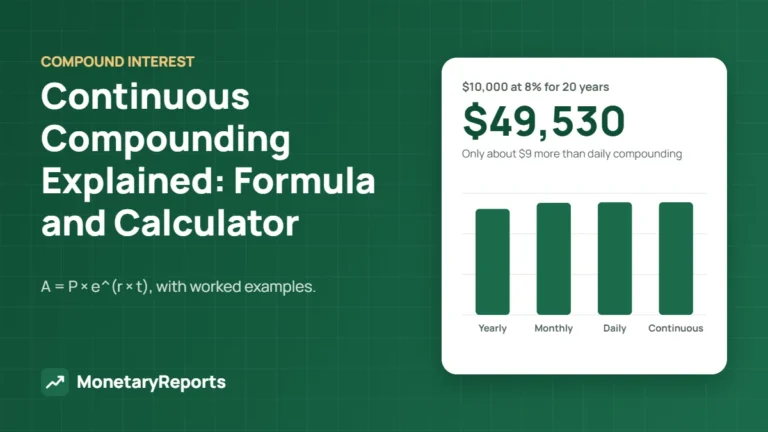
- How often interest is added. Daily or monthly compounding grows slightly faster than yearly compounding, although the difference is small (see daily vs monthly vs annual compounding).
A quick way to feel the effect of the rate is to look at how long it takes to double your money:
| Yearly rate | Years to double (Rule of 72) | Exact years (yearly compounding) |
|---|---|---|
| 4% | 18.0 | 17.7 |
| 6% | 12.0 | 11.9 |
| 8% | 9.0 | 9.0 |
| 10% | 7.2 | 7.3 |
Compound interest in 4 everyday situations
- An emergency fund. $5,000 in a high-yield savings account at 4% APY becomes about $6,083 after 5 years if the rate stays the same. Rates change, so compare current offers.
- Saving for a child. $1,000 put aside at birth at 5% (compounded monthly) becomes about $2,455 by age 18, without adding anything else.
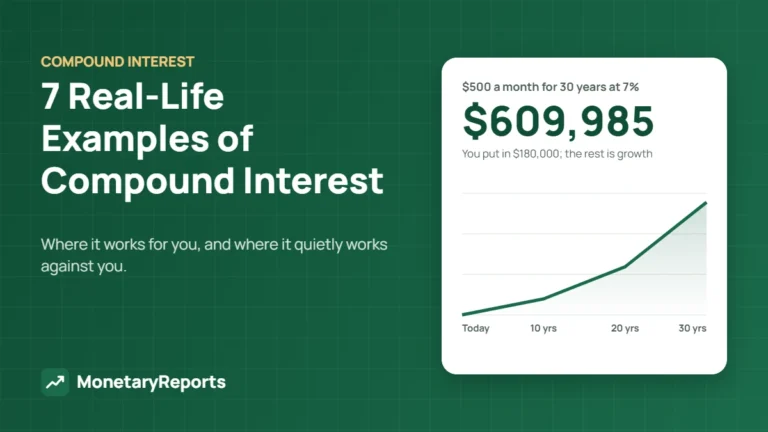
- A workplace 401(k). $300 a month for 30 years at an average 7% return can grow to about $365,991, while you only put in $108,000.
- A credit card. A $3,000 balance at 22% APR, compounded daily, grows to about $3,738 in a year if nothing is paid. Here compound interest is working against you.
More cases with full numbers are in 7 real-life examples of compound interest.
What compound interest means for you
Depending on where you are
- In your 20s: time is your biggest advantage. Even $50 to $100 a month can grow into a meaningful amount by retirement.
- In your 30s and 40s: you usually earn more, so raising your monthly savings has a big effect. Every year you wait makes the required monthly amount higher.
- In your 50s and beyond: there is less time, but compound interest still works. U.S. retirement accounts allow extra “catch-up” contributions from age 50.
- If you have high-interest debt: paying it off first stops compound interest from working against you, which is often the best “return” available.
Common mistakes
- Taking money out early. Each withdrawal removes the base that future interest is built on.
- Comparing APR with APY. APY already includes compounding. To compare savings accounts, always look at the APY.
- Ignoring fees. A 1% yearly fee turns a 7% return into roughly 6%, which can cost tens of thousands of dollars over 30 years.
- Expecting a straight line. Investments go up and down. The smooth curves in this guide are averages, not guarantees.
- Forgetting inflation. Future dollars buy less than today’s dollars, so the “real” growth is lower than the number on the screen.
Try it with your own numbers
Change the starting amount, monthly deposit, rate and number of years, and watch the chart update instantly.
When compound interest works against you
Compound interest works on debt exactly as it works on savings. If you carry a credit card balance at 22% APR and make no payments, $5,000 can grow to about $6,218 in one year and almost $14,900 in five years (compounded monthly). Credit card rates are often above 20% (see the Federal Reserve data in our sources).
The fix is simple, though not always easy: pay credit cards in full every month when you can, pay more than the minimum when you cannot, and pay the highest-rate debt first.
Frequently asked questions
What is compound interest in simple words?
It is interest that earns interest. When the bank or investment adds interest to your balance, that interest starts earning money too, so your balance grows faster each year. The longer you leave it alone, the stronger the effect becomes.
Is compound interest good or bad?
It depends on which side you are on. When you save or invest, compound interest is good because your money grows faster. When you owe money, especially on a credit card, it is bad because your debt grows faster too. The same math works in both directions.
Do savings accounts use compound interest?
Yes. Most U.S. savings accounts and CDs compound interest daily or monthly and credit it to your account monthly. The bank shows the yearly effect as the APY (annual percentage yield), which is the best number to compare accounts.
How do I calculate compound interest?
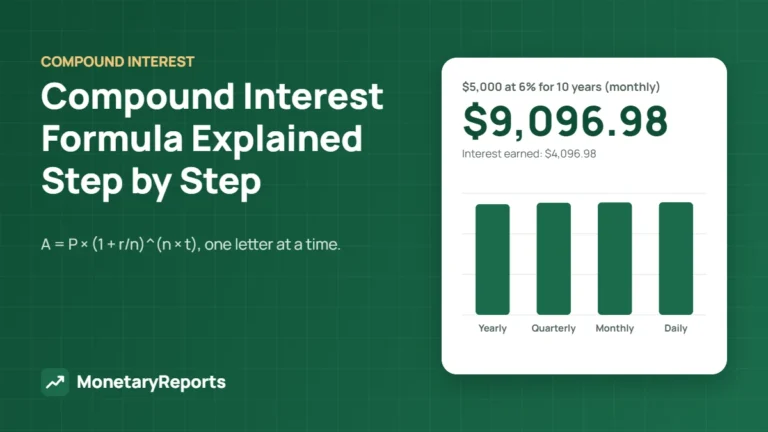
Use the formula A = P × (1 + r/n)^(n × t), where P is the starting amount, r the yearly rate as a decimal, n the number of times interest is added per year and t the number of years. Or skip the math and use our interest calculator. Our formula guide walks through it step by step.
How long does it take to double my money with compound interest?
Divide 72 by the yearly rate. At 6% it takes about 12 years, at 8% about 9 years and at 10% a little over 7 years. Try the Rule of 72 calculator with your own rate.
Can I lose money even with compound interest?
In an FDIC-insured savings account or CD, your deposit is protected up to the legal limit. Investments such as stocks and funds can lose value, especially in the short term, because they do not pay a fixed interest rate. Compounding helps over long periods, but it does not remove risk.
Related guides and calculators
- Compound interest formula explained step by step
- Compound interest vs simple interest
- 7 real-life examples of compound interest
- Interest calculator
Sources
- Investor.gov (U.S. SEC): Compound interest calculator
- Federal Reserve: Consumer credit (G.19), including credit card interest rates
- FDIC: National rates and rate caps
- MonetaryReports: How we calculate
This guide is for educational purposes only and is not financial advice. The figures are estimates before taxes, fees and inflation, and real savings rates and investment returns change over time.