Rule of 72 Calculator: How Long Will It Take to Double Your Money?
Use this Rule of 72 calculator to find out how long it takes for your money to double. Type an interest rate or yearly return below: you get the classic Rule of 72 estimate, the exact answer and a chart of how your money keeps doubling over time.
Quick answer
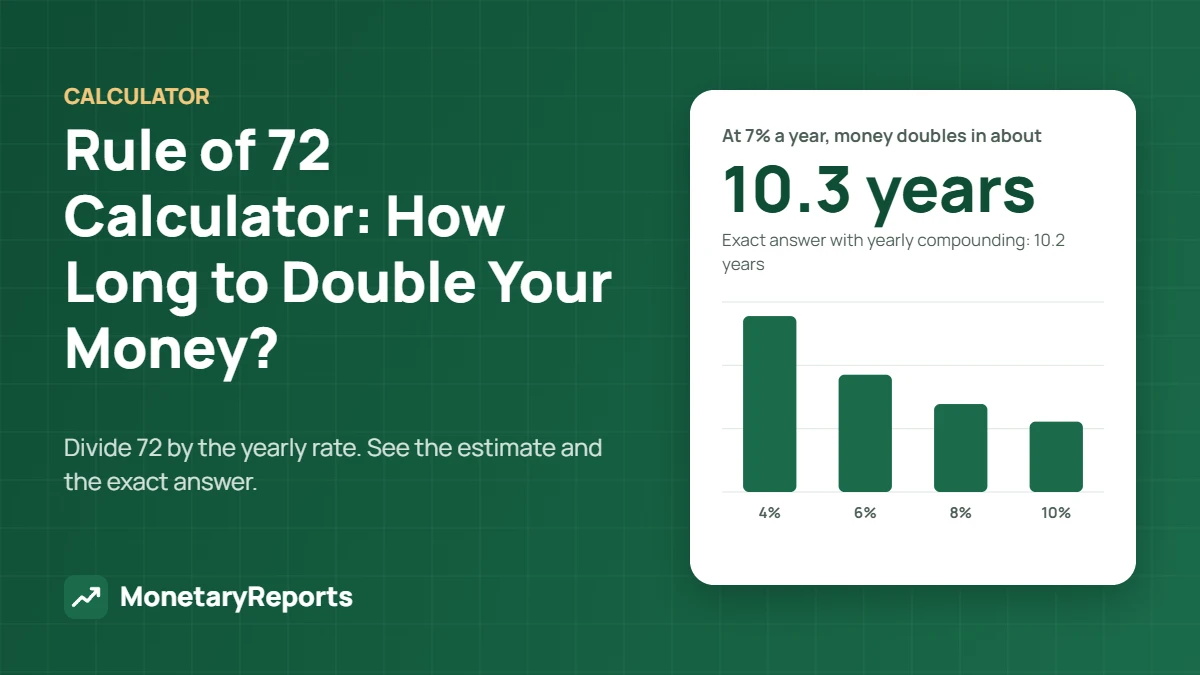
The Rule of 72 says: years to double ≈ 72 ÷ yearly rate. At 6% your money doubles in about 12 years, at 8% in about 9 years and at 10% in about 7.2 years. It is a quick mental shortcut; the calculator above also shows the exact answer.
What is the Rule of 72?
The Rule of 72 is a shortcut for estimating how long it takes for money to double with compound interest. You divide 72 by the yearly rate (as a whole number, not a decimal). The answer is the approximate number of years.
Years to double ≈ 72 ÷ rate
Rate needed ≈ 72 ÷ years
It also works backwards: if you want to double your money in 8 years, you need roughly 72 ÷ 8 = 9% a year.
How to use this Rule of 72 calculator
- Starting amount: the money you have today. It is used to show what the balance becomes after each doubling.
- Annual interest rate or return: the interest rate or average yearly return, in %. For a savings account, use its APY.
- Results: the Rule of 72 estimate, the exact doubling time with yearly compounding, the difference between the two and a bar chart where each bar is one doubling of your money (hover or tap a bar to see the amount).
Doubling time at different rates
| Yearly rate | Rule of 72 estimate | Exact years (yearly compounding) |
|---|---|---|
| 1% | 72.0 | 69.7 |
| 2% | 36.0 | 35.0 |
| 3% | 24.0 | 23.4 |
| 4% | 18.0 | 17.7 |
| 5% | 14.4 | 14.2 |
| 6% | 12.0 | 11.9 |
| 7% | 10.3 | 10.2 |
| 8% | 9.0 | 9.0 |
| 10% | 7.2 | 7.3 |
| 12% | 6.0 | 6.1 |
| 15% | 4.8 | 5.0 |
| 20% | 3.6 | 3.8 |

Example: $10,000 at 7%
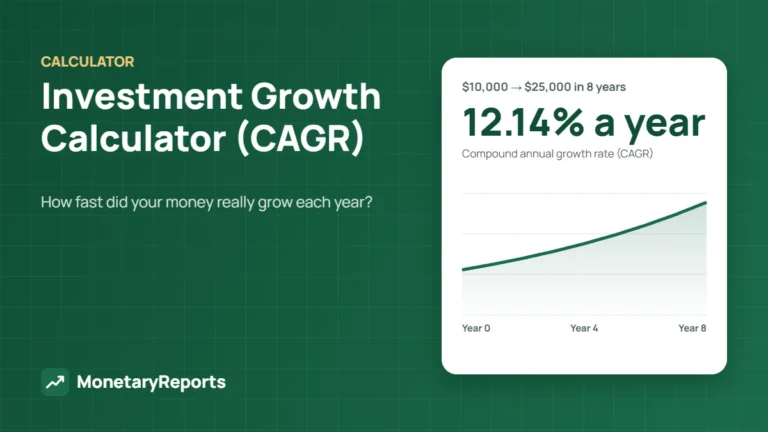
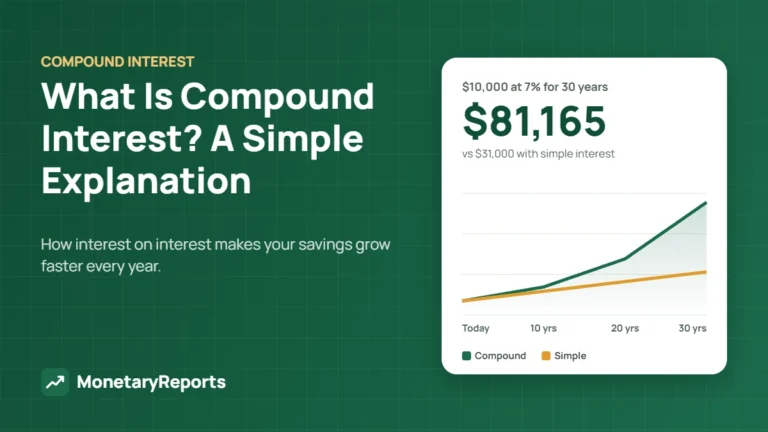
At 7% a year, 72 ÷ 7 ≈ 10.3 years. So $10,000 becomes about $20,000 after roughly 10 years, about $40,000 after roughly 20 years and about $80,000 after roughly 30 years. Each doubling takes the same time, but each one adds twice as many dollars as the one before. That is compound interest in a single picture.
| Doubling | Approximate year | Balance |
|---|---|---|
| Start | 0 | $10,000 |
| 1st | 10 | $20,000 |
| 2nd | 20 | $40,000 |
| 3rd | 31 | $80,000 |
How accurate is the Rule of 72?
Very accurate for typical rates between about 4% and 12%, where the estimate is usually within a few months of the exact answer. At very low rates it slightly overestimates the time, and at very high rates it slightly underestimates it. Some people use 70 or 69.3 for low rates or continuous compounding; 72 is popular because it divides evenly by many numbers (2, 3, 4, 6, 8, 9 and 12).
5 smart ways to use the Rule of 72
- Savings: at 4% APY, a savings balance doubles in about 18 years.
- Investments: compare two expected returns quickly. 6% doubles in about 12 years, 9% in about 8.
- Inflation: at 3% inflation, prices double in about 24 years, which means your cash loses half its buying power in that time.
- Debt: a credit card at 22% APR can double an unpaid balance in about 3 to 3.5 years.
- Goals: to double money in 10 years, you need about 7.2% a year.
What the Rule of 72 means for you
- A few percentage points make a big difference: 4% vs 8% means doubling in 18 years instead of 9.
- Starting earlier gives you more doublings before you need the money.
- High-interest debt doubles fast, so paying it off is a priority.
Try it with your own numbers
Want to add monthly deposits or compare simple and compound interest? Use the full interest calculator.
Frequently asked questions
Why 72 and not 70 or 69?
The exact doubling time uses logarithms, and 69.3 is the “true” number for continuous compounding. 72 is slightly higher, which makes it more accurate for yearly compounding at common rates, and it divides evenly by many numbers, so it is easy to use in your head. Some people prefer 70 for low rates.
Does the Rule of 72 work with monthly deposits?
No. It only works for a single amount growing at a steady rate. With regular deposits your balance grows faster than a single doubling suggests. For that case, use our interest calculator, which handles weekly, every-two-weeks and monthly deposits.
Does the Rule of 72 work for investments that go up and down?
Only as a rough guide. It assumes the same return every year. With real investments the doubling time depends on the actual sequence of returns, so use it for planning, not as a promise. If you know the start value, end value and years, the investment growth calculator gives the real average rate.
Can I use the Rule of 72 for debt?
Yes. It shows how fast an unpaid balance can double. At 22% APR, 72 ÷ 22 ≈ 3.3 years. That is a good reason to pay high-interest debt first.
How do I use the Rule of 72 for inflation?
Divide 72 by the inflation rate to see how long it takes for prices to double, or for cash to lose half its buying power. At 3% inflation that is about 24 years; at 6% about 12 years.
Is the Rule of 72 calculator accurate?
The calculator shows both the Rule of 72 estimate and the exact answer, so you can see the difference. For rates between about 4% and 12% the two are almost the same.
Related guides and calculators
- What is compound interest?
- How much will $10,000 grow?
- Investment growth (CAGR) calculator
- Interest calculator
Sources
- Investor.gov (U.S. SEC): Compound interest calculator
- U.S. Bureau of Labor Statistics: Consumer Price Index
- MonetaryReports: How we calculate
This guide is for educational purposes only and is not financial advice. The figures are estimates before taxes, fees and inflation, and real savings rates and investment returns change over time.