
This free interest calculator works for savings, CDs and long-term investing. Choose compound or simple interest, pick how often you add money (every week, every 2 weeks, every month, every 3 months or every year) and see how your savings could grow. Change any number and the chart updates instantly.
| Year | Deposits | Interest | Balance |
|---|
How to use the interest calculator
| Field | What to enter | Tip |
|---|---|---|
| Interest type | Compound or simple | Savings accounts, CDs and investments use compound interest. |
| Currency | USD, GBP, EUR or CAD | Only changes the symbol; the math is the same. |
| Starting amount | Money you have today | Can be $0 if you start from nothing. |
| Regular deposit | How much you add each time | Use 0 to see only the starting amount grow. |
| Deposit frequency | Weekly, every 2 weeks, monthly, quarterly or yearly | Match how you get paid if you save every payday. |
| Yearly interest rate | The rate or expected return, in % | For a savings account use its APY. |
| Compounding | Daily, weekly, monthly, quarterly or yearly | Check your account disclosure; monthly is a good default. |
| Years | How long you will save | Try 10, 20 and 30 years to see the difference. |
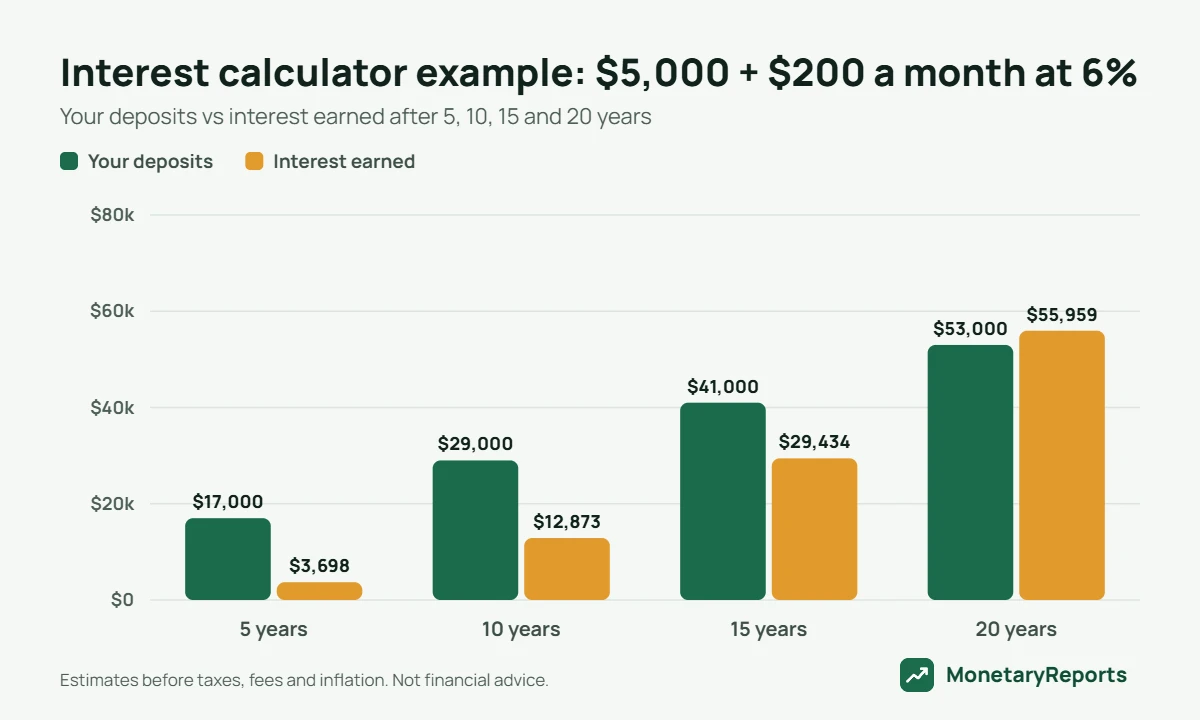
Example: $5,000 plus $200 a month
Say you have $5,000 and can save $200 a month at 6% a year, compounded monthly, for 20 years. The calculator shows a final balance of about $108,959: $53,000 of your own deposits and about $55,959 of interest. In the last years, interest earns more than your deposits each year.
How to read the results
- Final balance: what you could have at the end, before taxes, fees and inflation.
- Total deposits: all the money you put in, including the starting amount.
- Interest earned: the difference. This is the part compound interest adds.
- Chart: the green part is your money and the orange part is interest. Hover or tap to see any year.
- Year-by-year table: the exact balance at the end of each year.
Assumptions
Deposits are added at the end of each period. The rate stays the same every year. Results do not include taxes, fees or inflation. Real savings rates change and investments can lose value. See how we calculate for details.
How compound interest works
Compound interest means you earn interest on your deposits and also on the interest you already earned. Each year the base gets bigger, so the growth speeds up. That is why the orange part of the chart grows faster in the later years.
The formula
A = P × (1 + r/n)^(n × t)
P is the starting amount, r the yearly rate as a decimal, n how many times per year interest is added and t the number of years. Regular deposits are added on top, one by one, which is what the calculator does for you.
Simple vs compound interest: $10,000 at 7%
| After | Simple interest | Compound interest (monthly) |
|---|---|---|
| 10 years | $17,000 | $20,097 |
| 20 years | $24,000 | $40,387 |
| 30 years | $31,000 | $81,165 |
Frequently asked questions
Does it matter if I save every week or every month?
A little. Saving weekly puts money to work slightly earlier, so the result is a bit higher, but the total you deposit matters much more than how often you deposit it.
Is daily compounding much better than monthly?
Only slightly. At 7% over 20 years, daily compounding changes the final balance by well under 1% compared with monthly.
Does this include taxes or inflation?
No. It shows growth before taxes and before inflation (in future dollars). What that money can buy will be lower once you account for inflation.
What rate should I use?
Use the APY of your savings account or CD. For long-term investing, try a few different rates to see a range instead of a single number.
What is a realistic interest rate to use?
For cash, use the current APY of your account; national averages are published by the FDIC. For long-term investing, try a cautious rate and a more optimistic one (for example 5% and 7%) to see a range.
Why is my result different from my bank statement?
Banks may compound daily, credit interest on a specific day or round each month. Rates can also change over time. Small differences are normal.
Can I use it for debt?
It shows how a balance grows at a given rate, which helps you understand why unpaid debt grows. For paying debt down with monthly payments, a loan payoff calculator is more accurate.
Related guides and calculators
- What is compound interest?
- Compound interest formula explained
- Compound vs simple interest
- Daily vs monthly vs annual compounding
- Rule of 72 calculator
- Investment growth (CAGR) calculator
- How much will $10,000 grow?
Sources
- Investor.gov (U.S. SEC): Compound interest calculator
- FDIC: National rates and rate caps
- U.S. Bureau of Labor Statistics: Consumer Price Index
- MonetaryReports: How we calculate
Last updated: November 2026. Results are estimates for educational purposes only and are not financial advice.