What $100 a Month Becomes in 30 Years
$100 a month is about $3.30 a day: roughly the price of a coffee or a streaming subscription or two. It does not sound like much, but over 30 years compound interest can turn it into a surprisingly large amount. Here are the numbers, and what they mean for you depending on when you start.
Quick answer
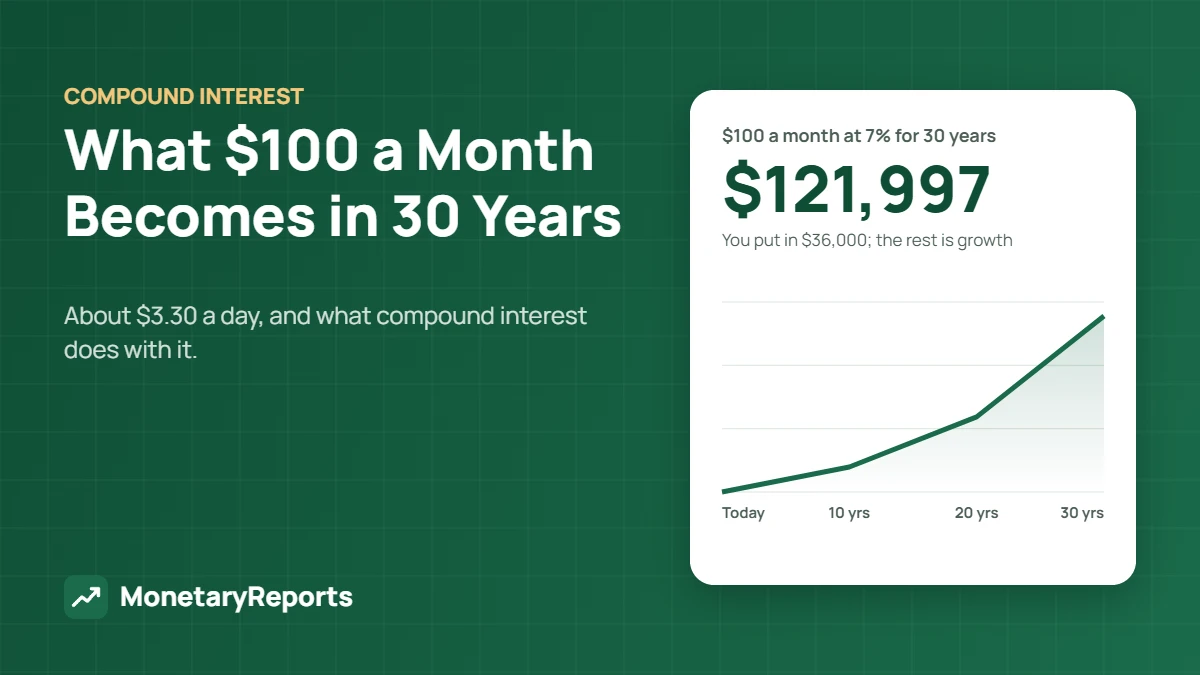
If you save $100 a month for 30 years, you put in $36,000. At 7% a year it can grow to about $121,997, so $85,997 of that is growth. At 4% you would have about $69,405; at 10% about $226,049.
$100 a month for 30 years at different rates
| Yearly rate | You put in | Growth | Total after 30 years |
|---|---|---|---|
| 0% (under the mattress) | $36,000 | $0 | $36,000 |
| 4% | $36,000 | $33,405 | $69,405 |
| 5% | $36,000 | $47,226 | $83,226 |
| 6% | $36,000 | $64,452 | $100,452 |
| 7% | $36,000 | $85,997 | $121,997 |
| 8% | $36,000 | $113,036 | $149,036 |
| 10% | $36,000 | $190,049 | $226,049 |
Interactive chart
Each line starts at $0 and adds $100 every month. Hover or tap to see the balance in any year.
Interactive chart: hover or tap to see each year. Estimates only, before taxes and inflation.
When you start saving $100 a month matters most
Here is the same $100 a month at 7%, saved until age 65, starting at different ages:
| Start at | Years saving | You put in | Balance at 65 |
|---|---|---|---|
| 25 | 40 | $48,000 | $262,481 |
| 35 | 30 | $36,000 | $121,997 |
| 45 | 20 | $24,000 | $52,093 |
| 55 | 10 | $12,000 | $17,308 |

Starting at 25 instead of 35 means only $12,000 more in deposits, but more than double the final balance. Read the full comparison in starting to save at 25 vs 35.
What changes with more years
| Saving $100 a month at 7% for | You put in | Total |
|---|---|---|
| 5 years | $6,000 | $7,159 |
| 10 years | $12,000 | $17,308 |
| 20 years | $24,000 | $52,093 |
| 30 years | $36,000 | $121,997 |
| 40 years | $48,000 | $262,481 |
Going from 30 to 40 years adds only $12,000 of deposits but more than doubles the total. That is compound interest doing the heavy lifting.
What changes with more money
| Monthly deposit | Total after 30 years at 7% |
|---|---|
| $50 | $60,999 |
| $100 | $121,997 |
| $200 | $243,994 |
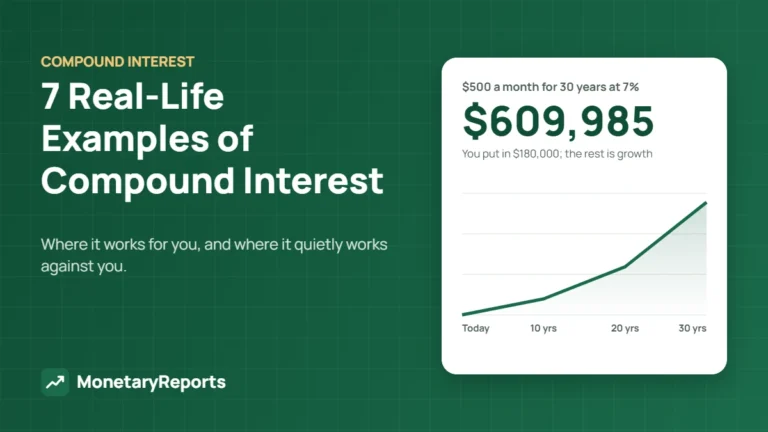
| $500 | $609,985 |
Doubling your monthly deposit doubles the result. If $100 feels like too much right now, $50 is still worth starting with, and you can raise it later.
Weekly, every 2 weeks or monthly?
If you put away the same $1,200 a year, how often you deposit makes only a small difference:
| How you save $1,200 a year | Total after 30 years at 7% |
|---|---|
| $1,200 once a year | $118,132 |
| $100 a month | $121,997 |
| About $46 every 2 weeks | $122,188 |
| About $23 a week | $122,270 |
Saving more often helps a little because the money starts working sooner. Choose whatever matches your paycheck; the habit matters far more than the schedule.
Try it with your own numbers
Try your own monthly amount, and switch between weekly, every-2-weeks and monthly deposits.
How to start with $100 a month
- Automate it. Set up an automatic transfer the day after payday so you do not have to think about it.
- Choose the right place. For money you might need within a few years, a high-yield savings account (at 4% APY, $100 a month becomes about $6,630 in 5 years). For long-term goals like retirement, many people use a workplace 401(k) or an IRA.
- Check for an employer match. If your employer matches 401(k) contributions, that extra money compounds too.
- Increase it over time. When you get a raise, add a little more.
- Leave it alone. Withdrawals reset the snowball and can trigger taxes and penalties in retirement accounts.
What this means for you
- Just starting out: $100 a month is a strong habit; the amount can grow with your income.
- Already saving: an extra $100 a month on top of what you do now could mean about $122,000 more in 30 years at 7%.
- Paying off debt: putting the same $100 toward a 22% credit card first is usually the better “investment”.
Common mistakes
- Waiting for a bigger amount. Every year of waiting costs more than the small deposits you skip.
- Stopping after a bad market year. Regular deposits buy more shares when prices are low.
- Ignoring fees. With a 1% yearly fee, a 7% return becomes about 6%, and $100 a month for 30 years ends at about $100,452 instead of $121,997.
- Forgetting inflation. With 3% inflation, $121,997 in 30 years would buy roughly what $50,000 buys today. That is still much more than the $36,000 you put in.
Frequently asked questions
Is $100 a month enough for retirement?
On its own it is probably not enough for most people, but it is a strong start. Many people begin with a small amount and increase it as their income grows. Combined with Social Security and any employer match, it can make a real difference.
What if I can only save $50 a month?
Start with $50. At 7% for 30 years it can grow to about $60,999. The most important step is starting the habit; you can raise the amount later when your budget allows.
What does $100 a month become in 20 years?
At 7% compounded monthly, about $52,093. You would have put in $24,000, so more than half of the balance is growth.
Where should I invest $100 a month?
It depends on your goal and timeline. For short-term goals, many people use a high-yield savings account. For retirement, a 401(k) (especially with an employer match) or an IRA invested in diversified, low-cost funds is common. This is general information, not personal advice.
What about inflation?
These are nominal amounts. With 3% inflation, $121,997 in 30 years would buy roughly what $50,000 buys today. Investing still beats keeping cash, which loses buying power every year.
Is saving $100 a month worth it if I have debt?
If the debt has a high rate, like a credit card at 20% or more, paying it off first usually saves more than investing would earn. Many people still contribute enough to get any employer 401(k) match while they pay down debt.
How much is $100 a month for 10 years?
At 7% compounded monthly, about $17,308. You would have put in $12,000, so about $5,308 is growth. At 4% it would be about $14,725.
Related guides and calculators
- Starting to save at 25 vs 35
- How much will $10,000 grow?
- How to make compound interest work for you
- Interest calculator
Sources
- Investor.gov (U.S. SEC): Compound interest calculator
- U.S. Bureau of Labor Statistics: Consumer Price Index
- FDIC: National rates and rate caps
- IRS: Retirement plans
- MonetaryReports: How we calculate
This guide is for educational purposes only and is not financial advice. The figures are estimates before taxes, fees and inflation, and real savings rates and investment returns change over time.