Starting to Save at 25 vs 35: The Cost of Waiting 10 Years
Starting to save at 25 vs 35 may look like a small difference when you are young. Ten years can feel like nothing. But for compound interest, those first 10 years are worth more than almost anything you can do later. Here is what waiting really costs, in dollars, and what you can do if you are starting later.
Quick answer
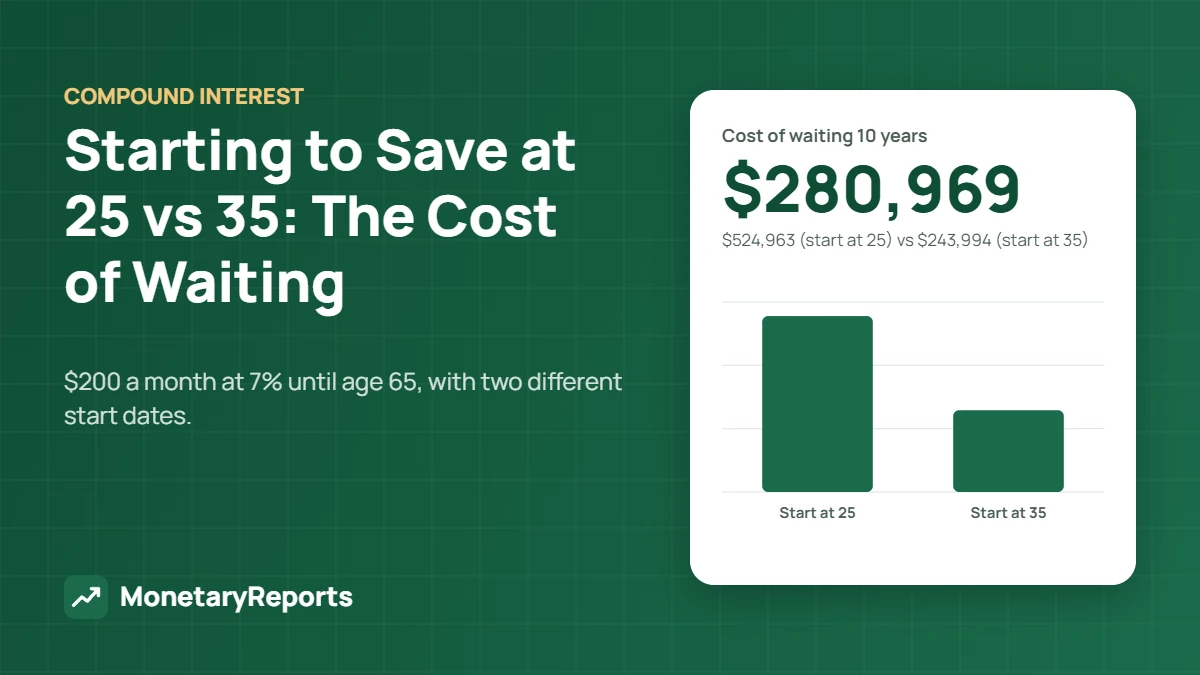
Saving $200 a month at 7% from age 25 to 65 can grow to about $524,963. Starting the same plan at 35 gives about $243,994, less than half, even though you only put in $24,000 less. To catch up, the 35-year-old would need to save about $430 a month.
Interactive chart: starting to save at 25 vs 35
Both savers put $200 a month into an account earning 7% a year until age 65. Hover or tap to see each age.
Interactive chart: hover or tap to see each year. Estimates only, before taxes and inflation.
The numbers by starting age
| Start saving at | Years saving | You put in | Balance at 65 |
|---|---|---|---|
| 25 | 40 | $96,000 | $524,963 |
| 30 | 35 | $84,000 | $360,211 |
| 35 | 30 | $72,000 | $243,994 |
| 45 | 20 | $48,000 | $104,185 |
Every 5 years of waiting costs roughly a third of the final balance. Waiting from 25 to 35 costs about $280,969, while saving only $24,000 less. Even with a more cautious 5% return, the 25-year-old ends with about $305,204 and the 35-year-old with about $166,452.
The saver who stopped after 10 years
Here is the most surprising example. Imagine two people, both earning 7% a year:
| Early saver | Late saver | |
|---|---|---|
| Saves $200 a month | From 25 to 35, then stops | From 35 to 65 |
| Years saving | 10 | 30 |
| Total put in | $24,000 | $72,000 |
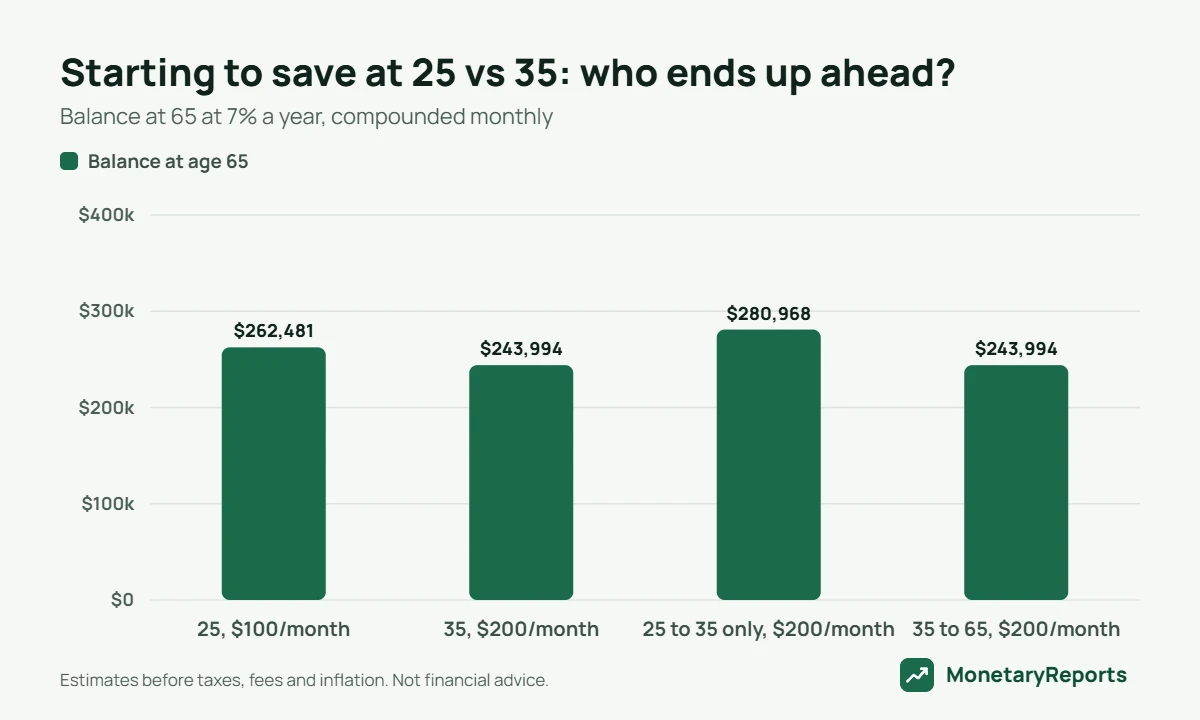
| Balance at 65 | $280,968 | $243,994 |
The early saver put in three times less money and still ends up with more, because that money had 40 years to grow. It is not a trick: it is simply compound interest with more time.
Half the money, but 10 years earlier
One more comparison: a 25-year-old who can only manage $100 a month versus a 35-year-old who saves $200 a month. At 7% until 65, the younger saver ends with about $262,481 and the older saver with about $243,994. Half the monthly amount, but a 10-year head start, wins.
Why the early years are so valuable
A dollar saved at 25 has 40 years to compound. At 7% compounded monthly, it can grow to about $16. A dollar saved at 35 has 30 years and can grow to about $8. The earlier dollar is worth roughly twice as much at retirement.
- Early money has more time to double. At 7%, money doubles about every 10 years (see the Rule of 72).
- Your 20s are when the base of the snowball forms. Later, the snowball does most of the work.
- Small amounts early can replace much larger amounts later.
How much more you need if you start later
To reach the same $524,963 by 65 at 7%, here is the monthly amount needed depending on when you start:
| Start at | Years until 65 | Monthly saving needed |
|---|---|---|
| 25 | 40 | $200 |
| 30 | 35 | about $291 |
| 35 | 30 | about $430 |
| 45 | 20 | about $1,008 |
Try it with your own numbers
Enter your age, your monthly savings and a rate to see where you could be.
Started late? What you can still do
If you are 35, 45 or older, do not be discouraged. Starting today is still far better than starting in 5 years.
- Save more per month. The table above shows the target; even part of it helps.
- Use your employer match. A 401(k) match is extra money that compounds for you. For example, a $125 monthly match invested for 40 years at 7% could grow to about $328,102 on its own.
- Use catch-up contributions. From age 50, U.S. retirement accounts allow higher yearly contributions (check the current IRS limits).
- Work a few more years. Every extra year adds deposits and gives the balance more time to grow.
- Keep fees low. Saving 1% a year in fees can add tens of thousands of dollars over decades.
What starting to save at 25 vs 35 means for you
- If you are in your 20s: any amount you can automate now has an outsized effect later.
- If you are in your 30s: you have plenty of time, but you will likely need to save a bit more each month.
- If you have high-interest debt: paying it off first is usually smart, while still taking any employer match.
Frequently asked questions
Is 35 too late to start saving?
No. With 30 years until 65, compound interest still has plenty of time to work. You may simply need to save a bit more each month: about $430 instead of $200 to reach the same goal at 7%. Starting now is far better than waiting another 5 years.
Is 7% a realistic return?
It is a common long-term planning assumption for a diversified stock portfolio, but returns are not guaranteed and vary a lot from year to year. Savings accounts usually pay less. Try a cautious rate such as 5% to see a more conservative picture.
Should I pay off debt or start investing at 25?
High-interest debt such as credit cards usually costs more than investments earn, so many people pay it off first while still contributing enough to get any employer 401(k) match. Low-interest debt is a closer call.
What about inflation?
These are nominal amounts. With 3% inflation, $524,963 in 40 years would buy roughly what $160,931 buys today. The comparison between starting at 25 and 35 stays the same: the early saver is still far ahead.
How much should I save at 25?
There is no single right number. A common approach is to start with whatever you can automate, at least enough to get any employer match, and raise it with every pay increase. Even $100 a month at 25 can beat $200 a month started at 35.
Does starting early still matter with a low return?
Yes. Time helps at any positive rate. At 5% the 25-year-old saving $200 a month ends with about $305,204 versus $166,452 for the 35-year-old. The gap is smaller in dollars, but still large.
What if I cannot save $200 a month at 25?
Save what you can and automate it. Even $50 or $100 a month at 25 has decades to grow, and you can increase it as your income rises. A 25-year-old saving $100 a month at 7% can end up with about $262,481 by 65.
Related guides and calculators
- What $100 a month becomes in 30 years
- How to make compound interest work for you
- What is compound interest?
- Interest calculator
Sources
- Investor.gov (U.S. SEC): Compound interest calculator
- IRS: Retirement topics, catch-up contributions
- U.S. Bureau of Labor Statistics: Consumer Price Index
- MonetaryReports: How we calculate
This guide is for educational purposes only and is not financial advice. The figures are estimates before taxes, fees and inflation, and real savings rates and investment returns change over time.