Pay Yourself First: The Simple Rule to Automate Your Savings
Pay yourself first means saving or investing a set amount as soon as you get paid, before paying bills or spending on anything else. It flips the usual order (spend first, save what is left) and is one of the most reliable ways to build savings, because it does not depend on willpower at the end of the month.
Quick answer
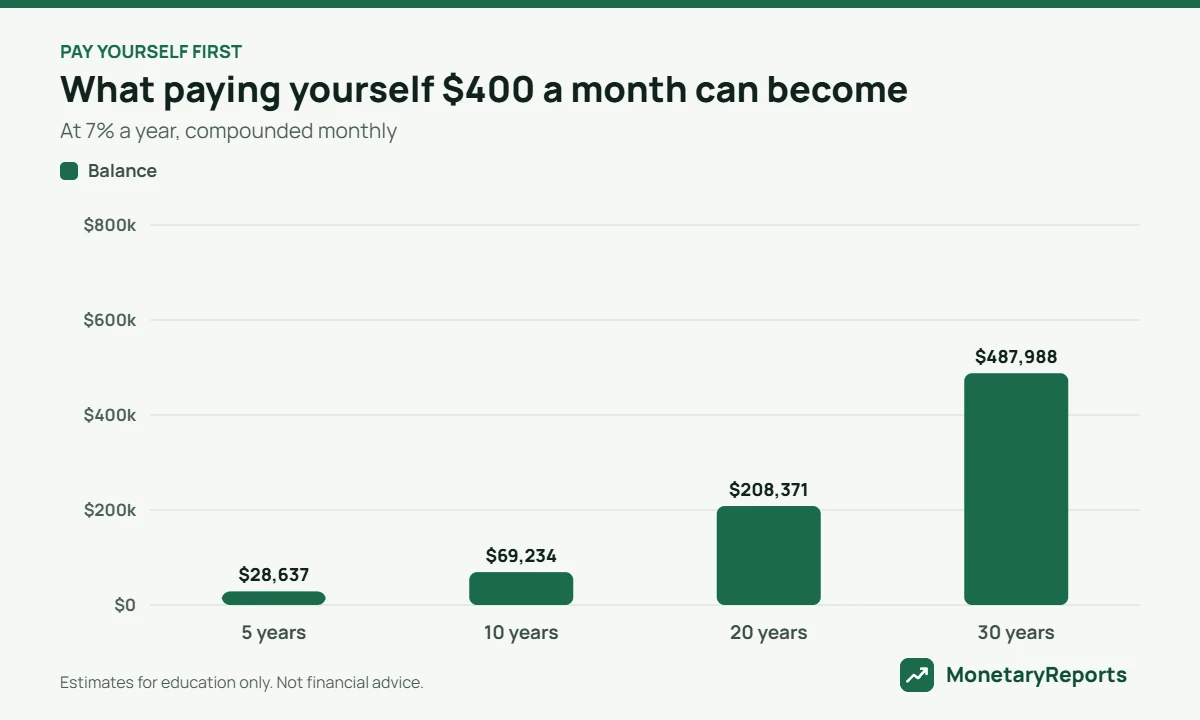
To pay yourself first, set an automatic transfer on payday to savings or investments, for example 10% of your take-home pay. On $4,000 a month that is $400, which at 7% a year could grow to about $69,234 in 10 years and $487,988 in 30 years.
Why pay yourself first works
- It removes the decision. The money moves before you can spend it.
- You adapt to what is left. Most people adjust their spending to the money they see in checking.
- It is consistent. Regular deposits give compound interest something to work with every month.
How to automate your savings in 5 steps
- Choose your accounts: an emergency fund in high-yield savings, then retirement (401(k) or IRA), then other goals.
- Pick an amount or percentage you can keep, even if it is small.
- Schedule the transfer for the day after payday, or use payroll deduction for your 401(k).
- Split your direct deposit if your employer allows it, so part goes straight to savings.
- Increase the amount by 1% of pay every time you get a raise.
How much to pay yourself
| Take-home pay per month | 5% | 10% | 15% | 20% |
|---|---|---|---|---|
| $3,000 | $150 | $300 | $450 | $600 |
| $4,000 | $200 | $400 | $600 | $800 |
| $5,000 | $250 | $500 | $750 | $1,000 |
The 50/30/20 budget suggests 20% for savings and debt payments. If that is too much today, start at 5% and grow from there.
What it can grow to
| $400 a month for | At 4% (savings) | At 7% (long-term investing) |
|---|---|---|
| 5 years | $26,520 | $28,637 |
| 10 years | $58,900 | $69,234 |
| 30 years | $277,620 | $487,988 |
What paying yourself first means for you
- Automation beats motivation: set it up once and let it run.
- Start with your emergency fund, then capture any employer 401(k) match.
- Raise the amount with every raise, before your lifestyle catches up.
Frequently asked questions
What does pay yourself first mean?
It means moving money to savings or investments as soon as you are paid, before spending on anything else.
How much should I pay myself first?
A common target is 10% to 20% of take-home pay. If that feels like too much, start with 5% or even $50 and raise it over time.
What if I have bills to pay?
Essential bills still come first in practice; the idea is to treat savings like a bill too, instead of saving only what is left.
Should I pay myself first if I have debt?
Many people save a small emergency fund and get any employer match, then put extra money toward high-interest debt.
Where should the money go?
Typically an emergency fund in a high-yield savings account first, then retirement accounts, then other goals.
Related guides and calculators
- How to make compound interest work for you
- 50/30/20 budget calculator
- Sinking funds explained
- Emergency fund calculator
Sources
- Investor.gov (U.S. SEC): Compound interest calculator
- FDIC: National rates and rate caps
- Consumer Financial Protection Bureau (CFPB)
- MonetaryReports: How we calculate
This guide is for educational purposes only and is not financial advice. The figures are estimates before taxes, fees and inflation, and real rates, returns and rules change over time.