Sinking Funds Explained: What They Are and How to Use Them
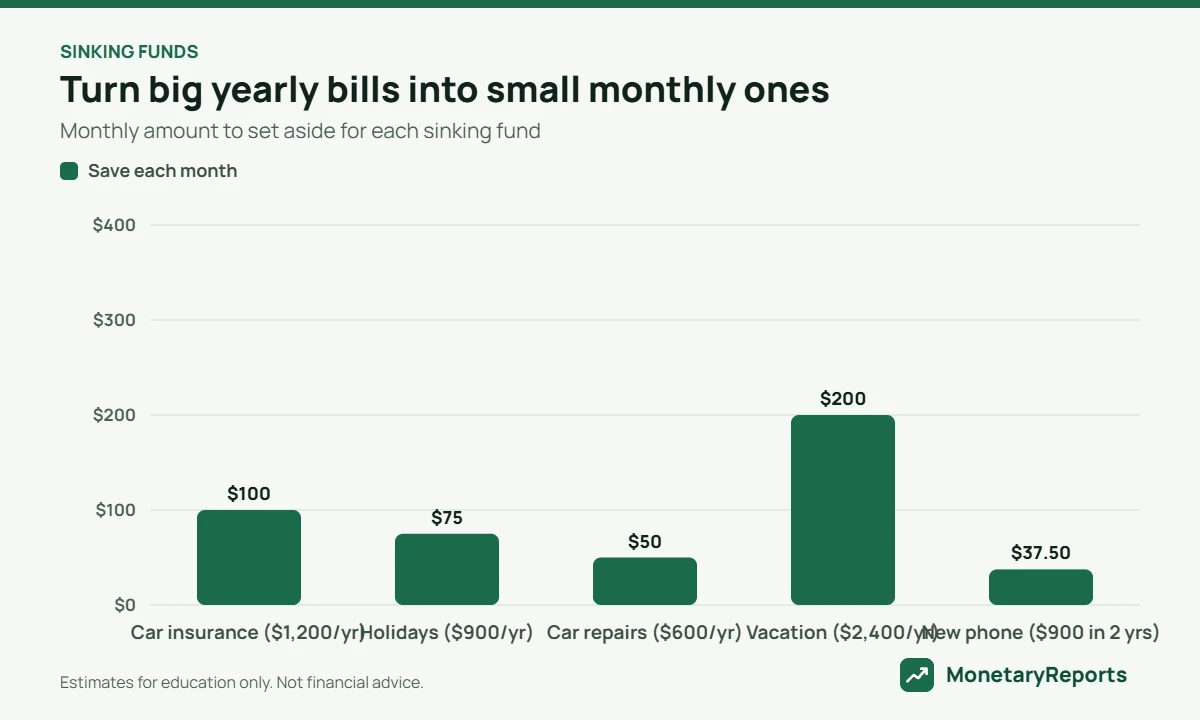
Sinking funds are small savings pots for expenses you know are coming, like car insurance, holiday gifts or a new phone. Instead of being surprised by a big bill, you save a little every month and pay it in full when it arrives. They are one of the simplest ways to stop using credit cards for “unexpected” expenses that were actually predictable.
Quick answer
A sinking fund divides a future expense by the months until it is due. A $1,200 yearly car insurance bill becomes $100 a month; $900 of holiday spending becomes $75 a month. Unlike an emergency fund, sinking funds are for planned costs.
What are sinking funds?
The name comes from finance, where companies set aside money over time to repay a debt. For households, the idea is the same: break a known future cost into monthly pieces. When the bill arrives, the money is already there.
Monthly sinking fund amount = cost ÷ months until it is due
Sinking funds vs emergency fund
| Sinking funds | Emergency fund | |
|---|---|---|
| Purpose | Known, planned expenses | True surprises (job loss, medical bills) |
| Examples | Insurance, gifts, car tags, vacations | Unexpected repairs, income gaps |
| Amount | Exact cost of each item | 3 to 6 months of essentials |
| When used | On a schedule | Only in emergencies |
Common sinking funds and monthly amounts
| Sinking fund | Yearly cost | Save each month |
|---|---|---|
| Car insurance | $1,200 | $100 |
| Holiday gifts | $900 | $75 |
| Car maintenance and repairs | $600 | $50 |
| Vacation | $2,400 | $200 |
| New phone in 2 years | $900 | $37.50 |
| Annual subscriptions | $300 | $25 |
How to set up sinking funds
- List your irregular expenses from the last 12 months (check bank statements).
- Write the cost and the due date of each one.
- Divide each cost by the months until it is due.
- Open one high-yield savings account and track each fund in a spreadsheet, or use a bank that lets you create separate “buckets”.
- Automate one transfer for the total every payday.
What sinking funds mean for you
- They turn big, stressful bills into small, boring monthly transfers.
- They protect your emergency fund for real emergencies.
- Start with the 2 or 3 biggest irregular bills; add more later.
Frequently asked questions
What is a sinking fund in simple words?
Money you save a little at a time for a specific future expense, so you can pay it in full when it arrives.
How many sinking funds should I have?
As many as you can track easily. Many people start with 3 to 5: car costs, insurance, gifts, travel and home maintenance.
Do I need a separate account for each sinking fund?
No. One savings account with a simple spreadsheet works. Some banks let you create named sub-accounts or buckets, which makes it easier.
What if I need more than I saved?
Pay the difference from your budget that month and raise the monthly amount for next time.
Should sinking funds earn interest?
Keeping them in a high-yield savings account is a good idea: the money stays safe and earns a little while it waits.
Related guides and calculators
- Emergency fund calculator
- How to make a budget for beginners
- Pay yourself first
- Savings goal calculator
Sources
- Consumer Financial Protection Bureau (CFPB)
- FDIC: National rates and rate caps
- MonetaryReports: How we calculate
This guide is for educational purposes only and is not financial advice. The figures are estimates before taxes, fees and inflation, and real rates, returns and rules change over time.