Emergency Fund Calculator: How Much Should You Save?

Use this emergency fund calculator to find your target and how long it will take to get there. An emergency fund is money set aside for surprises: a job loss, a medical bill, a car repair. Having it means you do not need a credit card or a loan when life happens.
Quick answer
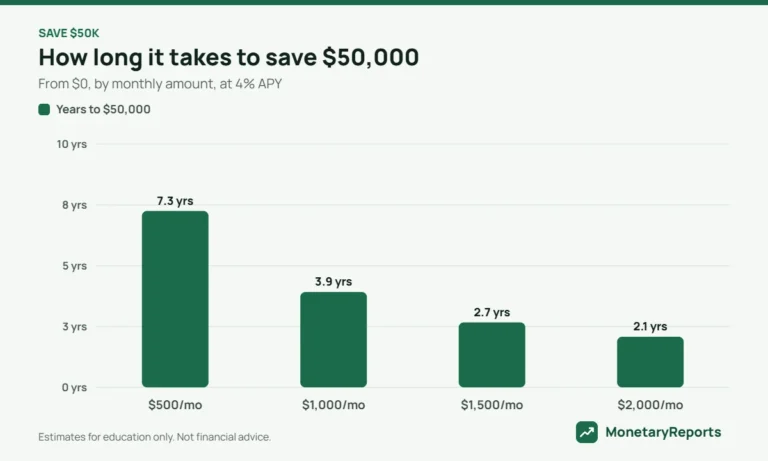
A common rule is to save 3 to 6 months of essential expenses. If your essentials cost $3,000 a month, your emergency fund target is $9,000 to $18,000. Saving $400 a month from $2,000, you would reach $18,000 in about 40 months.
How to use the emergency fund calculator
- Essential monthly expenses: only what you must pay, not your full spending.
- Months to cover: 3 months is a common minimum; 6 or more if your income is less stable.
- Already saved: cash you can use for emergencies today.
- You can save each month: a realistic amount you can keep up.
What counts as essential expenses
| Include | Usually leave out |
|---|---|
| Rent or mortgage | Restaurants and takeout |
| Utilities and phone | Streaming and subscriptions you can pause |
| Groceries | Travel and entertainment |
| Insurance (health, car, home) | Extra debt payments above the minimum |
| Minimum debt payments | New clothes and gadgets |
| Transportation to work | Savings and investing contributions |
How many months you need
- 3 months: stable job, two incomes in the household, few dependents.
- 6 months: single income, children or other dependents, or a job in a field with layoffs.
- 9 to 12 months: self-employed, commission-based or seasonal income, or close to retirement.
Read the full comparison in emergency fund: 3 months or 6 months?
Where to keep your emergency fund
Your emergency fund needs to be safe and easy to reach, not invested in stocks. A high-yield savings account at an FDIC-insured bank (or NCUA-insured credit union) is the usual choice. At 4% APY, an $18,000 fund earns roughly $720 a year while it waits. Keep it separate from your checking account so you are not tempted to spend it.
How to build it step by step
- Start with a first milestone of $1,000 to cover small surprises.
- Automate a monthly transfer, even if it is small.
- Put windfalls (tax refunds, bonuses, gifts) into the fund until you reach your target.
- Once you reach 1 month of expenses, keep going to 3, then 6.
- If you use the fund, pause other goals and refill it first.
What this means for you
- Calculate with essential expenses only; your target will be smaller and more reachable than you think.
- If you have high-interest debt, many people build a small starter fund first, then pay the debt, then finish the fund.
- An emergency fund is insurance, not an investment: its job is to be there, not to grow fast.
Frequently asked questions
How much should be in an emergency fund?
A common guideline is 3 to 6 months of essential expenses. With $3,000 of essentials a month, that is $9,000 to $18,000. People with less stable income often aim for more.
Should my emergency fund be in a savings account?
Usually yes. A high-yield savings account keeps the money safe, insured up to the legal limit and available within a day or two, while still earning some interest.
Is $1,000 enough for an emergency fund?
It is a good first milestone and covers many small emergencies, such as a car repair. For a job loss you would need much more, so keep building toward 3 months of expenses.
Should I invest my emergency fund?
Most experts advise against it. Investments can drop in value exactly when you need the money, for example during a recession when layoffs also rise.
Should I save for emergencies or pay off debt first?
Many people do both: a small starter fund first so a surprise does not create new debt, then focus on high-interest debt, then finish the emergency fund.
Related guides and calculators
- Emergency fund: 3 or 6 months?
- Savings goal calculator
- High-yield savings account calculator
- Pay off debt or save first?
Sources
- Consumer Financial Protection Bureau (CFPB)
- FDIC: National rates and rate caps
- MonetaryReports: How we calculate
This guide is for educational purposes only and is not financial advice. The figures are estimates before taxes, fees and inflation, and real rates, returns and rules change over time.