50/30/20 Budget Calculator: Split Your Income in Seconds

This 50/30/20 budget calculator splits your monthly take-home pay into three simple buckets: 50% for needs, 30% for wants and 20% for savings and extra debt payments. Enter your income and see your budget in seconds.
Quick answer
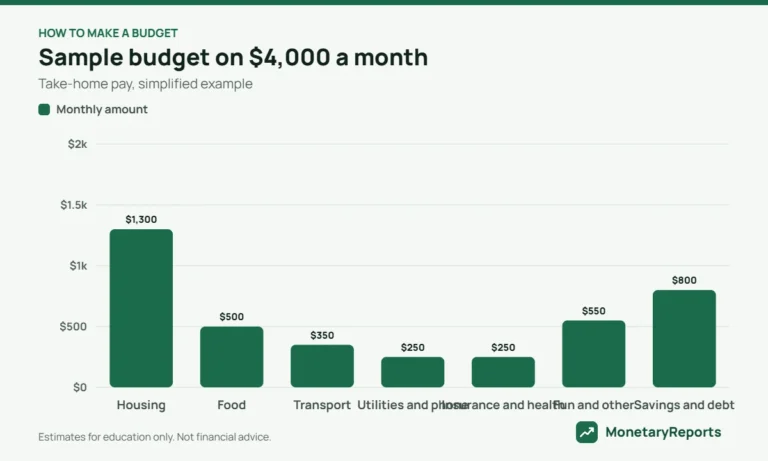
With $4,000 of monthly take-home pay, the 50/30/20 rule gives $2,000 for needs, $1,200 for wants and $800 for savings and debt, which is $9,600 a year.
What the 50/30/20 rule is
It is a simple budgeting guideline: half of your after-tax income for essentials, about a third for lifestyle and a fifth for your future. It does not track every dollar; it gives you guardrails.
50/30/20 budget calculator examples
| Take-home pay per month | Needs (50%) | Wants (30%) | Savings and debt (20%) |
|---|---|---|---|
| $3,000 | $1,500 | $900 | $600 |
| $4,000 | $2,000 | $1,200 | $800 |
| $5,000 | $2,500 | $1,500 | $1,000 |
| $6,000 | $3,000 | $1,800 | $1,200 |
What goes in each bucket
| Needs (50%) | Wants (30%) | Savings and debt (20%) |
|---|---|---|
| Rent or mortgage | Dining out | Emergency fund |
| Utilities and phone | Streaming and hobbies | Retirement contributions |
| Groceries | Travel | Extra debt payments |
| Insurance | Shopping | Other goals (house, car) |
| Minimum debt payments | Upgrades and gadgets | Sinking funds |
When to adjust the percentages
- High housing costs: needs may take 60%; trim wants first.
- Paying off high-interest debt: push savings and debt above 20% for a while.
- Big goals: early retirement or a down payment may need 30% or more savings.
- Lower income: any savings rate is a win; start small and grow it.
What this 50/30/20 budget calculator means for you
- Use take-home pay (after taxes) for the calculation.
- Automate the 20% on payday so it happens first.
- Review your split every few months.
Frequently asked questions
What is the 50/30/20 rule?
A budget guideline: 50% of take-home pay for needs, 30% for wants and 20% for savings and extra debt payments.
Is the 50/30/20 rule based on gross or net income?
On take-home (net) pay, after taxes. Retirement contributions taken from your paycheck can count toward the 20%.
What if my needs are more than 50%?
Reduce wants first, then look for savings on big needs like housing, transportation and insurance.
Do minimum debt payments count as needs?
Yes, minimum payments are usually needs; anything extra goes in the 20% bucket.
Is 20% savings enough?
It is a strong target for most people. Big goals may need more.
Related guides and calculators
Sources
This guide is for educational purposes only and is not financial advice. The figures are estimates before taxes, fees and inflation, and real rates, returns and rules change over time.