Simple Interest Calculator: Interest, Total and Time

This simple interest calculator shows how much interest you earn or pay when interest is charged only on the original amount. Enter the principal, the yearly rate and the number of years to see the total interest, the final amount and a year-by-year chart.
Quick answer
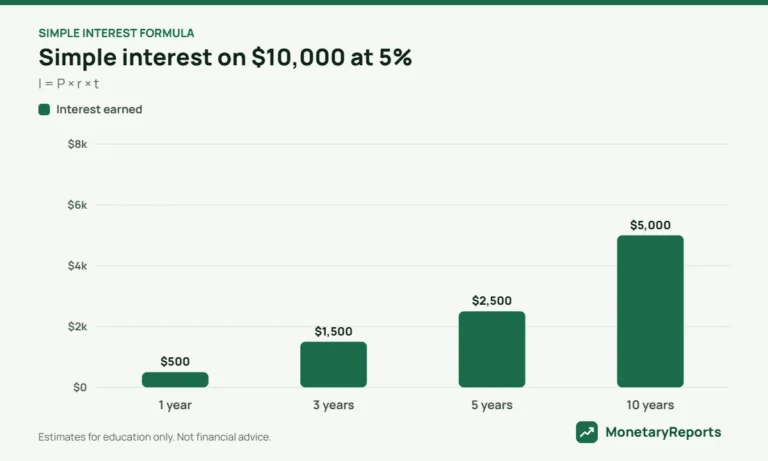
Simple interest = principal × rate × years. For example, $10,000 at 5% for 3 years earns $1,500 of simple interest ($500 a year), for a final amount of $11,500. With compound interest the same money would earn a little more, because interest would also earn interest.
How to use the simple interest calculator
- Amount (principal): the money you deposit or borrow.
- Yearly interest rate: the annual rate in percent.
- Years: how long the money is borrowed or invested. Half years work too.
- Results: total interest, final amount, interest per year and a chart.
Simple interest examples
| Principal | Rate | Years | Simple interest | Final amount |
|---|---|---|---|---|
| $1,000 | 5% | 1 | $50 | $1,050 |
| $10,000 | 5% | 3 | $1,500 | $11,500 |
| $10,000 | 5% | 5 | $2,500 | $12,500 |
| $25,000 | 7% | 4 | $7,000 | $32,000 |
Where simple interest is used
- Many auto loans and some personal loans charge simple interest on the remaining balance, often calculated daily. On a $20,000 balance at 6.5%, 30 days of interest is about $106.85.
- Some bonds and CDs pay interest out instead of adding it to the balance, which works like simple interest for you.
- Short-term loans between people or businesses are often quoted with simple interest.
Simple vs compound interest
With simple interest your balance grows by the same amount every year: a straight line. With compound interest it grows faster each year: a curve. Over 30 years, $10,000 at 5% becomes $25,000 with simple interest but about $44,677 with monthly compounding. See compound vs simple interest for the full comparison, or the simple interest formula guide for more examples.
What this means for you
- When you borrow, simple interest is usually the cheaper kind; paying early lowers the interest.
- When you save, compound interest grows faster, so compare APYs.
- For quick estimates, principal × rate × years is all you need.
Frequently asked questions
How do you calculate simple interest?
Multiply the principal by the yearly rate (as a decimal) and by the number of years: I = P × r × t. $10,000 × 0.05 × 3 = $1,500.
How do I calculate simple interest for months?
Convert months to years: 6 months is 0.5 years. $10,000 × 0.05 × 0.5 = $250.
Is simple interest better than compound interest?
For borrowers, yes, it usually costs less. For savers, compound interest earns more over time.
Do car loans use simple interest?
Many U.S. auto loans are simple interest loans, where interest is charged on the remaining balance. Check your loan agreement to be sure.
What is the simple interest formula for the final amount?
A = P × (1 + r × t). With $10,000 at 5% for 3 years, A = 10,000 × 1.15 = $11,500.
Related guides and calculators
- Simple interest formula with examples
- Compound vs simple interest
- Interest calculator (simple and compound)
- Loan payment calculator
Sources
- Investor.gov (U.S. SEC): Compound interest calculator
- Consumer Financial Protection Bureau (CFPB)
- MonetaryReports: How we calculate
This guide is for educational purposes only and is not financial advice. The figures are estimates before taxes, fees and inflation, and real rates, returns and rules change over time.