Loan Payment Calculator With Amortization Schedule
This loan payment calculator shows your monthly payment, the total interest and a full amortization schedule for any fixed-rate loan: personal loans, auto loans or other installment loans. Enter the amount, APR and term.
Quick answer
A $25,000 loan at 8% for 5 years costs about $506.91 a month and $5,415 in total interest. The payment formula is P × r ÷ (1 − (1 + r)^−n), where r is the monthly rate and n the number of payments.
In this guide
- How to use the loan payment calculator
- The loan payment formula
- Examples by loan type
- How the APR changes the payment
- How the term changes the cost
- Origination fees
- What extra payments save
- How much loan can you afford?
- Reading the amortization schedule
- Common mistakes
- Fixed vs variable, secured vs unsecured
- Checklist before you sign
- FAQ
How to use the loan payment calculator
- Loan amount: what you borrow.
- APR: the yearly rate from your loan offer.
- Loan term: the number of years.
- Open “Show the full table” to see principal, interest and the balance for each year.
The loan payment formula
Payment = P × r ÷ (1 − (1 + r)^(−n))
P is the loan amount, r the monthly rate (APR ÷ 12) and n the number of monthly payments. Example: $10,000 at 10% for 3 years gives about $322.67 a month and $1,616 of interest.
Loan payment calculator examples by loan type
Here is what the loan payment calculator shows for four common loans:
| Loan | Amount, APR and term | Monthly payment | Total interest |
|---|---|---|---|
| Personal loan | $10,000 at 12%, 3 years | $332.14 | $1,957 |
| Car loan | $30,000 at 6.5%, 5 years | $586.98 | $5,219 |
| Debt consolidation loan | $20,000 at 11%, 4 years | $516.91 | $4,812 |
| Home improvement loan | $50,000 at 9%, 10 years | $633.38 | $26,005 |
Notice the last row: a 10-year term keeps the payment low, but interest adds more than half of the amount borrowed.
How the APR changes your loan payment
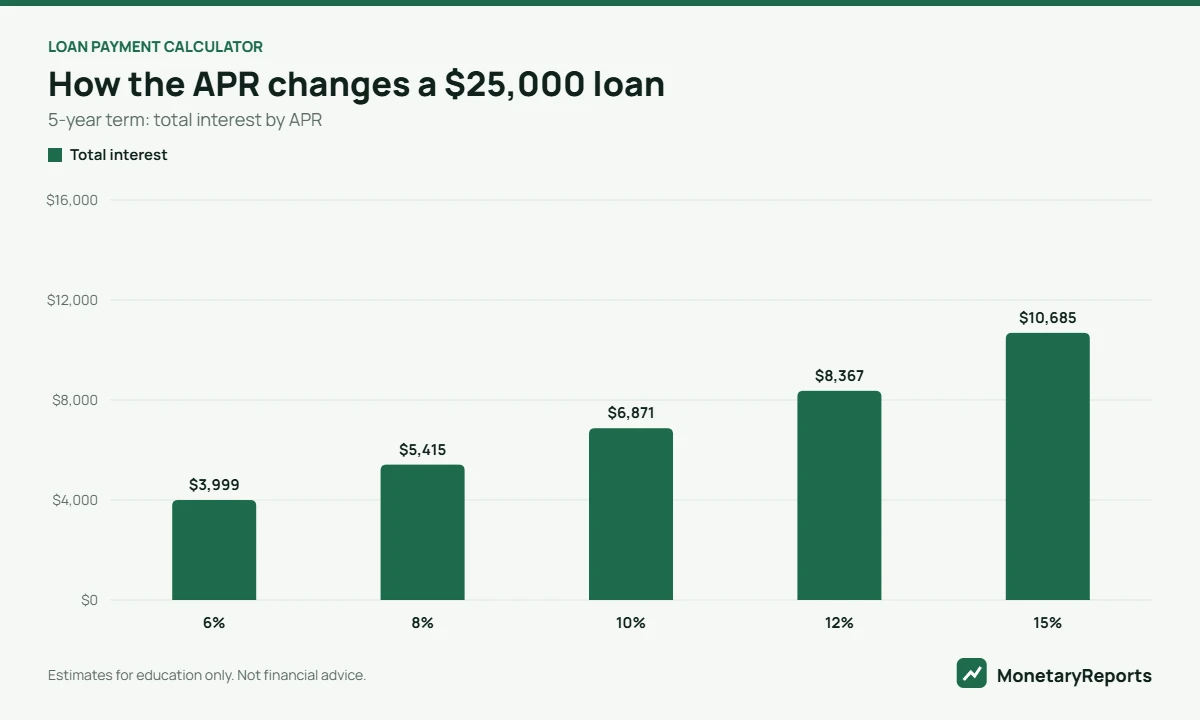
On a 5-year, $25,000 loan, every 2 points of APR adds roughly $25 a month and about $1,400 to $1,500 of interest:
| APR | Monthly payment | Total interest |
|---|---|---|
| 6% | $483.32 | $3,999 |
| 8% | $506.91 | $5,415 |
| 10% | $531.18 | $6,871 |
| 12% | $556.11 | $8,367 |
| 15% | $594.75 | $10,685 |
How the term changes the cost
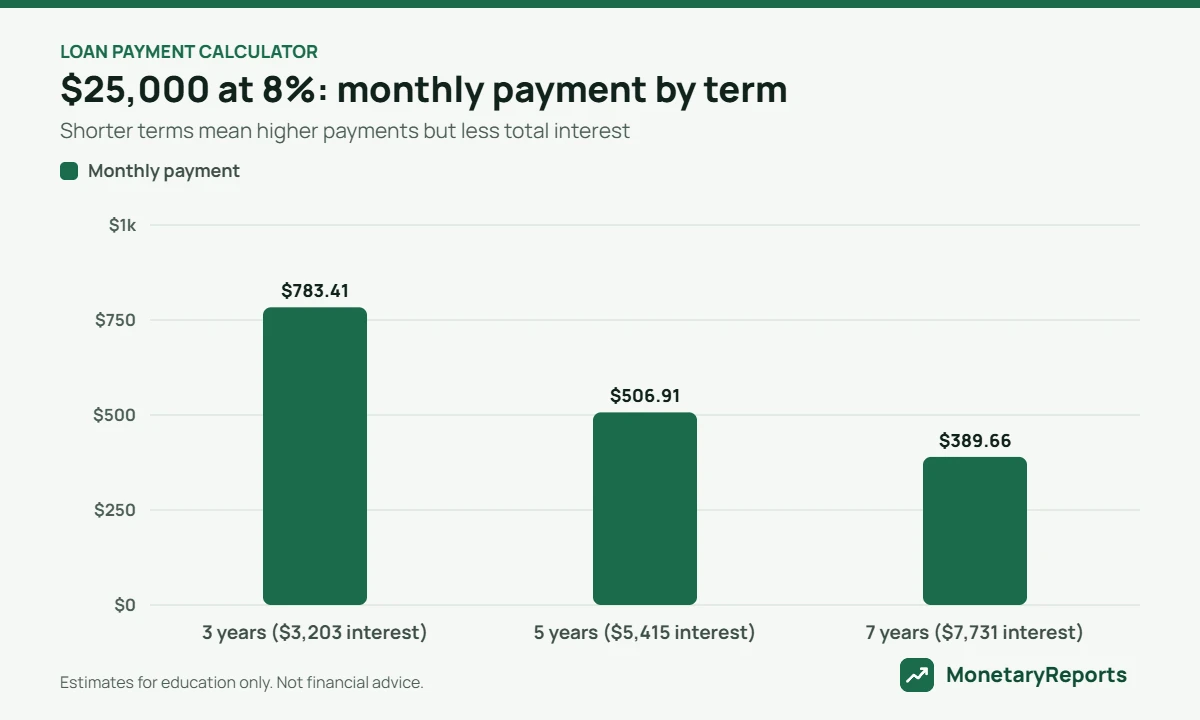
| $25,000 at 8% | Monthly payment | Total interest |
|---|---|---|
| 3 years | $783.41 | $3,203 |
| 5 years | $506.91 | $5,415 |
| 7 years | $389.66 | $7,731 |
Origination fees: why the APR is the number to compare
Many personal loans charge an origination fee that is taken out of the money you receive. Say you borrow $20,000 at a 10% interest rate for 3 years with a 5% fee. The payment is $645.34 a month, but you only receive $19,000. Measured on the money you actually get, the true cost is about 13.56% APR, not 10%.
That is why lenders must show the APR: it builds fees into one comparable number. When you use the loan payment calculator to compare offers, enter each offer’s APR, not just its interest rate.
What extra payments save
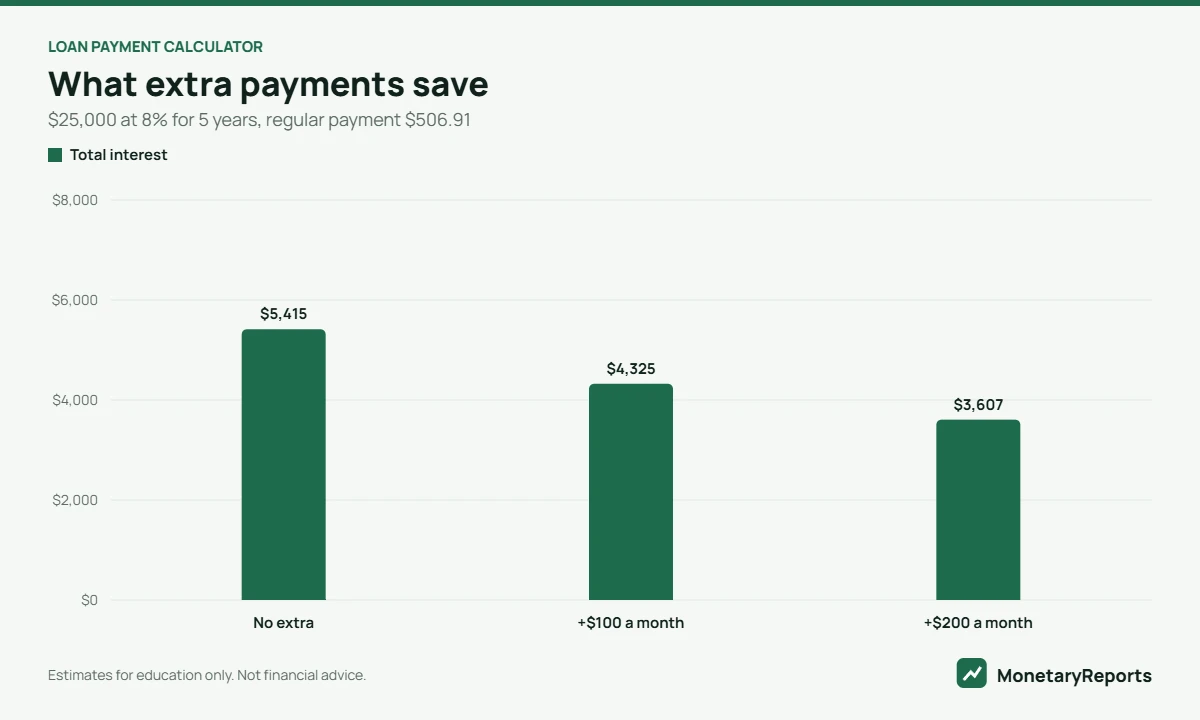
Extra payments go to principal, so they shorten the loan and cut interest. On $25,000 at 8% for 5 years:
| Monthly payment | Paid off in | Total interest |
|---|---|---|
| $506.91 (regular) | 5 years | $5,415 |
| $606.91 (+$100) | 4 years, 1 month | $4,325 |
| $706.91 (+$200) | 3 years, 5 months | $3,607 |
How much loan can you afford?
You can also run the loan payment calculator in reverse. If $400 a month is the most you want to pay, at 8% for 5 years that supports a loan of about $19,727. Try different terms and rates until the payment fits your budget with room to spare.
Reading the amortization schedule
Each payment covers that month’s interest first; the rest reduces the balance. Early payments are mostly interest, later ones mostly principal. Paying extra early saves the most. See amortization explained with a simple table.
What this loan payment calculator means for you
- Compare offers by APR and total interest, not only the monthly payment.
- Choose the shortest term with a payment you can comfortably afford.
- Check for prepayment penalties before paying extra.
Common mistakes when comparing loan payments
- Choosing the lowest monthly payment. It usually means the longest term and the most interest.
- Comparing interest rates instead of APRs. Fees can make a lower rate more expensive.
- Borrowing the maximum you are approved for. Approval is not the same as affordable.
- Not checking for prepayment penalties. They can cancel out the benefit of paying early.
- Forgetting the loan is fixed. If your income may drop, a slightly longer term with voluntary extra payments gives you flexibility.
Fixed vs variable, secured vs unsecured
The loan payment calculator assumes a fixed rate, which is what most personal and auto loans use. Two other differences change how much you pay:
| Type | How it works | Pros | Cons |
|---|---|---|---|
| Fixed rate | Same APR and payment for the whole term | Predictable budget | Usually starts a little higher than variable |
| Variable rate | APR moves with a benchmark rate | Can start lower | Payment can rise; the calculator result is only a snapshot |
| Secured loan | Backed by an asset such as a car or home | Often a lower APR | You can lose the asset if you stop paying |
| Unsecured loan | Based on your credit and income only | No collateral at risk | Higher APR, stricter approval |
What this means for you: if you take a variable-rate loan, run the loan payment calculator a second time with the rate 2 or 3 points higher. If that payment would still fit your budget, the risk is manageable.
Loan payment checklist before you sign
- Run the loan payment calculator with the exact APR, amount and term from each offer.
- Write down the total interest for each one, not just the monthly payment.
- Check for origination fees, late fees and prepayment penalties.
- Make sure the payment leaves room for savings and an emergency fund.
- Choose the shortest term you can comfortably afford, and pay extra when you can.
Frequently asked questions
How is a loan payment calculated?
With the amortization formula P × r ÷ (1 − (1 + r)^−n), using the monthly rate and the number of payments.
How much is a $25,000 loan payment?
About $506.91 a month at 8% for 5 years.
Does a longer term save money?
No. It lowers the monthly payment but increases total interest.
Can I pay off a loan early?
Usually yes; many loans have no prepayment penalty, but check your agreement.
Is APR the same as the interest rate?
APR can include certain fees, so it is a better number for comparing loan offers.
What is the monthly payment on a $10,000 loan?
It depends on the APR and term. At 12% for 3 years it is about $332.14; at 8% for 5 years it is about $202.76. Enter your own numbers in the loan payment calculator above.
Does the loan payment calculator include fees?
It uses the APR you enter. If your loan has an origination fee, use the APR from your loan disclosure, which already includes it, to compare offers fairly.
Related guides and calculators
- Amortization explained
- Car loan calculator
- Student loan payoff calculator
- Simple interest calculator
Sources
- Consumer Financial Protection Bureau (CFPB)
- Federal Reserve: Consumer credit (G.19)
- MonetaryReports: How we calculate
This guide is for educational purposes only and is not financial advice. The figures are estimates before taxes, fees and inflation, and real rates, returns and rules change over time.