Debt Snowball vs Avalanche Calculator: Which Plan Saves More?

Should you pay off your smallest debt first or your highest-rate debt first? This debt snowball vs avalanche calculator runs both methods on up to three debts and shows how much interest each one costs and how long it takes to be debt-free.
Quick answer
With three example debts ($2,500 at 9%, $6,000 at 26% and $11,000 at 18%) and $250 a month extra, the avalanche method costs about $6,091 in interest and the snowball method about $6,824. Avalanche saves about $733 here, and is debt-free about a month sooner.
How to use the debt snowball vs avalanche calculator
- Enter the balance, APR and minimum payment of up to three debts (set unused ones to $0).
- Enter the extra amount you can pay each month on top of all minimums.
- Compare total interest and time to debt-free for both methods.
The two methods
| Debt avalanche | Debt snowball | |
|---|---|---|
| Order | Highest APR first | Smallest balance first |
| Saves the most interest? | Yes, usually | No |
| Quick wins | Fewer at first | Yes, small debts disappear fast |
| Best for | Saving money | Staying motivated |
Month by month: when each debt disappears
The debt snowball vs avalanche calculator does not just compare totals; the order of payoffs is very different. With the example debts and $250 a month extra:
| Debt | Snowball: paid off in | Avalanche: paid off in |
|---|---|---|
| $2,500 at 9% | Month 8 | Month 37 |
| $6,000 at 26% | Month 23 | Month 19 |
| $11,000 at 18% | Month 38 | Month 37 |

The snowball gives you a win in month 8. The avalanche makes you wait 19 months for the first debt to disappear, but by then the most expensive balance is gone, which is why it ends up cheaper.
How the extra payment changes the result
| Extra each month | Snowball: time | Snowball: interest | Avalanche: time | Avalanche: interest |
|---|---|---|---|---|
| $0 (minimums only) | 6 years, 7 months | $15,653 | 6 years, 7 months | $15,653 |
| $100 | 4 years, 7 months | $10,249 | 4 years, 6 months | $9,406 |
| $250 | 3 years, 2 months | $6,824 | 3 years, 1 month | $6,091 |
| $500 | 2 years, 2 months | $4,449 | 2 years, 1 month | $3,920 |
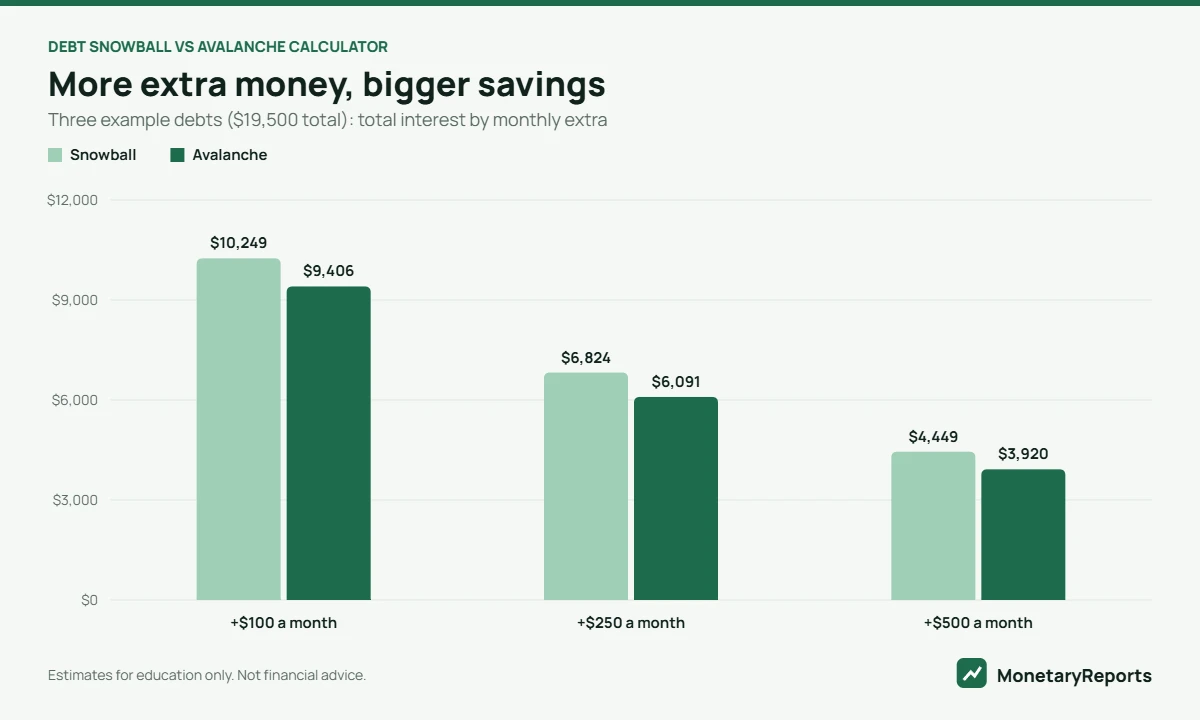
What this means for you: going from $100 to $250 extra saves more than $3,000 with either method, while choosing avalanche over snowball saves about $500 to $850. Find the extra money first, then settle snowball vs avalanche.
Which one should you choose?
Mathematically, the avalanche usually wins because the most expensive debt shrinks first. But the snowball’s quick wins keep many people going, and the best plan is the one you will stick with. If the difference is small in your numbers, pick the method that motivates you. Read the full comparison in debt snowball vs avalanche.
What the debt snowball vs avalanche calculator means for you
- Always pay every minimum; extra money goes to one target debt at a time.
- When a debt is paid off, roll its payment into the next one.
- Stop adding new debt while you pay down the old.
When the two methods give the same answer
In a snowball vs avalanche comparison, the gap depends on how your balances and rates line up:
- Smallest debt also has the highest rate ($3,000 at 24%, $7,000 at 20%, $9,000 at 19%, $250 extra): both methods pick the same order, so the result is identical: 3 years and 4 months and $6,855 of interest.
- Rates are close together: the difference is usually small, so the snowball’s quick wins cost very little.
- One debt has a much higher rate than the rest: the avalanche pulls ahead, as in the main example where the 26% card drives the gap.
Some people use a hybrid: clear one tiny balance first for a quick win, then switch to highest rate first. Run both orders in the debt snowball vs avalanche calculator and compare.
Common mistakes with either method
- Splitting the extra money across all debts. Both methods work because the extra goes to one target at a time.
- Not rolling payments forward. When a debt is paid off, its whole payment must move to the next one, or the plan slows down.
- Using the cards again. New charges undo the progress the calculator shows.
- Skipping a minimum. Late fees and penalty rates can wipe out the savings.
- Ignoring promo rates. A 0% balance that jumps to 25% later should be ranked by the rate it will have.
Frequently asked questions
Is the debt avalanche or snowball better?
The avalanche usually saves more interest; the snowball may help you stay motivated. Both work if you keep going.
What if two debts have similar APRs?
Then paying the smaller balance first (snowball) costs almost nothing extra and gives a quick win.
Should I include my mortgage?
Most people focus on high-interest consumer debt and keep paying the mortgage normally.
What if I cannot pay the minimums?
Contact your lenders early, and consider a nonprofit credit counselor. The CFPB has guides on getting help with debt.
How much extra should I pay?
Any amount helps. Even $50 a month extra can shorten the timeline and reduce interest.
Does the debt snowball vs avalanche calculator work for loans and cards together?
Yes. Enter any debt with a balance, an APR and a minimum payment: credit cards, personal loans, car loans or student loans.
How much does the avalanche usually save?
It depends on the gap between your rates. In the example here it saves $529 to $843 depending on the extra payment. When rates are close, the difference can be close to zero.
Related guides and calculators
- Debt snowball vs debt avalanche
- Credit card payoff calculator
- How to pay off $20,000 of debt in 2 years
- Pay off debt or save first?
Sources
- Consumer Financial Protection Bureau (CFPB)
- Federal Reserve: Consumer credit (G.19)
- MonetaryReports: How we calculate
This guide is for educational purposes only and is not financial advice. The figures are estimates before taxes, fees and inflation, and real rates, returns and rules change over time.