How Credit Card Interest Is Calculated (Daily APR Explained)

Ever wondered how credit card interest is calculated? Most U.S. cards use a daily rate on your average daily balance, and they only charge interest if you carry a balance past the due date. Understanding the math makes it obvious why paying in full is so powerful.
Quick answer
Most cards multiply your average daily balance by the daily periodic rate (APR ÷ 365) and by the days in the billing cycle. With a $1,000 average balance at 24% APR over 30 days: 1,000 × 0.24 ÷ 365 × 30 ≈ $19.73. Pay the full statement balance by the due date and you usually pay no interest on purchases.
How credit card interest is calculated, step by step
- Daily periodic rate: APR ÷ 365 (some issuers use 360). 24% ÷ 365 ≈ 0.0658% a day.
- Average daily balance: add up your balance at the end of each day in the cycle and divide by the number of days.
- Interest for the cycle: average daily balance × daily rate × days in the cycle.
- Compounding: many issuers include unpaid interest in the daily balance, so interest is charged on interest.
Interest = average daily balance × (APR ÷ 365) × days in cycle
A full billing cycle, step by step
Real balances change during the month. Here is how credit card interest is calculated when you make a purchase and a payment in the same 30-day cycle at 24% APR:
| Days | What happens | Balance each day |
|---|---|---|
| 1–10 | Start of the cycle | $1,200 |
| 11–20 | You buy something for $300 | $1,500 |
| 21–30 | You pay $500 | $1,000 |
- Add up the daily balances: (10 × $1,200) + (10 × $1,500) + (10 × $1,000) = $37,000.
- Divide by the 30 days: average daily balance = $1,233.33.
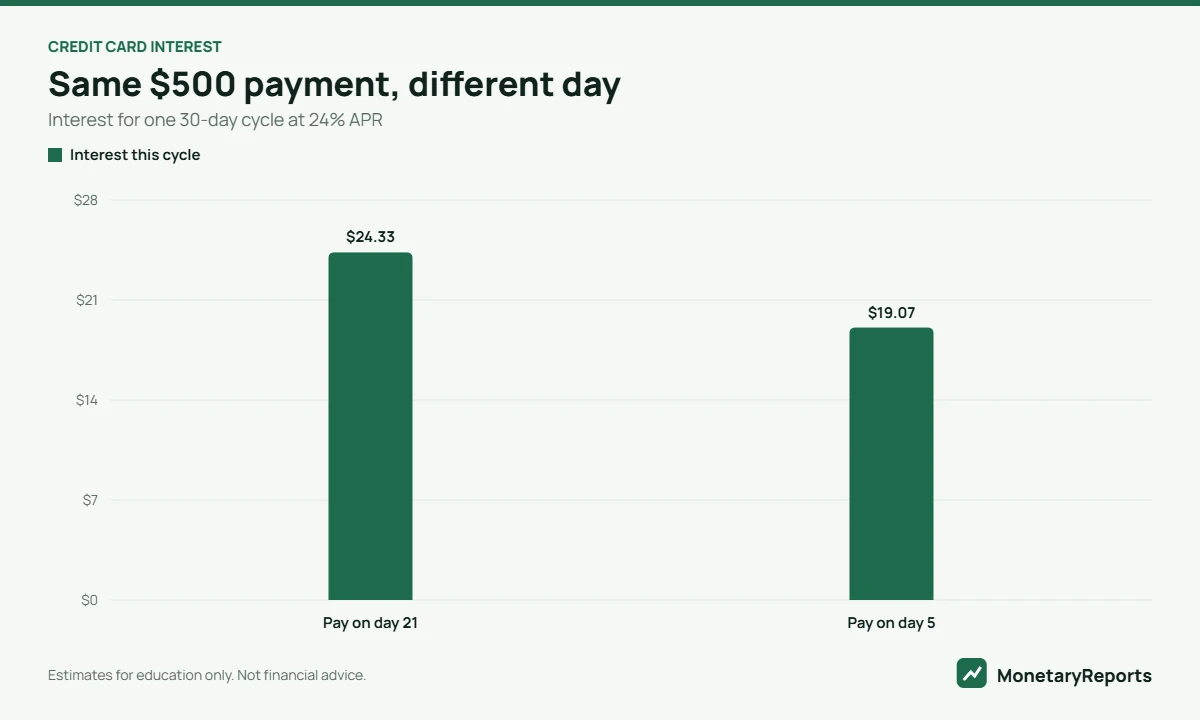
- Multiply by the daily rate and the days: $1,233.33 × (0.24 ÷ 365) × 30 = $24.33 of credit card interest.
Now move the same $500 payment to day 5. The balance drops sooner, the average daily balance falls to $966.67 and the interest falls to $19.07. Same payment, same card, $5.26 less interest, just because the money arrived earlier.
The grace period
If you pay your full statement balance by the due date, most cards give you a grace period: no interest on new purchases. Once you carry a balance, you usually lose the grace period until you pay in full again. Cash advances typically have no grace period and a higher APR.
Purchase APR, cash advance APR and penalty APR
One card can have several rates. Each balance is calculated the same way, but with its own APR and rules:
| Rate | When it applies | Grace period? |
|---|---|---|
| Purchase APR | Everyday purchases you do not pay off by the due date | Usually yes, if you pay in full |
| Cash advance APR | ATM withdrawals and cash-like transactions; often higher than the purchase APR | Usually no: interest starts the same day |
| Penalty APR | Can apply after a late payment; on existing balances, only once you are 60 days late | No |
| Intro 0% APR | Promotional rate on purchases or balance transfers; by law it must last at least 6 months | Not needed while 0% |
Cash advance example: take $500 from an ATM with a 5% fee and a 29% cash advance APR. You pay a $25 fee on day one, plus about $11.92 of interest over 30 days, even if you repay it with your next statement.
Examples by balance
| Average daily balance | Interest for 30 days at 24% APR | Per year if the balance stayed |
|---|---|---|
| $500 | $9.86 | about $120 |
| $1,000 | $19.73 | about $240 |
| $2,500 | $49.32 | about $600 |
| $5,000 | $98.63 | about $1,200 |
Over a full year the numbers add up fast. Because credit card interest is calculated daily and added to the balance, a $5,000 balance that is never paid down costs more than the APR suggests:

Why the real rate is higher than the APR
Because interest is calculated daily and added to the balance, a 24% APR works out to about 27% a year if you never pay it down. See APY vs APR for the full explanation.
What this means for you
- Paying the full statement balance each month avoids interest on purchases.
- If you carry a balance, pay as early and as much as you can; it lowers the average daily balance.
- Credit card APRs are often above 20%; check the Federal Reserve data for the current average.
How to pay less credit card interest
- Pay the full statement balance by the due date. This keeps the grace period, so purchases cost nothing.
- Pay early, or twice a month. As the example above shows, earlier payments lower the average daily balance.
- Pay before the statement closing date if you want a lower balance reported and less interest next cycle.
- Avoid cash advances. They start charging on day one and usually add a fee.
- Ask for a lower APR. If you have paid on time for a year, a short call to your issuer sometimes works.
- Move the balance to a 0% offer only if you can pay it off before the promo ends. See is a balance transfer worth it?
Common mistakes
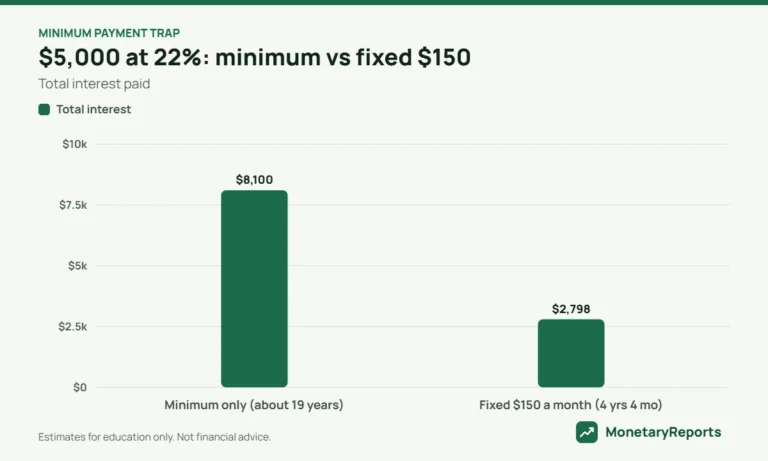
- Paying the minimum and thinking you are safe. You avoid late fees, but credit card interest keeps building on everything else. See the minimum payment trap.
- Mixing up the statement balance and the current balance. Paying the statement balance in full is what keeps the grace period.
- Paying a day late. You may lose the grace period, pay a late fee and, after 60 days, face a penalty APR.
- Forgetting the promo end date. When a 0% offer ends, any remaining balance starts at the regular APR.
Frequently asked questions
How is credit card interest calculated?
Usually with a daily rate (APR ÷ 365) applied to your average daily balance for each day of the billing cycle.
Do I pay interest if I pay the full balance?
Usually not on purchases, thanks to the grace period, as long as you pay the full statement balance by the due date.
Why do I still owe interest after paying in full?
This is sometimes called trailing or residual interest: interest that built up between your statement date and the day your payment arrived.
Is credit card interest compounded daily?
Many issuers effectively compound daily by including unpaid interest in the daily balance.
What is a daily periodic rate?
The APR divided by 365 (or 360), the rate charged for one day.
How much interest will I pay on $3,000 at 25% APR?
About $61.64 for a 30-day cycle if the average daily balance stays at $3,000: 3,000 × (0.25 ÷ 365) × 30. Over a year, with daily compounding and no payments, it would be roughly $850.
Does paying twice a month lower credit card interest?
Yes, if you carry a balance. Credit card interest is calculated on the average daily balance, so any payment that arrives earlier lowers it.
Is credit card interest calculated on the statement balance?
No. It is calculated on the average daily balance during the billing cycle, which can be higher or lower than the statement balance.
Related guides and calculators
Sources
- Federal Reserve: Consumer credit (G.19)
- CFPB: Credit cards
- CFPB: What is a grace period for a credit card?
- MonetaryReports: How we calculate
This guide is for educational purposes only and is not financial advice. The figures are estimates before taxes, fees and inflation, and real rates, returns and rules change over time.