APY vs APR: What’s the Difference and Which Matters?

APY vs APR: both describe a yearly interest rate, but they are not the same. APR is the simple yearly rate; APY includes the effect of compounding. Banks show the APY when they pay you interest and the APR when they charge you interest. Knowing the difference helps you compare savings accounts and loans correctly.
Quick answer
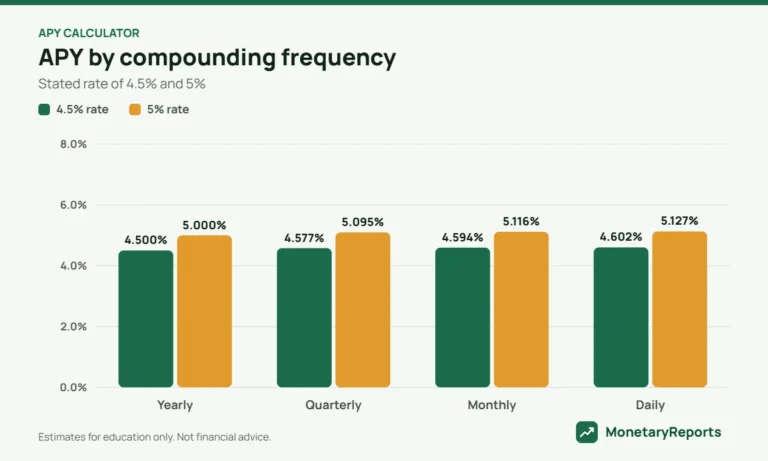
APR (annual percentage rate) is the yearly rate without compounding. APY (annual percentage yield) includes compounding, so it shows the real yearly result. A 24% credit card APR compounded daily works out to about 27.11% a year; a 4.5% savings rate compounded daily is about 4.602% APY.
APY vs APR in one table
| APR | APY | |
|---|---|---|
| Includes compounding? | No | Yes |
| Usually shown on | Loans, credit cards, mortgages | Savings accounts, CDs, money market accounts |
| Which is higher? | Lower (same rate) | Higher, unless compounding is yearly |
| Best use | Compare the cost of loans | Compare what deposits earn |
How to convert APR to APY
APY = (1 + APR ÷ n)^n − 1
n is the number of compounding periods per year (365 for daily, 12 for monthly). Example: (1 + 0.24 ÷ 365)^365 − 1 ≈ 27.11%. Use the APY calculator to do it instantly.
APY for savers
When you save, a higher APY is better. Because APY already includes compounding, you can compare a daily-compounding account with a monthly-compounding CD directly. For example, 4.9% compounded daily (about 5.02% APY) beats 5% compounded yearly (5.00% APY).
APR for borrowers
On loans, the APR also includes certain fees, which makes it more useful than the interest rate alone when comparing offers, especially mortgages. On credit cards, the APR is converted into a daily periodic rate (APR ÷ 365) and charged on your balance, so carrying a balance costs a bit more than the APR suggests.
What APY vs APR means for you
- Saving? Compare APYs.
- Borrowing? Compare APRs, and remember that daily compounding adds a little extra.
- Paying your credit card in full each month avoids interest altogether in most cases.
Frequently asked questions
Is APY or APR better?
Neither is better; they measure different things. APY is best for comparing savings, APR for comparing loans.
Why is APY higher than APR?
Because APY includes interest earned on interest during the year. The more often interest compounds, the bigger the gap.
Do credit cards compound interest?
Most U.S. credit cards calculate interest daily on the unpaid balance, which effectively compounds it.
Is the APR on a mortgage the same as the interest rate?
No. The mortgage APR includes the interest rate plus certain fees, so it is usually a bit higher than the rate.
What is a good APY on savings?
It changes with the economy. Compare offers with the FDIC national average; high-yield accounts often pay several times the average.
Related guides and calculators
- APY calculator
- How credit card interest is calculated
- Daily vs monthly vs annual compounding
- High-yield savings account calculator
Sources
- Consumer Financial Protection Bureau (CFPB)
- FDIC: National rates and rate caps
- Federal Reserve: Consumer credit (G.19)
- MonetaryReports: How we calculate
This guide is for educational purposes only and is not financial advice. The figures are estimates before taxes, fees and inflation, and real rates, returns and rules change over time.