CD Ladder: How It Works (Step-by-Step Example)
A CD ladder splits your savings across several CDs with different maturity dates. Instead of locking everything for 5 years, part of your money becomes available every year, while most of it still earns longer-term CD rates. It is a simple way to balance yield and access.
Quick answer
To build a CD ladder, divide your money into equal parts and open CDs with staggered terms, for example 1, 2, 3, 4 and 5 years. Each year one CD matures; you either use the money or reinvest it in a new 5-year CD. With $20,000, that is five CDs of $4,000.
How a CD ladder works
- Split your money into equal parts (the “rungs”).
- Buy CDs with different terms: 1, 2, 3, 4 and 5 years.
- When the 1-year CD matures, reinvest it in a new 5-year CD (or use the money).
- After 4 years, every rung is a 5-year CD, and one matures every year.
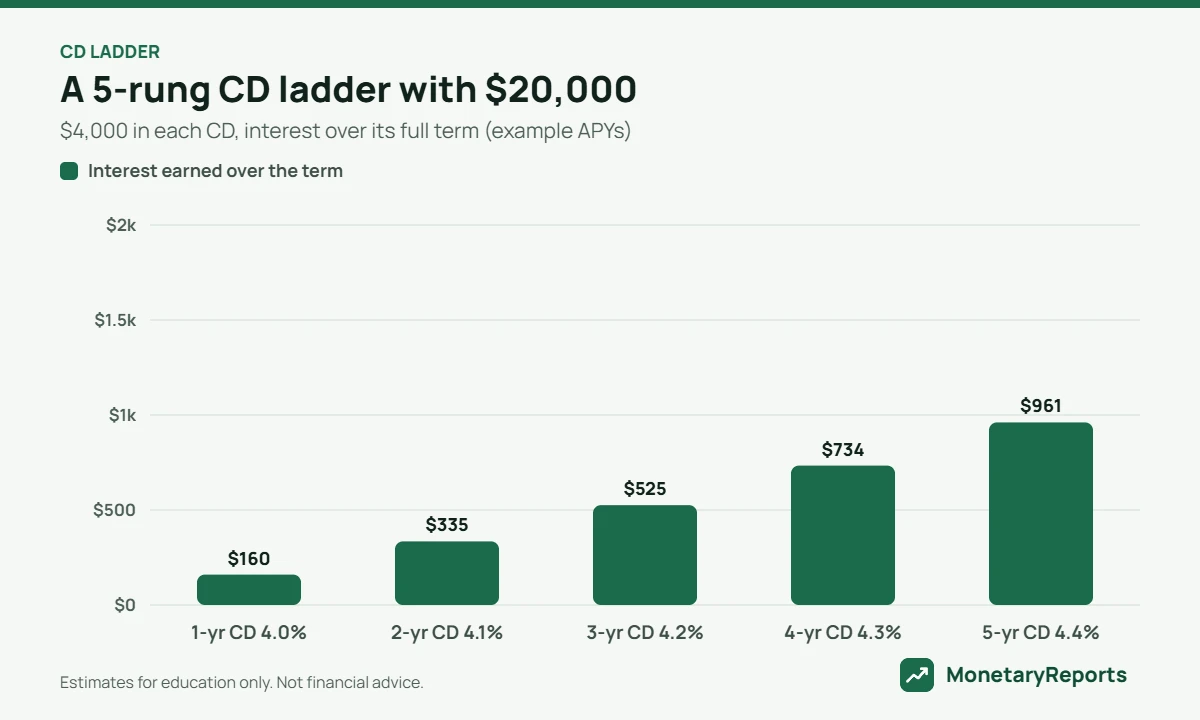
CD ladder example with $20,000
| Rung | Amount | Term | Example APY | Interest over the term |
|---|---|---|---|---|
| 1 | $4,000 | 1 year | 4.0% | $160.00 |
| 2 | $4,000 | 2 years | 4.1% | $334.72 |
| 3 | $4,000 | 3 years | 4.2% | $525.46 |
| 4 | $4,000 | 4 years | 4.3% | $733.66 |
| 5 | $4,000 | 5 years | 4.4% | $960.92 |
Pros and cons of a CD ladder
| Pros | Cons |
|---|---|
| Regular access: one CD matures every year | Less flexible than a savings account |
| Locks part of your money at longer-term rates | Penalties if you need money between maturities |
| Reduces the risk of locking everything at a bad time | Needs a little tracking |
| Insured at FDIC/NCUA institutions | Interest is taxable each year |
Other ladder shapes
- Short ladder: 3, 6, 9 and 12-month CDs, for money you need within a year.
- Barbell: part in very short CDs, part in long CDs, nothing in the middle.
- Treasury ladder: the same idea with Treasury bills or notes, whose interest is exempt from state income tax.
What a CD ladder means for you
- It is great for savings beyond your emergency fund that you want to keep safe.
- Keep your emergency fund in high-yield savings, not in the ladder.
- Set calendar reminders for each maturity date so CDs do not renew automatically at a low rate.
Frequently asked questions
What is a CD ladder?
A set of CDs with staggered maturity dates, so part of your money becomes available at regular intervals.
How much money do I need for a CD ladder?
Many banks have low minimums, so you can start with a few thousand dollars. The example above uses $20,000.
Is a CD ladder a good idea?
It can be for savings you want to keep safe while earning more than a regular savings account, especially if you are unsure where rates will go.
What happens when a CD in the ladder matures?
You can withdraw the money or reinvest it in a new long-term CD to keep the ladder going.
Can I build a CD ladder at different banks?
Yes. Spreading CDs across banks can also help you stay within insurance limits if you have large balances.
Related guides and calculators
- CD calculator
- CD vs high-yield savings account
- Treasury bills vs CDs vs savings accounts
- How much interest does $50,000 earn in a CD?
Sources
- FDIC: National rates and rate caps
- FDIC: Deposit insurance
- TreasuryDirect: Treasury bills
- MonetaryReports: How we calculate
This guide is for educational purposes only and is not financial advice. The figures are estimates before taxes, fees and inflation, and real rates, returns and rules change over time.