Is Savings Account Interest Taxable? (1099-INT Explained)
Is interest on savings taxable? In most cases, yes. Interest from savings accounts, CDs and money market accounts is taxed as ordinary income in the U.S. This beginner’s guide explains how it works, which forms you receive and the accounts where interest can grow tax-deferred or tax-free.
Quick answer
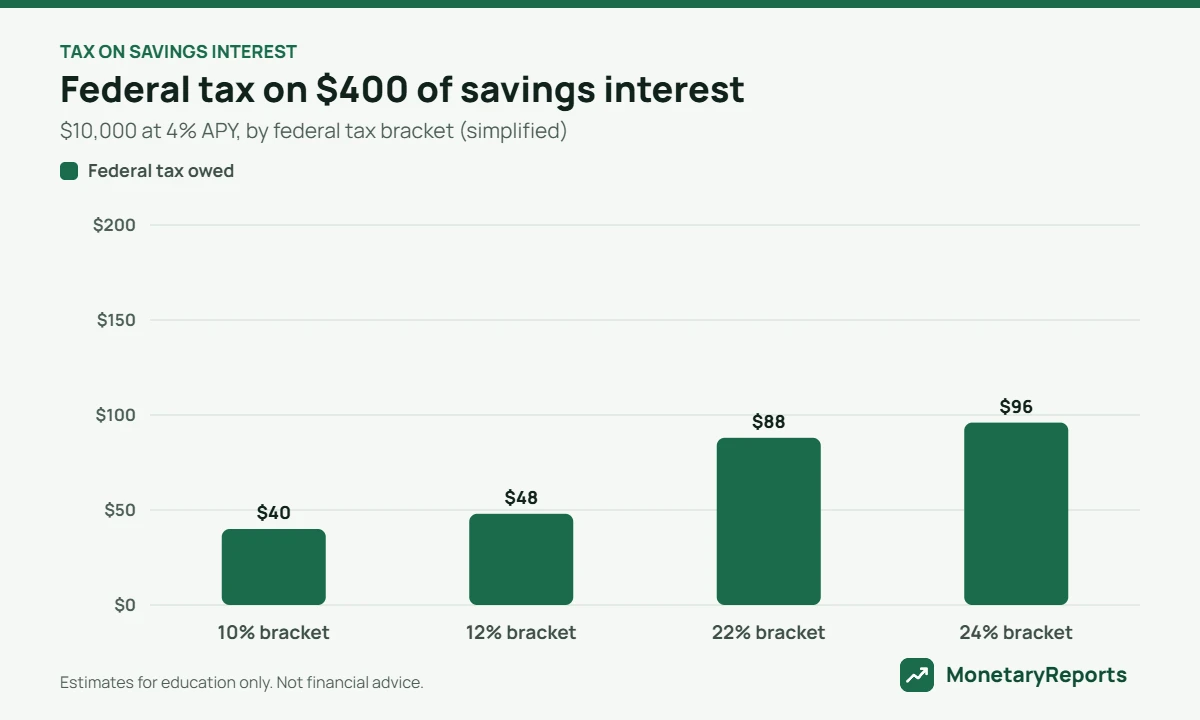
Yes, interest on savings is generally taxable as ordinary income at your federal tax rate, and usually by your state too. Banks send Form 1099-INT when you earn $10 or more. On $400 of interest in the 22% bracket, that is about $88 of federal tax.
Is interest on savings taxable? How it works
- Interest is added to your other income and taxed at your ordinary income tax rate.
- It is taxable in the year it is credited to your account, even if you do not withdraw it.
- Most states also tax interest; Treasury interest is the main exception at the state level.
- You must report all taxable interest, even if you do not receive a 1099-INT.
Form 1099-INT
Banks and credit unions usually send Form 1099-INT early in the year when you earned at least $10 of interest. The form shows the interest paid during the previous year, and the IRS receives a copy too.
Example: tax on $400 of interest
| Federal bracket | Federal tax on $400 | Interest kept (before state tax) |
|---|---|---|
| 10% | $40 | $360 |
| 12% | $48 | $352 |
| 22% | $88 | $312 |
| 24% | $96 | $304 |
Where interest can grow tax-free or tax-deferred
- Traditional IRA and 401(k): taxes are deferred until you withdraw.
- Roth IRA: qualified withdrawals can be tax-free.
- Health Savings Account (HSA): tax-advantaged when used for qualified medical expenses.
- Treasury bills and bonds: taxed federally but exempt from state and local income tax.
- Municipal bonds: interest is often exempt from federal tax.
What this means for you
- Plan for taxes when comparing savings options; after-tax returns are what you keep.
- Keep your 1099-INT forms with your tax documents.
- This is general information; for your situation, check IRS guidance or a tax professional.
Frequently asked questions
Is interest on a savings account taxable?
Yes, generally as ordinary income, federally and usually at the state level.
Do I pay tax on interest if I earn less than $10?
Banks may not send a 1099-INT under $10, but the interest is still taxable income and should be reported.
Is CD interest taxed every year?
Usually yes, in the year it is credited, even if the CD has not matured.
Is interest on Treasury bills taxable?
Yes for federal tax, but it is exempt from state and local income taxes.
How can I reduce tax on interest?
Use tax-advantaged accounts where possible, consider Treasury securities in high-tax states, and keep only the cash you need in taxable accounts.
Related guides and calculators
- Treasury bills vs CDs vs savings accounts
- How much interest will $10,000 earn?
- Roth IRA vs traditional IRA
- High-yield savings account calculator
Sources
- IRS: Topic 403, Interest received
- IRS: About Form 1099-INT
- TreasuryDirect: Treasury bills
- MonetaryReports: How we calculate
This guide is for educational purposes only and is not financial advice. The figures are estimates before taxes, fees and inflation, and real rates, returns and rules change over time.