Credit Card Payoff Calculator: How Long to Be Debt-Free
This credit card payoff calculator shows how long it will take to pay off your card and how much interest you will pay. Enter your balance, APR and monthly payment, and compare what happens if you pay more.
Quick answer
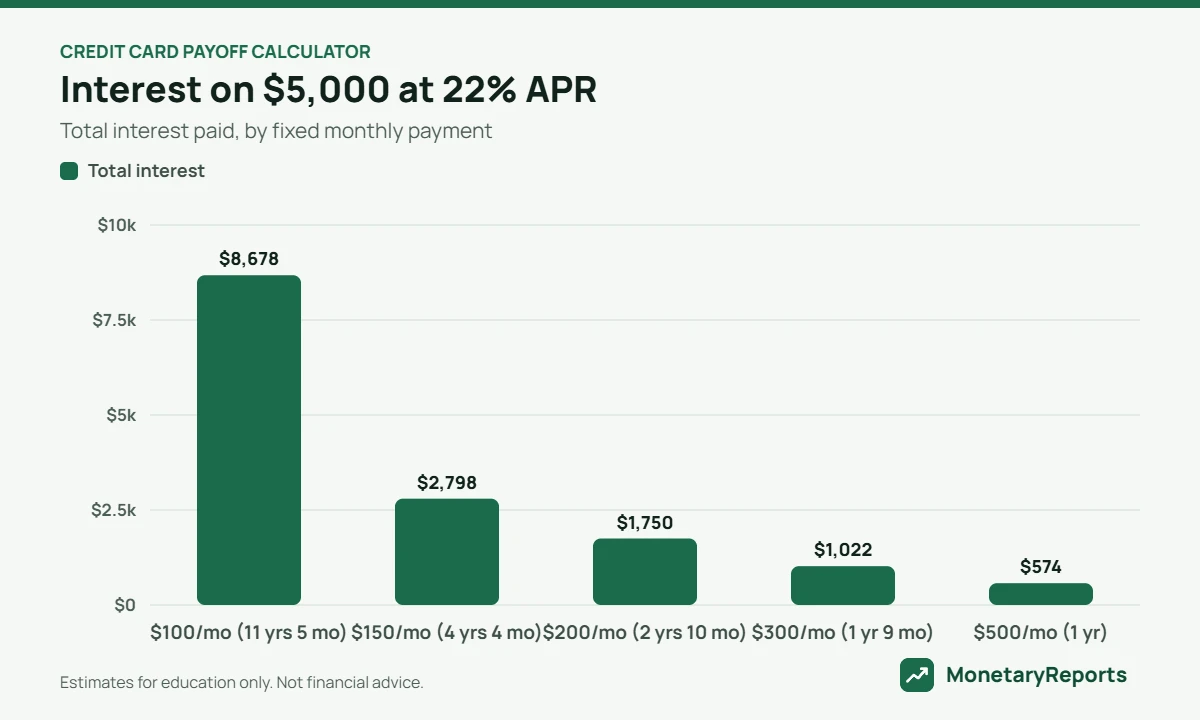
Paying $200 a month on a $5,000 balance at 22% APR takes about 2 years and 10 months and costs about $1,750 in interest. Paying only $100 a month stretches it to over 11 years and about $8,678 of interest.
How to use the credit card payoff calculator
- Card balance: what you owe today.
- APR: the interest rate on your statement.
- Monthly payment: a fixed amount you will pay every month (no new purchases).
How your payment changes everything
| Monthly payment | Time to pay off | Total interest |
|---|---|---|
| $100 | 11 years, 5 months | $8,678 |
| $150 | 4 years, 4 months | $2,798 |
| $200 | 2 years, 10 months | $1,750 |
| $300 | 1 year, 9 months | $1,022 |
| $500 | 1 year | $574 |
Pick a payoff date, then find the payment
You can also use the credit card payoff calculator backwards: choose when you want to be debt-free and adjust the payment until the date matches. For $5,000 at 22% APR:
| Debt-free in | Monthly payment | Total interest |
|---|---|---|
| 1 year | $467.97 | $616 |
| 2 years | $259.39 | $1,225 |
| 3 years | $190.95 | $1,874 |
| 4 years | $157.53 | $2,561 |
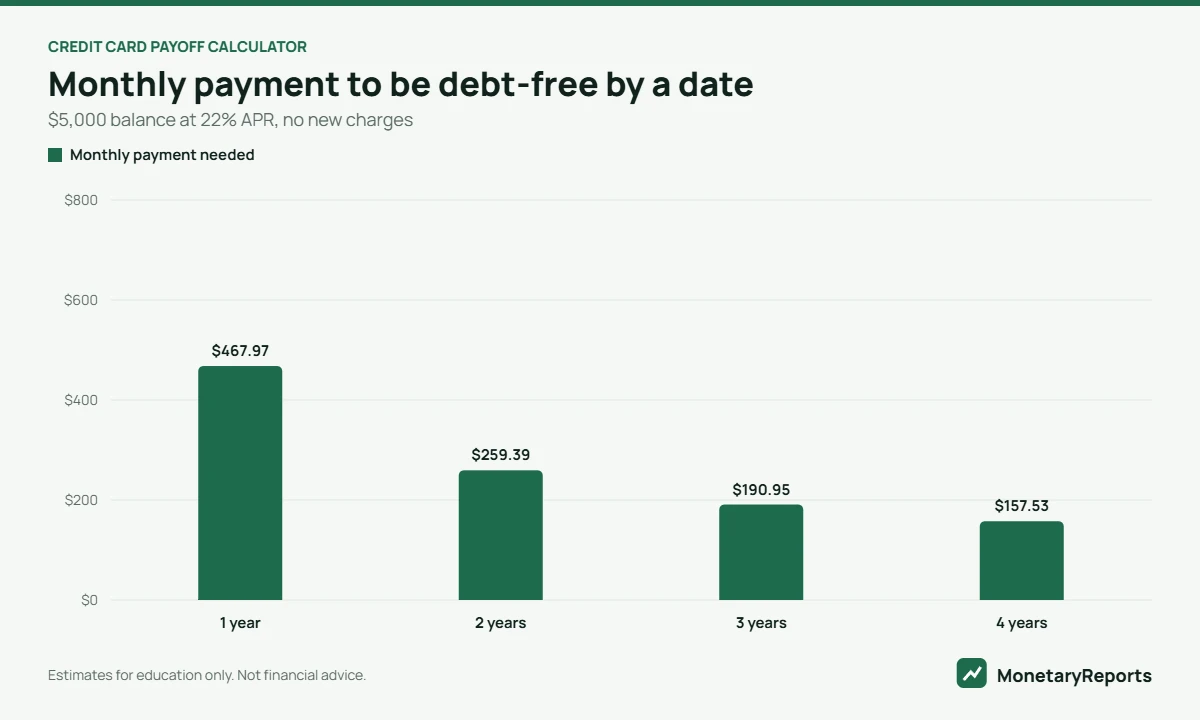
A 3-year target is a useful benchmark: card statements show a similar figure in the minimum payment warning box. If that payment fits your budget, it is a realistic plan.
How the APR changes your payoff
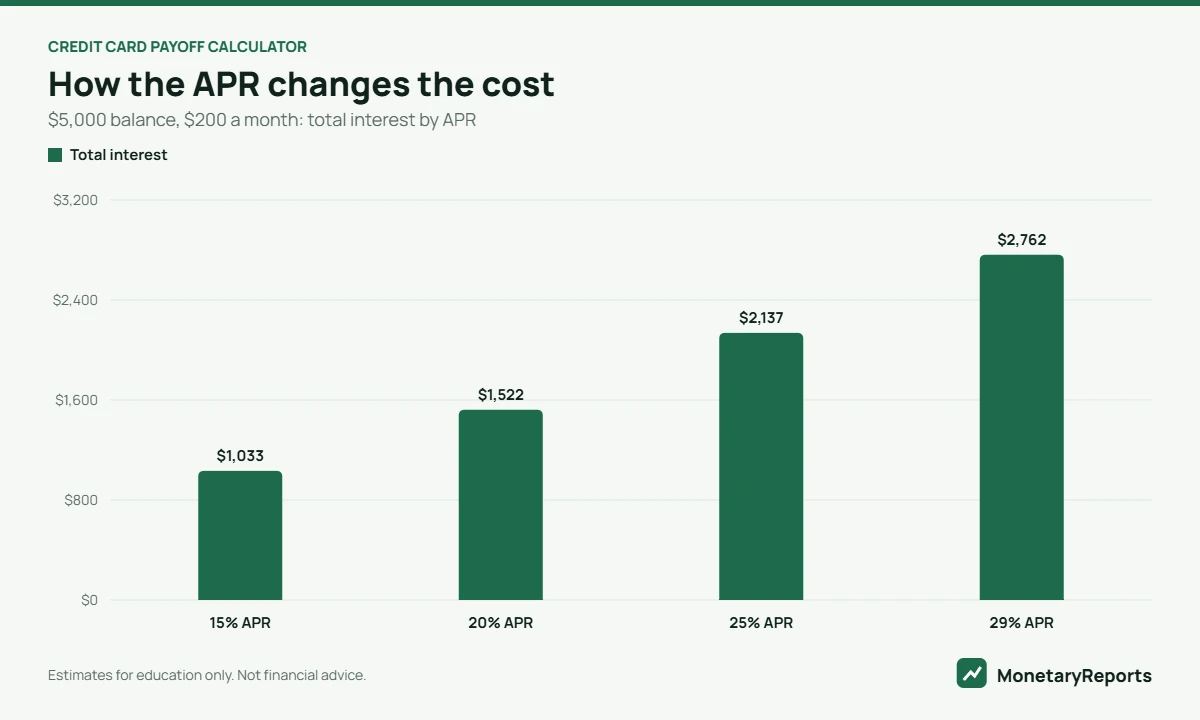
The rate matters, but less than the payment. With the same $200 a month on $5,000:
| APR | Time to pay off | Total interest |
|---|---|---|
| 15% | 2 years, 7 months | $1,033 |
| 20% | 2 years, 9 months | $1,522 |
| 25% | 3 years | $2,137 |
| 29% | 3 years, 3 months | $2,762 |
Credit card payoff calculator examples by situation
| Situation | Balance and APR | Payment | Time | Interest |
|---|---|---|---|---|
| One card, small balance | $2,500 at 24% | $150 | 1 year, 9 months | $572 |
| Mid-size balance | $8,000 at 20% | $300 | 3 years | $2,669 |
| Large balance, high APR | $15,000 at 26% | $500 | 4 years, 1 month | $9,488 |
What this means for you: on larger balances at high rates, interest can add more than 60% on top of what you borrowed. At that point, a lower rate (balance transfer or personal loan) may be worth checking alongside a bigger payment.
How to speed up your credit card payoff
- Stop adding new charges to the card you are paying off: every new purchase delays your credit card payoff.
- Pay more than the minimum, even $50 extra makes a difference.
- Ask for a lower APR: a quick call sometimes works if you have a good payment history.
- Consider a balance transfer to a 0% intro APR card, if the fee and terms make sense. See is a balance transfer worth it.
- Use the avalanche method if you have several cards: highest APR first.
What this credit card payoff calculator means for you
- The monthly payment is the biggest lever you control.
- High APRs make minimum payments very expensive; see the minimum payment trap.
- Once the card is paid off, keep paying the same amount into savings.
Common mistakes when using a credit card payoff calculator
- Entering the minimum payment. Minimums shrink as the balance falls, so a fixed-payment calculator will be too optimistic. Use the amount you will actually keep paying.
- Forgetting new charges. The result assumes you stop using the card. Every new purchase pushes the date back.
- Using a promo rate. If you have a 0% offer, check when it ends; the remaining balance moves to the regular APR.
- Ignoring fees. Annual fees and late fees are not in the calculation.
- Draining all savings to pay faster. Keep a small emergency fund so a surprise bill does not go back on the card. See pay off debt or save first?
A simple credit card payoff plan in 5 steps
- List every card with its balance, APR and minimum payment.
- Run each card through the credit card payoff calculator with the payment you can really afford, not the minimum.
- Pick a payoff date and adjust the payment until the calculator matches it.
- Automate that fixed payment right after payday, so it happens before you spend.
- Recheck every 3 months. If your balance is not falling as the calculator showed, look for new charges or a rate change.
After the last payment: keep the habit
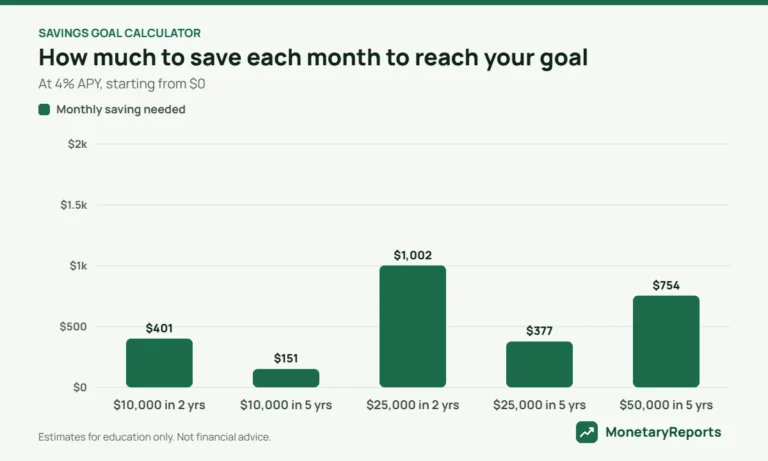
The day your card hits zero, the payment you were making becomes free money. If you keep sending the same $200 a month to a savings account at 4%, you would have about $13,260 after 5 years and about $29,450 after 10 years, using the same discipline that got you out of debt.
That is also the best protection against going back into debt: an emergency fund means the next car repair goes on savings, not on the card.
Paying off a card fast: pros and cons
| Pros | Cons |
|---|---|
| Saves the most interest, often at 20%+ APR | Less cash left for emergencies while you pay |
| Lower credit utilization can help your score | A very tight budget is harder to stick to |
| Frees up your monthly cash flow sooner | May delay retirement or employer-match savings |
A balanced approach for most people: keep a small emergency fund, get any employer 401(k) match, then put everything else toward the highest-rate card. The credit card payoff calculator shows how much each extra dollar saves.
Frequently asked questions
How long will it take to pay off my credit card?
It depends on the balance, APR and payment; the credit card payoff calculator above works it out for you. $5,000 at 22% takes about 2 years and 10 months at $200 a month.
How much should I pay to clear my card in a year?
For $5,000 at 22%, about $468 a month. Use the credit card payoff calculator to try different payments.
Does paying twice a month help?
It can slightly reduce interest, because the balance is lower for part of the month.
Should I close the card after paying it off?
Not necessarily; closing an old card can affect your credit utilization and history. Keep it open if there is no annual fee and you will not overspend.
Is credit card interest compounded?
Most cards calculate interest daily on your balance, so unpaid interest is added and charged interest too. See how credit card interest is calculated.
Is this credit card payoff calculator accurate?
It is a close estimate. It assumes a fixed payment, a fixed APR and no new charges, with interest calculated monthly. Card issuers calculate interest daily, so your real numbers can differ by a few dollars.
How do I pay off several credit cards?
Pay the minimum on all of them and put every extra dollar on one card: the highest APR (avalanche) to save the most, or the smallest balance (snowball) for quick wins. The debt snowball vs avalanche calculator compares both.
Related guides and calculators
- How long to pay off $10,000 in credit card debt
- The minimum payment trap
- Debt snowball vs avalanche calculator
- Is a balance transfer worth it?
Sources
- Federal Reserve: Consumer credit (G.19)
- Consumer Financial Protection Bureau (CFPB)
- CFPB: Credit cards
- MonetaryReports: How we calculate
This guide is for educational purposes only and is not financial advice. The figures are estimates before taxes, fees and inflation, and real rates, returns and rules change over time.