Savings Goal Calculator: How Much to Save Each Month
This savings goal calculator tells you how much to put aside each month to reach a target by a certain date. Enter your goal, what you already have, your deadline and the APY of your savings account. It works for any goal: an emergency fund, a trip, a car, a wedding or a house down payment.
Quick answer
To reach $20,000 in 3 years, starting with $2,000 in an account paying 4% APY, you need to save about $464.77 a month. Interest covers about $1,268 of the goal, so the rest comes from your deposits.
How to use the savings goal calculator
- Savings goal: the total you want to have.
- Already saved: money you can put toward this goal today.
- Years to reach it: your deadline. Half years work, such as 1.5.
- Interest rate (APY): what your savings account pays. Use 0 if the money sits in checking.
- Results: the monthly amount, your total deposits, the interest earned and a chart of your balance each year.
Monthly savings for common goals
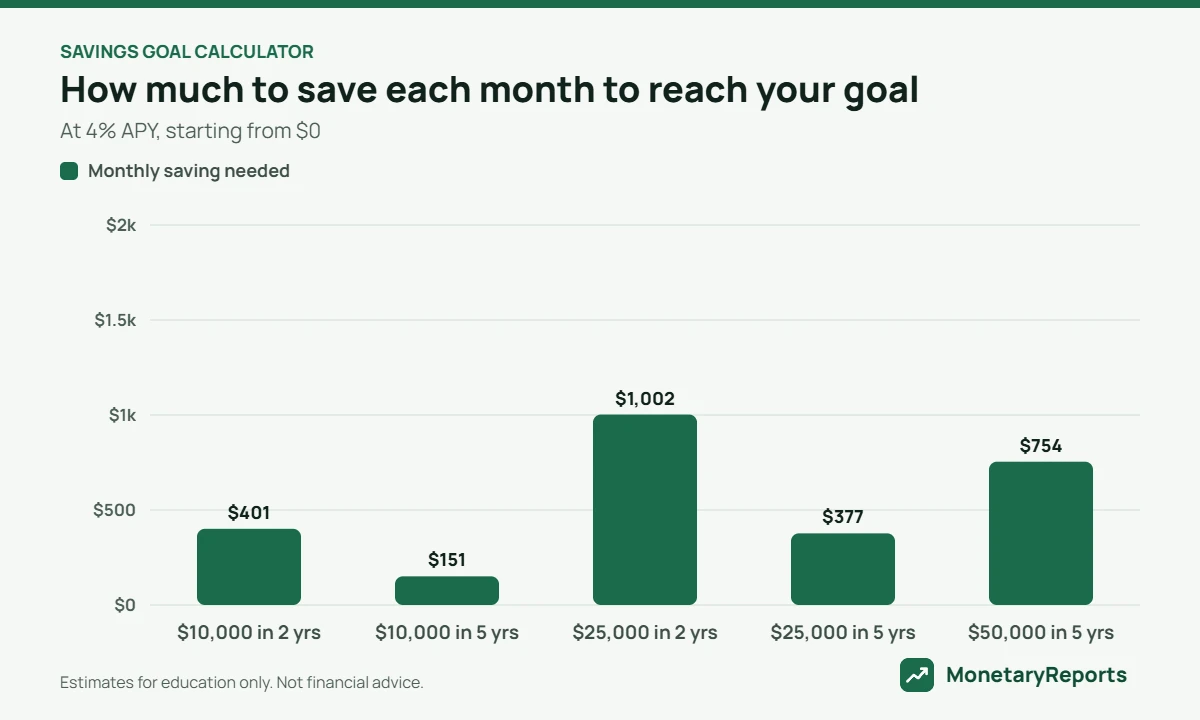
| Goal and deadline | Monthly at 0% | Monthly at 4% APY |
|---|---|---|
| $10,000 in 2 years | $416.67 | $400.92 |
| $10,000 in 5 years | $166.67 | $150.83 |
| $25,000 in 2 years | $1,041.67 | $1,002.29 |
| $25,000 in 5 years | $416.67 | $377.08 |
| $50,000 in 5 years | $833.33 | $754.16 |
Two things stand out. Interest helps more as the deadline gets longer: on a 5-year goal it covers almost 10% of the target. And time matters more than the rate: moving a $25,000 goal from 2 to 5 years cuts the monthly amount by more than half.
The formula behind it
Monthly saving = (Goal − Current × (1 + r)^n) × r ÷ ((1 + r)^n − 1)
Here r is the monthly rate (APY ÷ 12, approximately) and n the number of months. The calculator grows what you already have first, then works out the deposit that fills the rest of the gap. With a 0% rate it is simply the gap divided by the number of months.
How to hit your savings goal faster
- Automate the transfer for the day after payday, so the money never sits in checking.
- Use a separate high-yield account for each big goal. Seeing the balance grow keeps you motivated.
- Add windfalls such as tax refunds or bonuses straight to the goal.
- Round up: if the calculator says $464.77, save $500 and you finish early.
- Review every 3 months and adjust if your income or the APY changes.
What this means for you
- Short deadlines need big deposits; if the number feels impossible, try a longer deadline or a smaller first milestone.
- For goals under about 5 years, a savings account or CD is usually safer than investing, because the stock market can fall right before you need the money.
- Interest is a bonus, not a plan: your deposits do most of the work on short goals.
Frequently asked questions
How much should I save each month for a goal?
Divide what you still need by the number of months left, then adjust for interest. Our savings goal calculator does it for you: $10,000 in 2 years needs about $417 a month at 0% or $401 a month at 4% APY.
Should I count interest when I plan?
It helps to see it, but plan with a cautious rate. Savings account rates can change at any time, so many people use a slightly lower APY than today’s to stay on the safe side.
What if I cannot afford the monthly amount?
Extend the deadline, lower the goal or split it into milestones. Saving something every month builds the habit, and you can increase the amount later.
Is it better to save weekly or monthly?
The total matters most. Saving weekly can feel easier if you are paid weekly, and it puts the money to work a little sooner. About $107 a week is roughly the same as $465 a month.
Where should I keep money for a savings goal?
For most short and medium-term goals, an FDIC-insured high-yield savings account or a CD that matures before your deadline. Compare APYs and fees before choosing.
Related guides and calculators
- Emergency fund calculator
- How to save $10,000 in a year
- High-yield savings account calculator
- Interest calculator
Sources
- FDIC: National rates and rate caps
- Consumer Financial Protection Bureau (CFPB)
- MonetaryReports: How we calculate
This guide is for educational purposes only and is not financial advice. The figures are estimates before taxes, fees and inflation, and real rates, returns and rules change over time.