How Much to Save per Month to Reach $100,000
How much should you save per month to reach $100,000? If you want to save $100k, the answer depends on two things: how many years you have and what your money earns. This guide gives you clear monthly numbers for 5, 10, 15 and 20 years, plus a calculator to test your own plan.
Quick answer
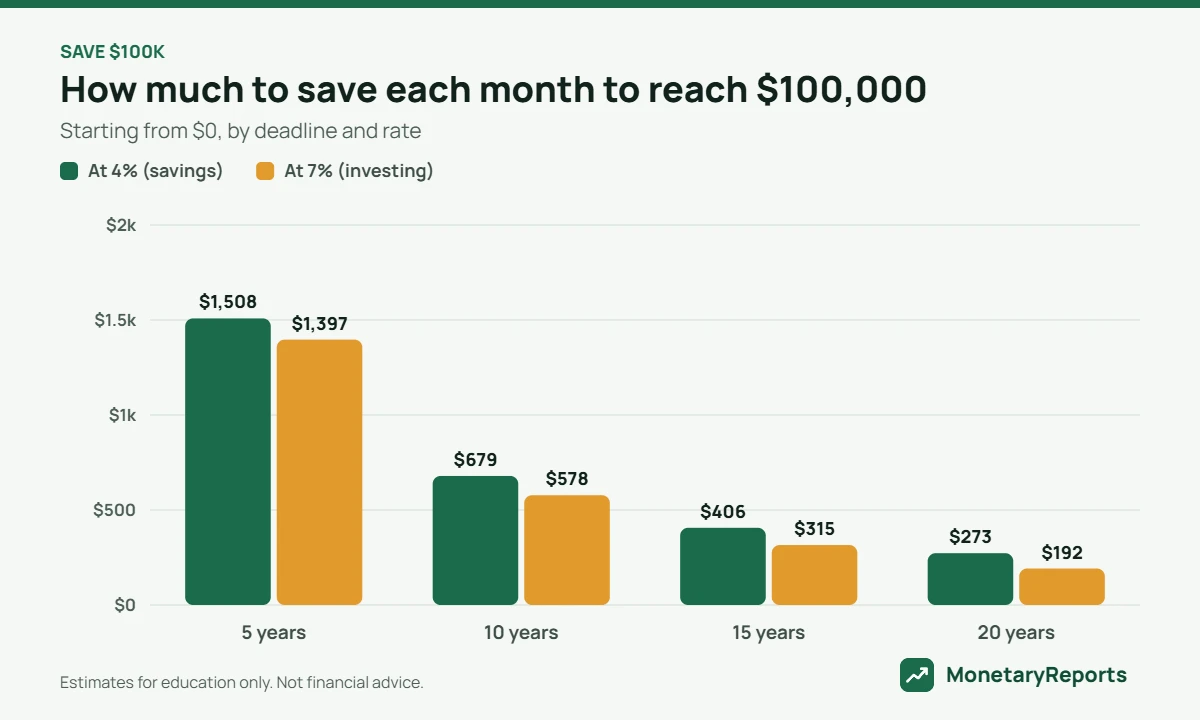
To save $100k from $0, you need about $1,667 a month for 5 years with no interest, $679 a month for 10 years at 4% or $578 a month for 10 years at 7%. With 20 years at 7% it drops to about $192 a month.
Monthly savings to save $100k
| Deadline | At 0% | At 4% (savings account) | At 7% (long-term investing) |
|---|---|---|---|
| 5 years | $1,666.67 | $1,508.32 | $1,396.79 |
| 10 years | $833.33 | $679.12 | $577.75 |
| 15 years | $555.56 | $406.35 | $315.49 |
| 20 years | $416.67 | $272.65 | $191.97 |
Time is the biggest lever. Stretching the deadline from 5 to 10 years halves the monthly amount even with no interest, and compound growth does more of the work the longer you give it.
Calculate your own plan
Enter $100,000 as the goal, add what you already have and choose your deadline:
Savings account or investing?
- Under about 5 years: many people keep the money in high-yield savings or CDs, because a market drop right before the deadline could hurt.
- 10 years or more: long-term investing in diversified, low-cost funds has historically grown faster, but the value goes up and down along the way.
- Mixed: some people invest early on and move to safer accounts as the deadline approaches.
3 realistic paths to $100k
| Path | Monthly amount | Time to $100,000 |
|---|---|---|
| Steady saver (4%) | $679 | 10 years |
| Long-term investor (7%) | $192 | 20 years |
| Fast track (no interest) | $1,667 | 5 years |
If none of these fit your budget today, start with what you can and increase the amount with each raise. A plan you can keep beats a perfect plan you abandon.
Common mistakes
- Using an optimistic return for a short goal. Plan short goals with a savings rate, not stock-market averages.
- Forgetting taxes. Interest and investment gains may be taxable outside retirement accounts.
- Not automating. A manual transfer is easy to skip in a busy month.
What this means for you
- Pick your deadline first; it decides the monthly amount more than anything else.
- Use an FDIC-insured savings account for money you need within a few years.
- Check your plan once a year and adjust the deposit if needed.
Frequently asked questions
How long does it take to save $100k?
Saving $1,000 a month at 4%, it takes about 7 years and 3 months; at 0% it takes 8 years and 4 months. Saving $500 a month at 7% takes a little over 11 years.
How much should I save per month to have $100,000 in 10 years?
About $833 a month with no interest, $679 at 4% or $578 at 7%, starting from $0.
Is $100k a good savings goal?
It is a common milestone because it often marks the point where growth starts to add noticeable amounts each year. At 7%, $100,000 can grow by about $7,000 in a year on its own.
Should I pay off debt before saving $100k?
High-interest debt usually comes first, because it costs more than savings earn. Many people keep a small emergency fund while they pay it down.
Can I reach $100k faster?
Raise the monthly amount, add windfalls and keep fees low. Each extra $100 a month at 4% for 10 years adds about $14,700.
Related guides and calculators
- Savings goal calculator
- How long will it take to save $50k?
- Millionaire calculator
- What $100 a month becomes in 30 years
Sources
- Investor.gov (U.S. SEC): Compound interest calculator
- FDIC: National rates and rate caps
- MonetaryReports: How we calculate
This guide is for educational purposes only and is not financial advice. The figures are estimates before taxes, fees and inflation, and real rates, returns and rules change over time.