Millionaire Calculator: When Will You Be a Millionaire?
When will I be a millionaire? This millionaire calculator answers that question in seconds. Enter your age, what you have invested today, how much you add each month and an expected yearly return, and see how long it could take to reach $1,000,000.
Quick answer
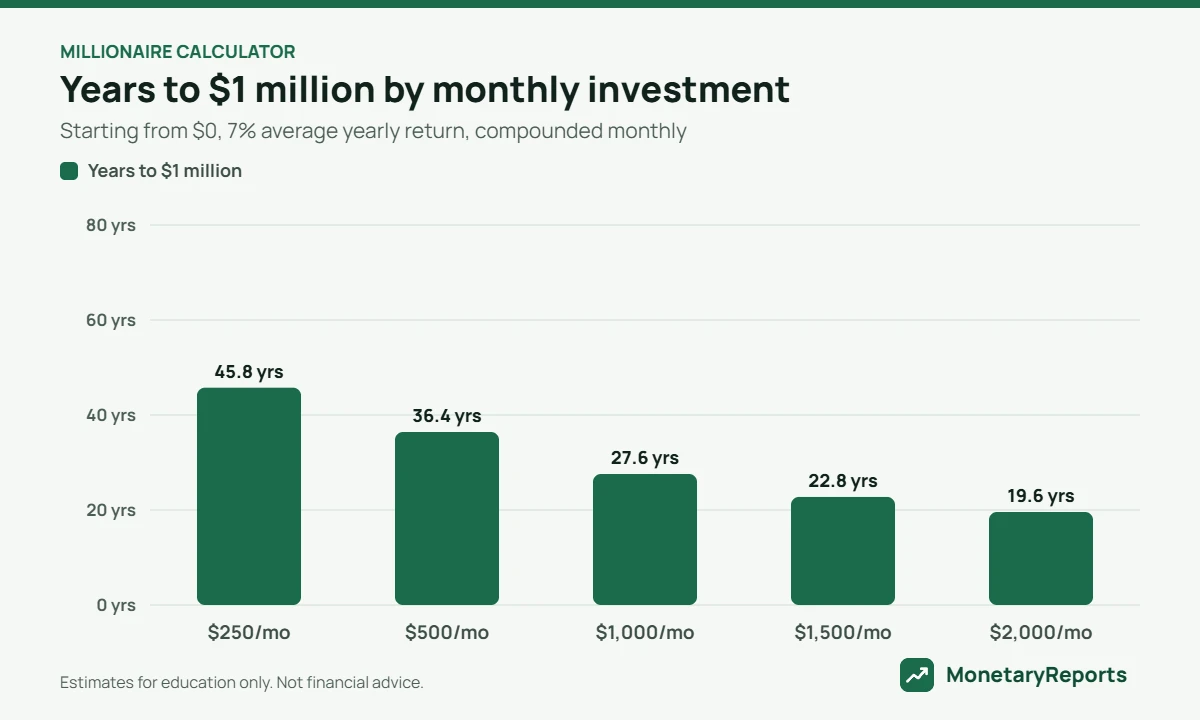
Investing $500 a month at an average 7% a year, starting from $0, could reach $1 million in about 36 years and 5 months. At $1,000 a month it takes about 27 years and 7 months; at $2,000 a month about 19 years and 7 months.
How to use the millionaire calculator
- Your age: used to show how old you would be when you reach $1 million.
- Invested today: what you already have in investment or retirement accounts.
- Monthly investment: what you add every month, including any employer match.
- Expected yearly return: a long-term average. Try a cautious rate (5% to 6%) and a more optimistic one (7% to 8%).
How long it takes to become a millionaire
| Monthly investment | Years to $1 million at 6% | Years to $1 million at 7% |
|---|---|---|
| $250 | – | 45 years, 9 months |
| $500 | 40 years, 1 month | 36 years, 5 months |
| $1,000 | 30 years | 27 years, 7 months |
| $1,500 | – | 22 years, 9 months |
| $2,000 | – | 19 years, 7 months |
Notice how doubling the monthly amount does not halve the time. Going from $500 to $1,000 a month saves almost 9 years, but going from $1,000 to $2,000 saves 8. The early years matter most, because compound interest needs time to build.
The 3 levers you control
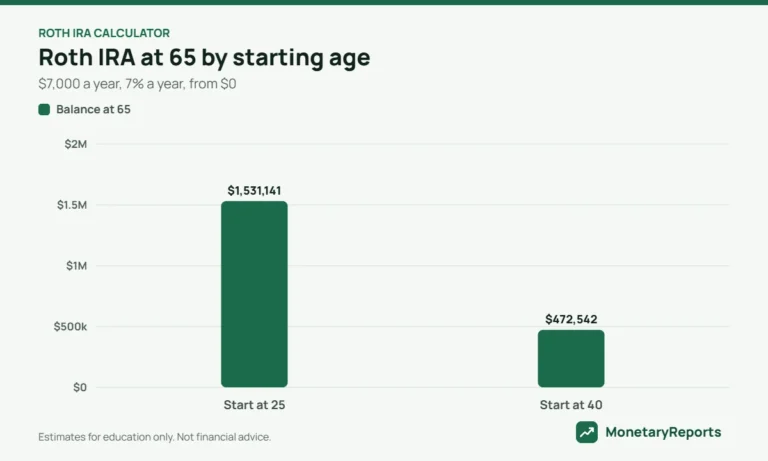
- Start earlier. Someone who invests $500 a month from 25 could reach $1 million around age 61 at 7%; starting at 35 pushes it past 71.
- Invest more. Raises, bonuses and a 401(k) match are the easiest ways to increase your monthly amount.
- Keep costs low. A 1% yearly fee turns a 7% return into about 6%, which adds several years to the journey.
Is $1 million still a lot?
It is still a meaningful amount, but inflation matters. With 3% inflation, $1 million in 36 years would buy roughly what $345,000 buys today. Using the 4% rule, $1 million could support about $40,000 a year of withdrawals in retirement. Use our inflation calculator to see the effect for your own timeline.
What this means for you
- Becoming a millionaire is mostly about time and consistency, not a high salary.
- An employer 401(k) match can cut years off the timeline, because it adds money you do not have to earn.
- Returns are not guaranteed; treat the result as a planning range, not a promise.
Frequently asked questions
How much do I need to invest to become a millionaire?
It depends on time and returns. At 7% a year, about $500 a month gets you there in roughly 36 years, $1,000 a month in about 28 years and $2,000 a month in about 20 years, starting from $0.
Can I become a millionaire with $100 a month?
At 7% a year it would take about 59 years, so for most people it would need a very early start. Raising the amount over time, even gradually, shortens it a lot.
What return should I use?
Use a conservative long-term assumption and test a range. Diversified stock portfolios have historically averaged more than savings accounts over long periods, but with big ups and downs. Past returns do not guarantee future results.
Does this include taxes?
No. Investing through tax-advantaged accounts such as a 401(k) or IRA can help more of the growth stay invested.
Is the millionaire calculator accurate?
The math is exact for the numbers you enter, but real returns vary every year. Treat the result as an estimate and recalculate once a year.
Related guides and calculators
- How much will $10,000 grow?
- Retirement savings calculator
- Starting to save at 25 vs 35
- Interest calculator
Sources
- Investor.gov (U.S. SEC): Compound interest calculator
- U.S. Bureau of Labor Statistics: Consumer Price Index
- MonetaryReports: How we calculate
This guide is for educational purposes only and is not financial advice. The figures are estimates before taxes, fees and inflation, and real rates, returns and rules change over time.