What Is a Good APR for a Car Loan? (And How to Get One)
What is a good APR for a car loan? It depends on your credit score, whether the car is new or used, the loan term and the overall level of interest rates. A “good” APR is one that is at or below what borrowers with your credit typically get. This guide shows how much the APR changes your cost and how to get a better one.
Quick answer
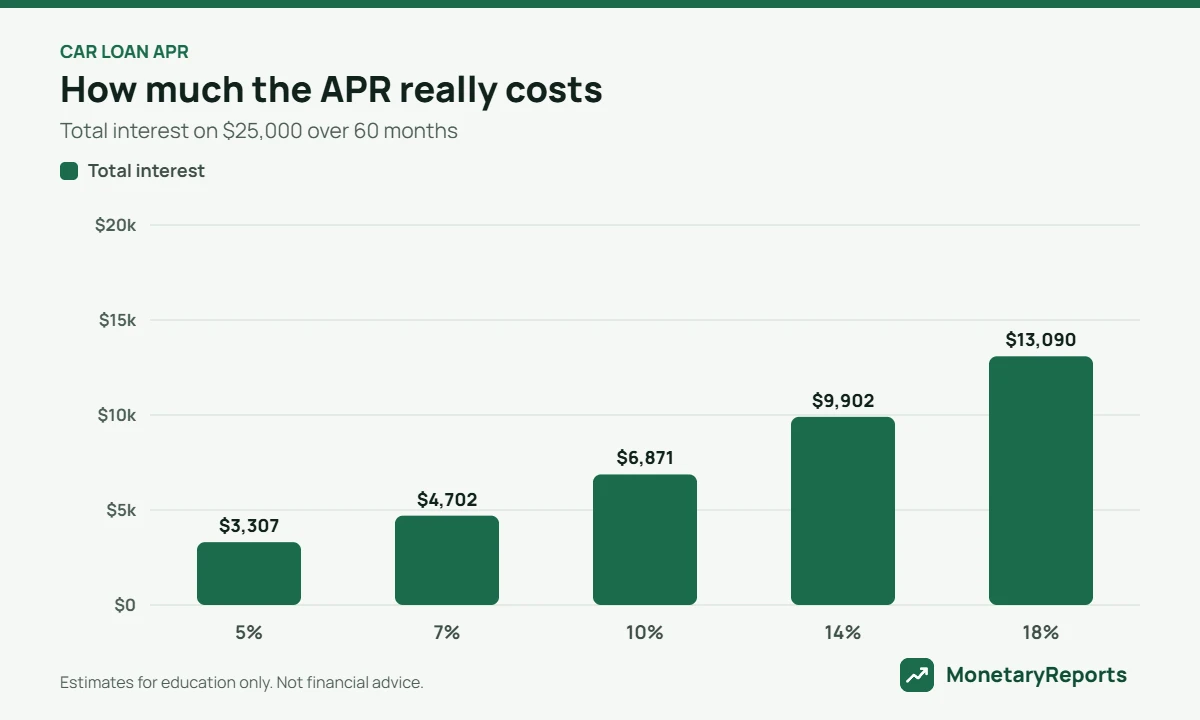
A good APR for a car loan is at or below the typical rate for your credit score. Borrowers with excellent credit usually get the lowest rates; lower scores pay much more. On $25,000 over 60 months, the difference between 5% and 14% is about $6,600 of extra interest.
How much the APR changes your cost
| APR | Monthly payment | Total interest |
|---|---|---|
| 5% | $471.78 | $3,307 |
| 7% | $495.03 | $4,702 |
| 10% | $531.18 | $6,871 |
| 14% | $581.71 | $9,902 |
| 18% | $634.84 | $13,090 |
Average car loan APR by credit score
Rates depend heavily on credit. These are the average APRs Experian reported for the second quarter of 2026. They are averages, so your own offer can be higher or lower.
| Credit tier | Score range | New car APR | Used car APR |
|---|---|---|---|
| Super prime | 781–850 | 4.41% | 6.29% |
| Prime | 661–780 | 6.15% | 8.81% |
| Near prime | 601–660 | 9.71% | 13.93% |
| Subprime | 501–600 | 13.52% | 19.10% |
| Deep subprime | 300–500 | 16.11% | 21.62% |
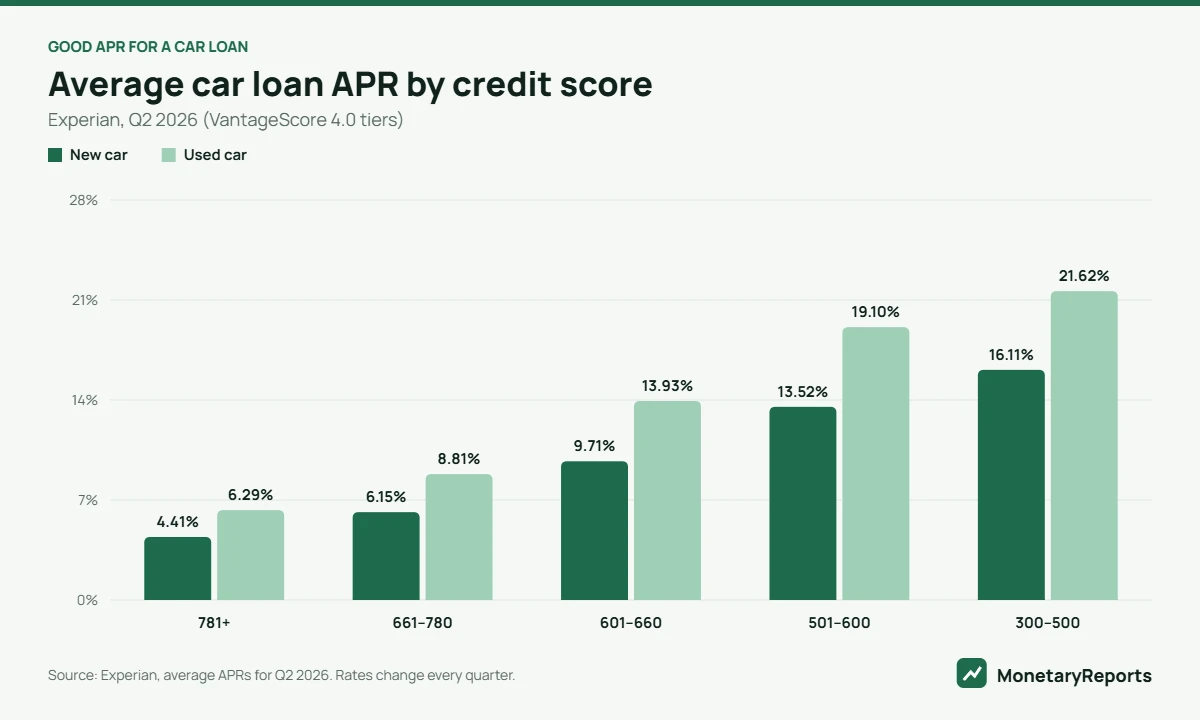
In dollars: on $25,000 for 60 months, the average prime rate for a new car (6.15%) means about $4,104 of interest. At the near-prime average (9.71%) it is about $6,657, and at the subprime average (13.52%) about $9,530. Moving up one credit tier can be worth thousands.
What this means for you: with a score of 661 or more, a new-car APR around 6% or lower is in the normal range. If you are offered 10% or more on a new car with good credit, compare offers from a bank or credit union before you sign. Used cars cost about 2 to 5 points more at every tier.
Source: Experian, Q2 2026 data (VantageScore 4.0 tiers). Rates change every quarter; check the latest figures before you borrow.
Good APR, bad term: why the length of the loan matters
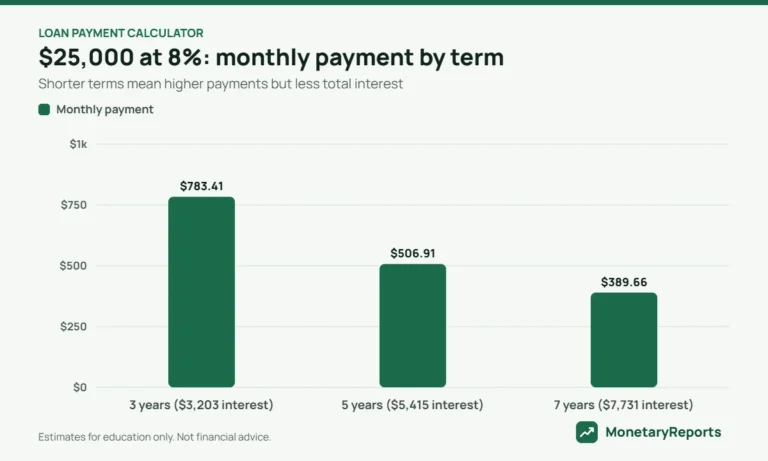
A good APR for a car loan can still turn into an expensive loan if the term is long. Here is the same $25,000 at 7% over different terms:
| Term | Monthly payment | Total interest |
|---|---|---|
| 36 months | $771.93 | $2,789 |
| 48 months | $598.66 | $3,735 |
| 60 months | $495.03 | $4,702 |
| 72 months | $426.23 | $5,688 |
| 84 months | $377.32 | $6,695 |

Long terms also raise the risk of owing more than the car is worth for years, because cars lose value fastest in the first years. Lenders often charge a higher APR on longer terms too, which makes the gap even bigger.
New vs used: what counts as a good APR
Used-car loans carry higher rates at every credit tier. On a $20,000 loan for 60 months, a borrower in the prime tier pays about $3,283 of interest at the average new-car rate (6.15%) and about $4,800 at the average used-car rate (8.81%), roughly $1,516 more. So a good APR for a used car loan is judged against used-car averages, not new-car ones.
Is your offer good? A 4-step check
- Find your credit tier (your score from your bank or card app is enough for a rough idea).
- Compare the offer with the average for your tier and for new or used in the table above.
- Get at least one pre-approval from a bank or credit union, so you have a real number to compare.
- Compare the total interest over the full term, not just the monthly payment.
Dealers often arrange financing through a lender and may be able to quote you a higher rate than the one the lender approved. A pre-approval in hand is the simplest protection: ask the dealer to beat it.
What affects your car loan APR
- Credit score: the biggest factor; higher scores get lower rates.
- New vs used: used-car loans usually have higher APRs.
- Loan term: longer terms often come with higher rates.
- Down payment: borrowing less relative to the car’s value can help.
- Lender type: credit unions, banks, online lenders and dealers can quote very different rates.
- The economy: rates rise and fall with the overall level of interest rates.
How to get a good APR for a car loan
- Check your credit report and fix errors before applying.
- Get pre-approved by a credit union or bank to have a rate to compare.
- Apply to several lenders within a short window; multiple auto-loan inquiries in a short period are often treated as one for scoring.
- Choose a shorter term if the payment fits.
- Look at promotional manufacturer financing, but compare it with cash rebates.
What a good APR for a car loan means for you
- A few points of APR can cost thousands; shop around.
- Compare the APR and the total cost, not just the monthly payment.
- The Federal Reserve publishes average auto loan rates if you want a benchmark.
Common mistakes when judging a car loan APR
- Shopping by monthly payment. A low payment usually means a long term, not a good APR.
- Accepting the first dealer offer. Without a pre-approval, you cannot tell if the rate is fair.
- Rolling negative equity into the new loan. Owing on your old car raises the amount financed and the total interest.
- Taking 0% instead of a larger cash rebate without doing the math. A rebate plus a low bank rate can be cheaper.
- Adding extras to the loan. Extended warranties and add-ons financed at your APR cost more than their sticker price.
Good APR for a car loan: the short version
- A good APR for a car loan is at or below the average for your credit tier, new or used.
- In Q2 2026, that meant roughly 6% or less for a new car and under 9% for a used car with prime credit.
- A shorter term and a pre-approval are the two easiest ways to pay less.
- Always compare the total interest, not just the monthly payment.
Frequently asked questions
What is a good APR for a car loan?
One at or below what borrowers with your credit score and loan type typically get. Pre-approval offers help you see what is realistic.
Is 7% APR good for a car loan?
It can be reasonable depending on your credit and current rates. Compare it with offers from credit unions and banks.
Is 0% financing a good deal?
It can be, but it may replace a cash rebate. Compare the total cost both ways.
How much does credit score affect car loan APR?
A lot. Borrowers with lower scores can pay several times the APR of those with excellent credit.
Can I refinance a car loan?
Yes, if your credit improves or rates fall, refinancing can lower your APR.
What APR can I get with a 700 credit score?
A 700 score is usually in the prime tier (661–780). In Q2 2026, Experian reported average APRs of about 6.15% for new cars and 8.81% for used cars in that tier. Your own offer depends on the lender, the term and the down payment.
Is 10% APR high for a car loan?
For a borrower with good credit, yes: it is well above the prime averages. For near-prime credit it is close to the average for a new car. Compare with your tier before deciding.
Is a good APR for a car loan different for 72 or 84 months?
Longer terms often come with higher rates, and even at the same rate they cost more interest. A good APR on a 36- or 48-month loan is usually a better deal than a slightly lower payment over 84 months.
Related guides and calculators
Sources
- CFPB: Auto loans
- Federal Reserve: Consumer credit (G.19)
- Experian: Average car loan interest rates by credit score
- MonetaryReports: How we calculate
This guide is for educational purposes only and is not financial advice. The figures are estimates before taxes, fees and inflation, and real rates, returns and rules change over time.