Amortization Explained: How Loan Payments Work (Simple Table)
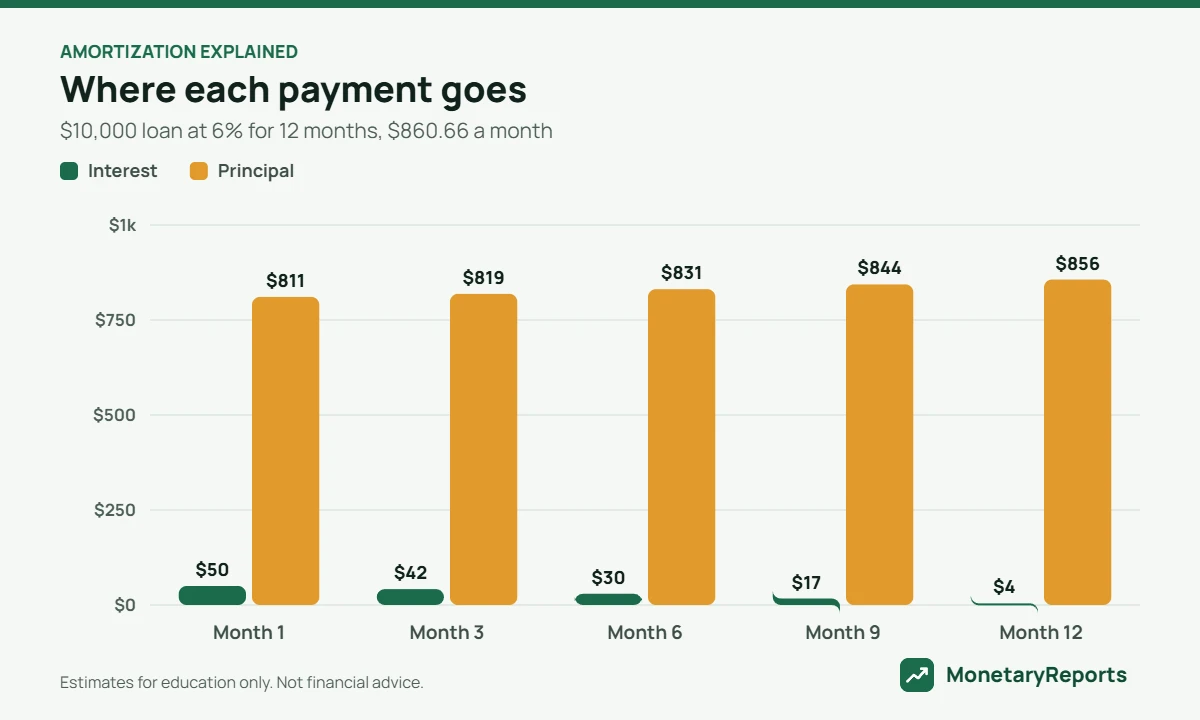
Amortization explained simply: it is the way a loan is paid off with equal monthly payments. Each payment covers the interest for that month first, and the rest reduces the balance. Early on, more goes to interest; later, more goes to principal. A small table makes it easy to see.
Quick answer
In an amortized loan, every payment is the same, but the split changes. On a $10,000 loan at 6% for 12 months, the payment is $860.66. In month 1, $50.00 is interest and $810.66 is principal; by month 12, only $4.28 is interest.
Amortization explained with a simple table
| Month | Payment | Interest | Principal | Balance left |
|---|---|---|---|---|
| 1 | $860.66 | $50.00 | $810.66 | $9,189.34 |
| 2 | $860.66 | $45.95 | $814.72 | $8,374.62 |
| 3 | $860.66 | $41.87 | $818.79 | $7,555.83 |
| 6 | $860.66 | $29.53 | $831.13 | $5,074.81 |
| 9 | $860.66 | $17.00 | $843.66 | $2,556.39 |
| 12 | $860.66 | $4.28 | $856.38 | $0.00 |
The amortization formula
Every amortized loan uses the same formula for the fixed monthly payment:
M = P × r × (1 + r)n ÷ [(1 + r)n − 1]
P is the amount borrowed, r is the monthly rate (APR ÷ 12) and n is the number of payments. For the $10,000 loan above: r = 0.06 ÷ 12 = 0.005, n = 12, and (1.005)12 ≈ 1.0617. So M = 10,000 × 0.005 × 1.0617 ÷ 0.0617 ≈ $860.66.
Once the payment is fixed, each row of the schedule follows two simple rules: interest = balance × r, and principal = payment − interest. That is all amortization is.
Why early payments are mostly interest
Interest is charged on the remaining balance. At the start the balance is highest, so the interest part is biggest. As you pay the balance down, the interest shrinks and more of the same payment goes to principal.
A mortgage example
On a $300,000 mortgage at 6.5% for 30 years, the payment is about $1,896.20. In the first year you pay about $19,401 of interest, and the balance only drops to about $296,647. That is why the first years of a long loan build equity slowly.
Year by year, the split slowly flips. Around year 20 the principal part finally becomes larger than the interest part:
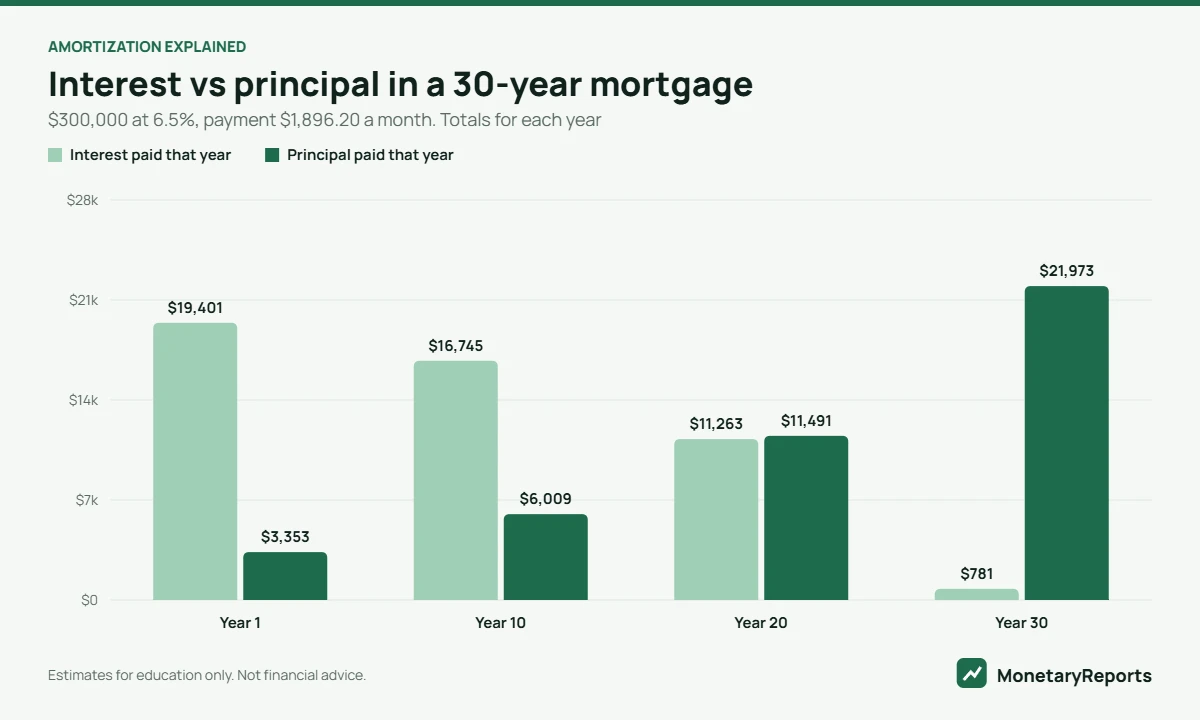
That also explains why the balance falls slowly at first and quickly at the end. After 10 years you still owe about $254,328; after 20 years, about $166,996. Over the full 30 years you pay about $382,633 of interest on top of the $300,000.

How extra payments change the schedule
Example: add $200 a month to the $300,000 mortgage above. The loan is paid off in about 23 years and 1 month instead of 30, and total interest falls from about $382,633 to about $279,185, a saving of roughly $103,449.
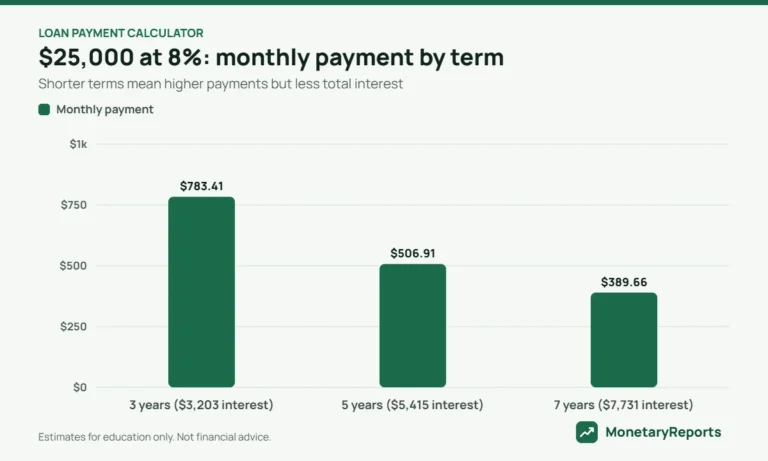
Extra payments go straight to principal (if your lender applies them that way), which lowers the balance that future interest is charged on. That shortens the loan and cuts total interest. Try it with the loan payment calculator:
What amortization means for you
- Extra payments early in a loan save the most interest.
- Check that extra payments are applied to principal.
- Compare loans by total interest, not just the monthly payment.
Amortization by loan type
The same rules apply to most installment loans. The longer the term and the higher the rate, the bigger the interest share of the first payment:
| Loan | Monthly payment | Total interest | Interest share of 1st payment |
|---|---|---|---|
| Car loan: $30,000 at 6.5%, 5 years | $586.98 | $5,219 | 28% |
| Personal loan: $10,000 at 12%, 3 years | $332.14 | $1,957 | 30% |
| Student loan: $30,000 at 5.5%, 10 years | $325.58 | $9,069 | 42% |
| Mortgage: $300,000 at 6.5%, 30 years | $1,896.20 | $382,633 | 86% |
Credit cards are different: they are not amortized. There is no fixed payment or end date, which is why paying only the minimum can take decades. See the minimum payment trap.
Common mistakes with amortized loans
- Comparing loans by the monthly payment only. A longer term lowers the payment but can double the total interest.
- Assuming extra payments go to principal automatically. Some lenders apply them to future payments instead. Ask, or mark them “principal only”.
- Refinancing late in the loan without checking the schedule. Restarting a 30-year clock when most of your payment is already principal can cost more overall.
- Ignoring fees. Origination fees and closing costs are not in the schedule but are part of what the loan costs.
15-year vs 30-year: same rate, different amortization
The term changes amortization more than anything else. Here is the same $300,000 at 6.5% over 15 and 30 years:
| 15-year loan | 30-year loan | |
|---|---|---|
| Monthly payment | $2,613.32 | $1,896.20 |
| Total interest | $170,398 | $382,633 |
| Balance after 5 years | $230,151 | $280,833 |
| Interest paid in first 5 years | $86,951 | $94,605 |
The 15-year loan costs about $717 more a month but saves about $212,235 of interest, and after 5 years you owe about $50,682 less. The 30-year loan gives you a lower payment and more flexibility: you can still pay extra when you can afford it.
Pros of a shorter term: far less interest, faster equity, debt-free sooner. Cons: a higher required payment, which can strain your budget if income drops. A common middle path is the 30-year loan with voluntary extra payments.
How to read your own amortization schedule
- Find the row for this month. The “balance left” column is roughly what you would owe if you paid the loan off today (before any fees).
- Compare the interest and principal columns. If interest is still the bigger part, extra payments will save the most now.
- Look 12 rows ahead to see how much your balance will fall in a year if you change nothing.
- Check the last row: the total interest is the true cost of borrowing.
- Repeat after any extra payment or refinance, since every change creates a new schedule.
Frequently asked questions
What does amortization mean?
Paying off a loan with regular equal payments that cover interest and gradually reduce the principal.
What is an amortization schedule?
A table showing, for each payment, how much goes to interest, how much to principal and the balance left.
Why is so much of my mortgage payment interest?
Because interest is charged on a large remaining balance at the start of the loan.
Do car loans amortize?
Most installment loans, including car and personal loans, are amortized.
Does paying extra reduce my payment?
Usually not; it shortens the loan. Some lenders offer to recalculate (recast) the payment.
What is negative amortization?
When your payment is smaller than the interest charged, the unpaid interest is added to the balance, so the debt grows. Some income-driven student loan plans and certain adjustable mortgages can work this way.
Is an interest-only loan amortized?
Not during the interest-only period. You pay just the interest, so the balance does not fall. When that period ends, the loan starts amortizing and the payment jumps.
How do I get an amortization schedule for my loan?
Ask your lender, or enter the amount, rate and term in the loan payment calculator to see each payment split into interest and principal.
Related guides and calculators
- Loan payment calculator
- Car loan calculator
- 7 real-life examples of compound interest
- Student loan payoff calculator
Sources
This guide is for educational purposes only and is not financial advice. The figures are estimates before taxes, fees and inflation, and real rates, returns and rules change over time.