What Is Inflation? How It Affects Your Savings (Simple Guide)

What is inflation and how does it affect your savings? Inflation is the general rise in prices over time. When prices rise, each dollar buys a little less. That is why money sitting in an account that earns nothing slowly loses value, and why your savings need to grow just to stay even.
Quick answer
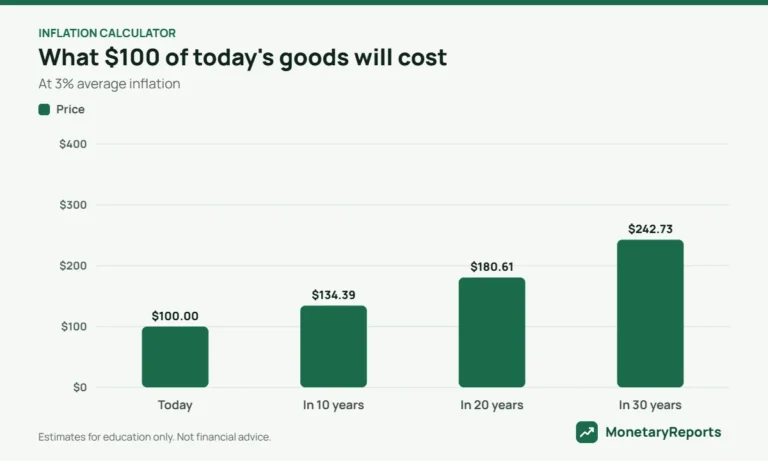
Inflation is the rate at which prices rise. In the U.S. it is usually measured by the Consumer Price Index (CPI). At 3% inflation, $100 of cash buys only about $74 of today’s goods after 10 years and about $55 after 20 years.
What is inflation?
Inflation means that, on average, prices go up over time: groceries, rent, cars and services. A little inflation is considered normal in a growing economy; the Federal Reserve aims for about 2% a year over the longer run.
How inflation is measured
The Bureau of Labor Statistics tracks the prices of a large basket of goods and services and publishes the Consumer Price Index (CPI) every month. The yearly change in the CPI is the inflation rate you usually hear in the news.
How inflation affects your savings
| Years | Buying power of $100 at 2% | At 3% | At 4% |
|---|---|---|---|
| 10 | $82.03 | $74.41 | $67.56 |
| 20 | $67.30 | $55.37 | $45.64 |
| 30 | $55.21 | $41.20 | $30.83 |
If your savings earn less than inflation, your real return is negative: the balance grows on paper, but it buys less. See nominal vs real interest rate.
What causes inflation
- Demand: when people and businesses want to buy more than the economy can produce, prices rise.
- Costs: higher costs for energy, materials or wages can be passed on to prices.
- Expectations: if everyone expects higher prices, wages and prices can rise faster.
How to protect your money
- Keep emergency savings in high-yield accounts, not at 0%.
- Consider inflation-protected options such as TIPS or I bonds.
- Invest long-term money in diversified assets that have historically outpaced inflation.
- Ask for raises that at least keep up with inflation.
What inflation means for you
- Cash is safe from losses, but not from inflation.
- Plan long-term goals in today’s dollars and adjust for inflation.
- Check the CPI a few times a year to compare with your savings rate.
Frequently asked questions
What is inflation in simple words?
Prices going up over time, so the same money buys less.
What is a normal inflation rate?
The Federal Reserve targets about 2% a year over the longer run.
How does inflation affect savings?
It reduces what your savings can buy. If your interest rate is lower than inflation, you lose buying power.
Who measures inflation in the U.S.?
The Bureau of Labor Statistics publishes the Consumer Price Index monthly.
Is inflation bad for borrowers?
Moderate inflation can help borrowers with fixed-rate loans, because they repay with dollars that are worth less.
Related guides and calculators
- Inflation calculator
- Nominal vs real interest rate
- How much will $1 million be worth in 30 years?
- Treasury bills vs CDs vs savings accounts
Sources
- U.S. Bureau of Labor Statistics: Consumer Price Index
- Federal Reserve: Why does the Fed target 2% inflation?
- MonetaryReports: How we calculate
This guide is for educational purposes only and is not financial advice. The figures are estimates before taxes, fees and inflation, and real rates, returns and rules change over time.