Investment Growth Calculator (CAGR): How Fast Did Your Money Grow?
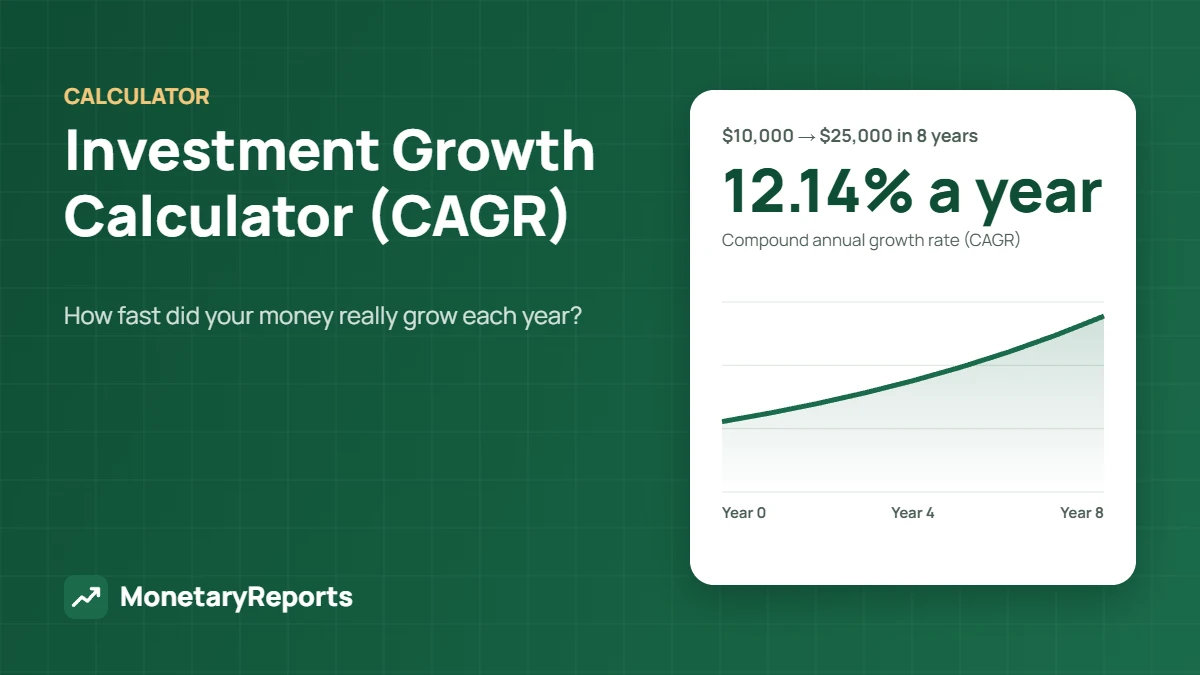
Use this investment growth calculator to find out how fast an investment really grew each year. Enter where it started, where it ended and how many years it took. You get the compound annual growth rate (CAGR): the steady yearly rate that would take you from the first number to the second.
Quick answer
Your yearly investment growth rate (CAGR) = (ending value ÷ starting value)^(1 ÷ years) − 1. Example: $10,000 that grew to $25,000 in 8 years grew at about 12.14% a year. Total growth was 150%, but the steady yearly rate is what lets you compare it fairly with other investments.
What this investment growth calculator measures
Real investments do not grow by the same amount every year: some years are great, others are negative. CAGR smooths that path into one number. It answers the question: “What constant yearly rate would have produced the same result?” That makes it easy to compare a fund, a stock, a house or a business over different periods.
How to use the calculator
- Starting value: what the investment was worth at the beginning.
- Ending value: what it was worth at the end, or what it is worth today.
- Number of years: the length of the period. Half years are allowed, such as 2.5.
- Results: the CAGR, the total growth in percent, the money gained and a chart of the value growing at that steady rate.
Important
Leave out any money you added or withdrew along the way. CAGR measures the growth of a single amount. If you made regular deposits, the result would overstate the growth.
The CAGR formula, step by step
CAGR = (End ÷ Start)^(1 ÷ Years) − 1
- Divide the ending value by the starting value: $25,000 ÷ $10,000 = 2.5.
- Raise it to the power of 1 ÷ years: 2.5^(1/8) ≈ 1.1214.
- Subtract 1: 1.1214 − 1 = 0.1214, or 12.14% a year.
In a spreadsheet you can type =(25000/10000)^(1/8)-1 or =RRI(8, 10000, 25000).
Investment growth needed to reach a goal
You can also use the formula backwards: what yearly investment growth do you need to double $10,000?
| To reach $20,000 from $10,000 | Yearly growth needed (CAGR) |
|---|---|
| In 5 years | 14.87% |
| In 10 years | 7.18% |
| In 15 years | 4.73% |
| In 20 years | 3.53% |

CAGR vs average return
The simple average of yearly returns can be misleading. Imagine $100 that gains 50% in year one (to $150) and loses 50% in year two (to $75). The average return is 0%, but you lost money. The CAGR is about −13.4% a year, which matches what really happened.
| Year | Return | Value of $10,000 |
|---|---|---|
| 1 | +20% | $12,000 |
| 2 | −10% | $10,800 |
| 3 | +15% | $12,420 |
| 4 | +5% | $13,041 |
When to use it
- Comparing funds: compare the CAGR of two funds over the same period, after fees.
- Your own portfolio: see how a one-time investment actually performed.
- A home: a house bought for $250,000 and worth $400,000 ten years later grew about 4.81% a year (before costs such as maintenance, taxes and selling fees).
- A business: revenue that grew from $1.2 million to $2 million in 5 years grew about 10.76% a year.
- Planning: find the growth rate you need to reach a target, then check whether it is realistic.
What CAGR does not tell you
- Risk: two investments can have the same CAGR but very different ups and downs along the way.
- Deposits and withdrawals: CAGR ignores money added or taken out. For that, a money-weighted return is more accurate.
- The future: past growth rates do not guarantee future results.
- Cherry-picked periods: the result can change a lot depending on the start and end dates chosen.
What this means for you
- Use CAGR to compare investments fairly, over the same period and after fees.
- Be skeptical of very high CAGRs over short periods; they rarely last.
- For planning with monthly deposits, use the interest calculator instead.
Try it with your own numbers
Planning future growth with regular deposits? Try the interest calculator.
Frequently asked questions
Is CAGR the same as an interest rate?
Not exactly. An interest rate is promised in advance; CAGR is measured after the fact. But CAGR behaves like a yearly compound interest rate: if something grew at a 7% CAGR, it ended up where 7% compound interest would have taken it.
Can CAGR be negative?
Yes. If the ending value is lower than the starting value, the CAGR is negative. For example, $10,000 that fell to $8,000 over 3 years has a CAGR of about −7.2% a year.
What is a good investment growth rate?
It depends on the type of investment and the risk. Savings accounts and CDs pay a fixed or variable rate set by the bank. Broad stock indexes have historically grown faster over long periods, but with large ups and downs. Compare any CAGR with a similar investment over the same period.
Why is CAGR lower than the average return?
Because losses hurt more than gains help. A 50% loss needs a 100% gain to recover. CAGR captures this; a simple average does not. The more volatile the returns, the bigger the gap between the two.
Can I use the investment growth calculator for my 401(k)?
Only if you did not add or withdraw money during the period. Most 401(k) balances include regular contributions, so the CAGR from the start and end balances would overstate the growth. Many plan statements show a personal rate of return that accounts for contributions.
How do I calculate CAGR in Excel?
Use =(End/Start)^(1/Years)-1, or the built-in function =RRI(Years, Start, End). Format the cell as a percentage.
Related guides and calculators
Sources
This guide is for educational purposes only and is not financial advice. The figures are estimates before taxes, fees and inflation, and real savings rates and investment returns change over time.