APY Calculator: Turn Any Interest Rate Into APY
Use this APY calculator to convert an interest rate into the annual percentage yield (APY): the real yearly return once compounding is included. Enter the stated rate, choose how often interest compounds and see the APY and the interest on your deposit.
Quick answer
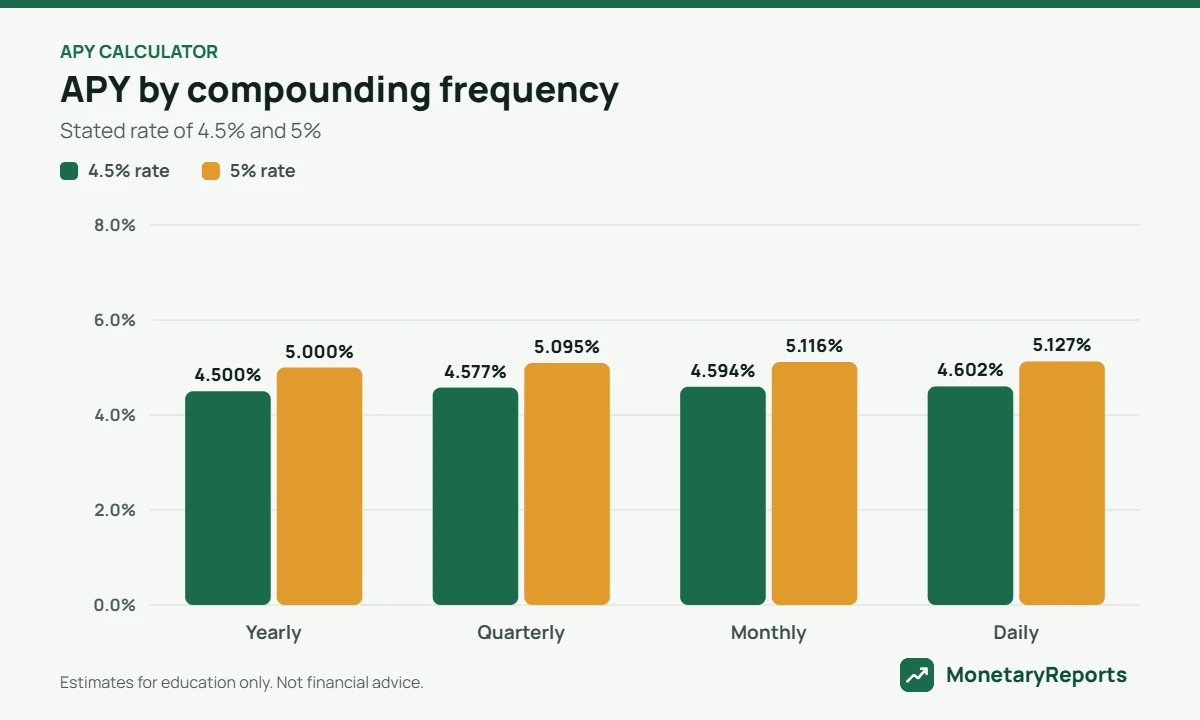
APY = (1 + rate ÷ n)^n − 1, where n is the number of times interest compounds per year. A 4.5% rate compounded daily equals an APY of about 4.602%; compounded monthly, about 4.594%. On $10,000 that is roughly $460 of interest in a year.
How to use the APY calculator
- Stated interest rate: the nominal yearly rate (sometimes called APR or interest rate).
- Compounding: how often the bank adds interest: yearly, quarterly, monthly, weekly or daily.
- Deposit: used to show the interest earned in one year.
The APY formula
APY = (1 + r ÷ n)^n − 1
r is the stated rate as a decimal and n the compounding periods per year. Example: (1 + 0.045 ÷ 365)^365 − 1 ≈ 0.04602, or 4.602%.
APY by compounding frequency
| Compounding | APY at 4.5% | APY at 5% |
|---|---|---|
| Yearly | 4.500% | 5.000% |
| Quarterly | 4.577% | 5.095% |
| Monthly | 4.594% | 5.116% |
| Daily | 4.602% | 5.127% |
Why APY matters when you compare accounts
U.S. banks must disclose the APY on deposit accounts, so you can compare offers that compound differently. A 4.9% rate compounded daily (APY about 5.02%) actually pays more than a 5% rate compounded once a year (APY 5.00%). For loans and credit cards the logic is reversed: interest that compounds daily costs a bit more than the APR suggests. Learn the difference in APY vs APR.
What this means for you
- Compare savings accounts and CDs by APY, not by the stated rate.
- Frequency matters less than the rate itself: half a point of APY beats daily compounding.
- APY can change on variable-rate savings accounts.
Frequently asked questions
What is APY?
Annual percentage yield: the real yearly return on a deposit, including the effect of compounding.
How do I convert an interest rate to APY?
Use APY = (1 + r/n)^n − 1. A 4.5% rate compounded monthly gives (1 + 0.045/12)^12 − 1 ≈ 4.594%.
Is a higher APY always better?
For savings, yes, as long as fees, minimum balances and access fit your needs and the bank is insured.
Why is APY higher than the interest rate?
Because interest added during the year also earns interest. The more often it compounds, the bigger the gap.
Does APY include fees?
APY reflects interest and compounding. Monthly fees can reduce what you actually earn, so check the account terms.
Related guides and calculators
- What is APY and how is it different from APR?
- Daily vs monthly vs annual compounding
- High-yield savings account calculator
- CD calculator
Sources
This guide is for educational purposes only and is not financial advice. The figures are estimates before taxes, fees and inflation, and real rates, returns and rules change over time.