The Minimum Payment Trap: What Paying the Minimum Really Costs
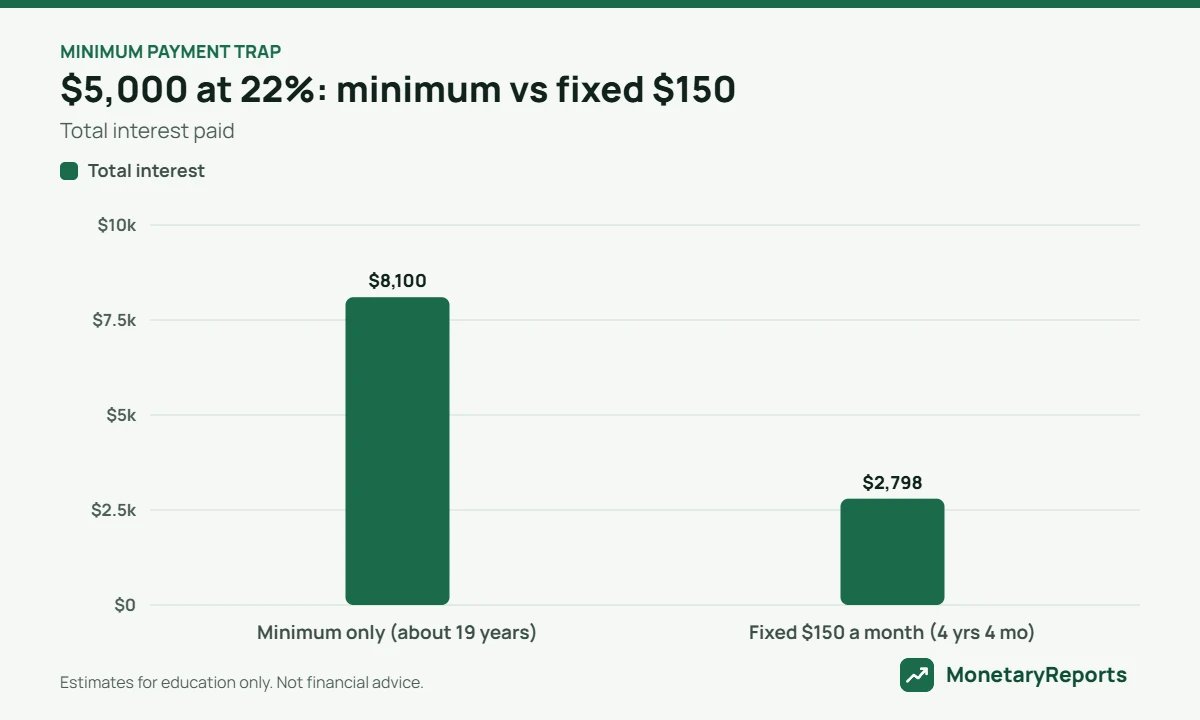
The minimum payment trap is what happens when you pay only the minimum on a credit card: most of each payment goes to interest, the balance barely moves and the debt can last for decades. Here is what paying the minimum really costs, with numbers.
Quick answer
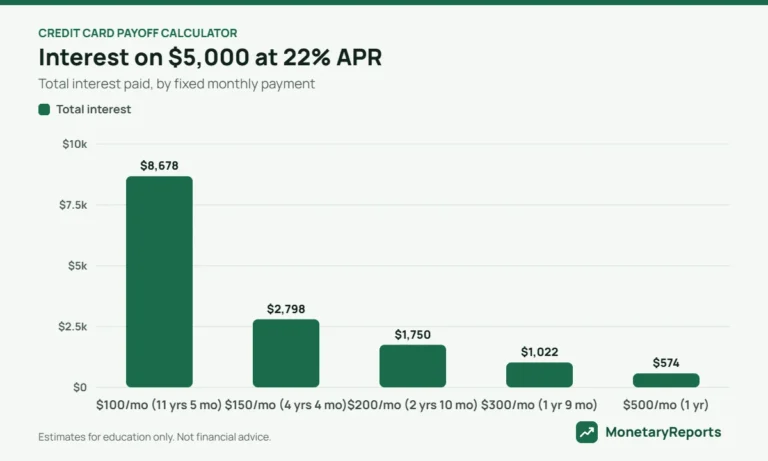
On a $5,000 balance at 22% APR, paying a typical minimum of 1% of the balance plus interest (at least $25) takes about 19 years and costs about $8,100 in interest. A fixed $150 a month clears it in about 4 years and 4 months for about $2,798.
How minimum payments work
Card issuers set the minimum as a small percentage of the balance (often 1% to 3%) plus that month’s interest and fees, with a floor such as $25 or $35. As the balance shrinks, the minimum shrinks too, which is why it takes so long. Your statement must show how long it will take to pay off the balance with minimum payments only.
What paying the minimum really costs
| $5,000 at 22% APR | Time to pay off | Total interest |
|---|---|---|
| Minimum only (1% + interest, $25 floor) | about 19 years | about $8,100 |
| Fixed $150 a month | 4 years, 4 months | $2,798 |
| Fixed $300 a month | 1 year, 9 months | $1,022 |
The first year of minimum payments
The minimum payment trap is easiest to see in year one. On $5,000 at 22% APR with a minimum of 1% of the balance plus interest, you pay about $1,610 in the first 12 months. About $1,041 of that is interest and only $568 reduces the debt.
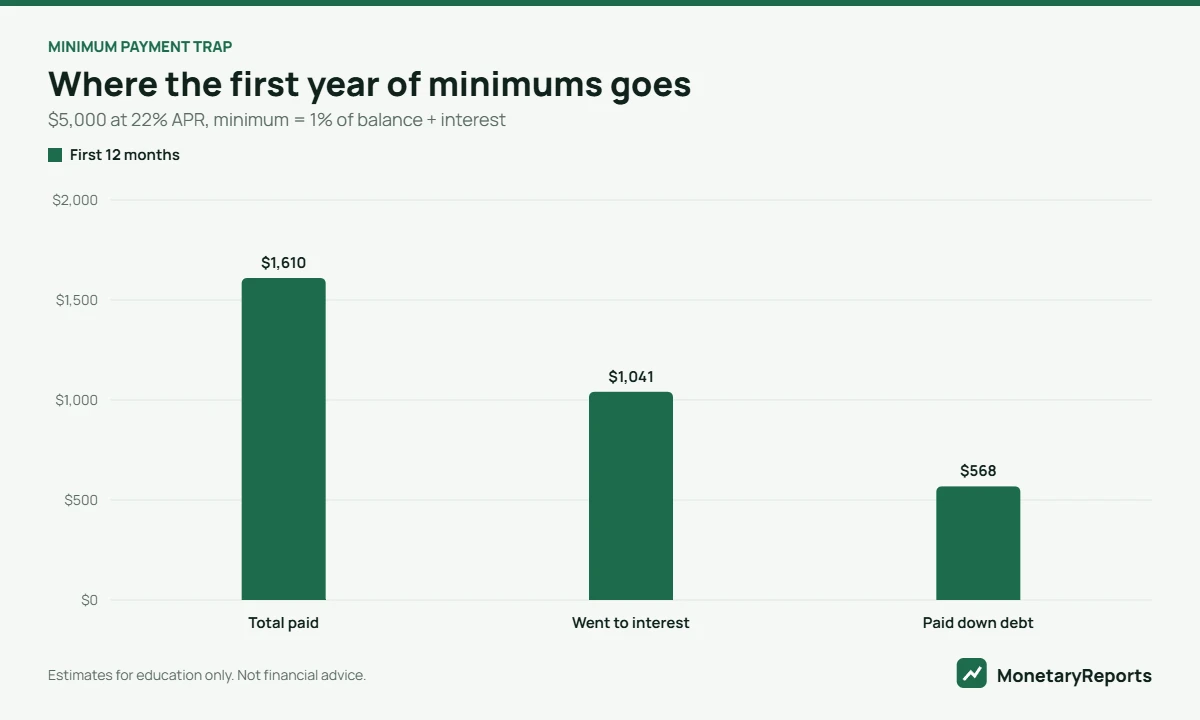
After a full year of on-time payments you still owe about $4,432. And because the minimum shrinks as the balance shrinks, the second year pays the debt down even more slowly.
The minimum payment trap at different balances
The trap gets deeper as the balance grows. Here is what paying the minimum costs compared with a fixed payment of 3% of the starting balance, kept the same every month, at 22% APR:
| Balance | Minimum only: time | Minimum only: interest | Fixed payment | Fixed: time | Fixed: interest |
|---|---|---|---|---|---|
| $2,000 | 11 years, 7 months | $2,600 | $60 | 4 years, 4 months | $1,119 |
| $5,000 | 19 years, 2 months | $8,100 | $150 | 4 years, 4 months | $2,798 |
| $10,000 | 24 years, 11 months | $17,266 | $300 | 4 years, 4 months | $5,596 |

Why the formula matters
Each issuer sets its own minimum. On the same $5,000 at 22% APR, the formula alone changes the outcome a lot:
| Minimum formula | Time to pay off | Total interest |
|---|---|---|
| 1% of balance + interest ($25 floor) | 19 years, 2 months | $8,100 |
| 3% of balance ($25 floor) | 17 years, 1 month | $7,014 |
| 4% of balance ($25 floor) | 10 years, 9 months | $3,921 |
Look for the formula in your card agreement, or simply read the “minimum payment warning” box on your statement.
How to escape the minimum payment trap
- Pick a fixed payment and keep it the same, even as the minimum falls.
- Set up autopay for that fixed amount, not the minimum.
- Stop adding new charges to the card.
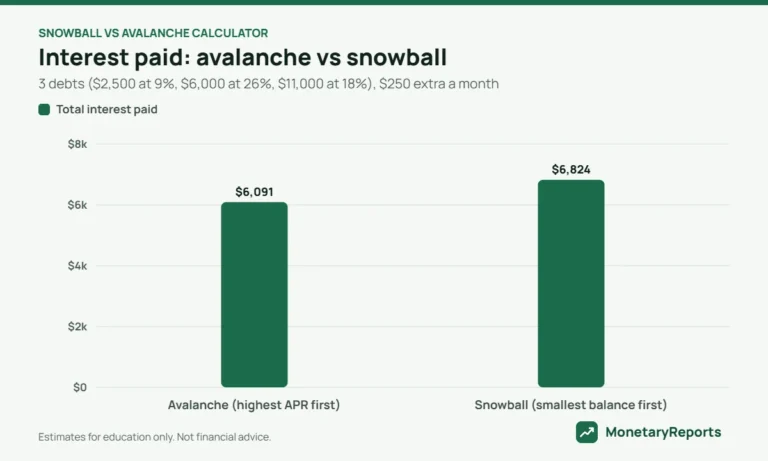
- Use the avalanche method if you have several cards.
- Consider a balance transfer or a lower-rate loan if the numbers work.
What the minimum payment trap means for you
- The minimum keeps your account in good standing, but it is not a payoff plan.
- A fixed payment shrinks the debt much faster.
- Check the “minimum payment warning” box on your statement to see your own numbers.
How to read the minimum payment warning on your statement
Under the Credit CARD Act, U.S. card statements must include a box that shows your own numbers:
- How long it would take to pay off the balance if you pay only the minimum.
- The total you would pay, interest included, with minimum payments only.
- The monthly payment needed to pay it off in about 3 years, and what that would cost in total.
For $5,000 at 22%, the 3-year payment would be about $190.95 a month, with about $1,874 of interest in total, compared with about $8,100 on the minimum. That box is the quickest way to see the minimum payment trap on your own card.
Signs you are stuck in the minimum payment trap
- Your balance is about the same as it was a year ago, even though you never missed a payment.
- More than half of each payment goes to interest.
- You use the card again after paying, so the balance never really falls.
- You have set autopay to the minimum and stopped checking the statement.
- You are paying the minimum on several cards at once.
Ways out of the minimum payment trap, compared
Here is the same $5,000 card balance at 22% APR handled four different ways. The numbers assume no new charges and on-time payments:
| Option | Monthly payment | Time | Total interest or fees |
|---|---|---|---|
| Minimum only (1% + interest) | Starts at about $142, then falls | 19 years, 2 months | $8,100 interest |
| Fixed $200 a month on the card | $200 | 2 years, 10 months | $1,750 interest |
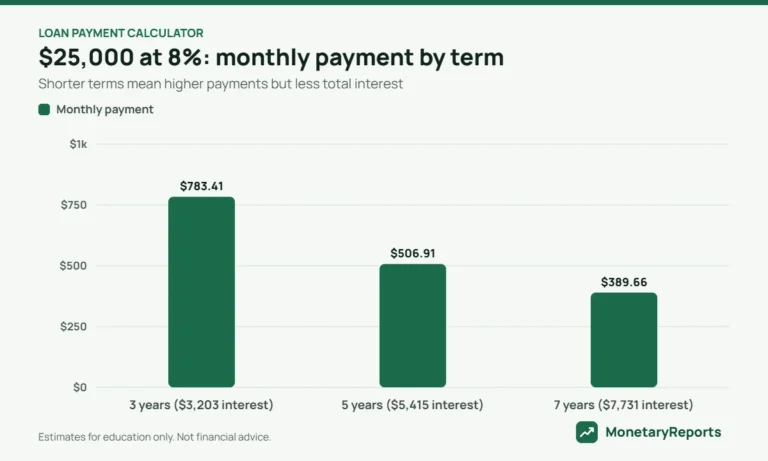
| Personal loan at 12% for 3 years | $166.07 | 3 years | $979 interest |
| 0% balance transfer for 18 months, 3% fee | $286.11 | 18 months | $150 fee |
Pros and cons: a fixed payment needs no application and works today. A personal loan gives a fixed end date but depends on your credit and may carry an origination fee. A balance transfer is the cheapest on paper, but only if you clear the balance before the promo ends and stop using the old card. See is a balance transfer worth it? for the full math.
What to do this week
- Find the minimum payment warning box on your latest statement and write down the 3-year payment.
- Choose a fixed payment you can keep, ideally at or above that 3-year amount.
- Change autopay from “minimum” to that fixed amount.
- Put the card somewhere you will not use it for daily purchases.
- Run your numbers in the credit card payoff calculator and set a payoff date on your calendar.
Frequently asked questions
Is it bad to pay only the minimum?
It avoids late fees, but it makes the debt last much longer and cost far more interest.
How is the credit card minimum calculated?
Usually a small percentage of the balance plus interest and fees, with a dollar floor. Each issuer sets its own formula.
How long does it take to pay off a card with minimum payments?
Often decades on a large balance at a high APR. On $5,000 at 22% it can take about 19 years.
Does paying more than the minimum help my credit?
Lower balances usually improve your credit utilization, which can help your score.
What if I can only afford the minimum?
Pay it to stay current, look for small extra amounts and contact your issuer or a nonprofit credit counselor for options.
How much of my minimum payment goes to interest?
At high APRs, most of it. On $5,000 at 22% with a 1% + interest minimum, about 65% of the first year of payments is interest.
Can I get out of the minimum payment trap with a small extra payment?
Yes. Even $25 to $50 a month above the minimum, kept the same every month, shortens the payoff by years. The key is a fixed amount that does not shrink with the balance.
Does the minimum payment trap hurt my credit score?
Paying the minimum on time does not hurt your payment history, but a high balance keeps your credit utilization high, which can hold your score down.
Related guides and calculators
- Credit card payoff calculator
- How credit card interest is calculated
- How long to pay off $10,000 in credit card debt
- Is a balance transfer worth it?
Sources
This guide is for educational purposes only and is not financial advice. The figures are estimates before taxes, fees and inflation, and real rates, returns and rules change over time.