Simple Interest Formula (I = P × r × t) With Easy Examples
The simple interest formula is the easiest interest formula in finance: interest equals principal times rate times time. This guide explains each part, works through several examples step by step, and shows how to solve for the rate, the time or the principal.
Quick answer
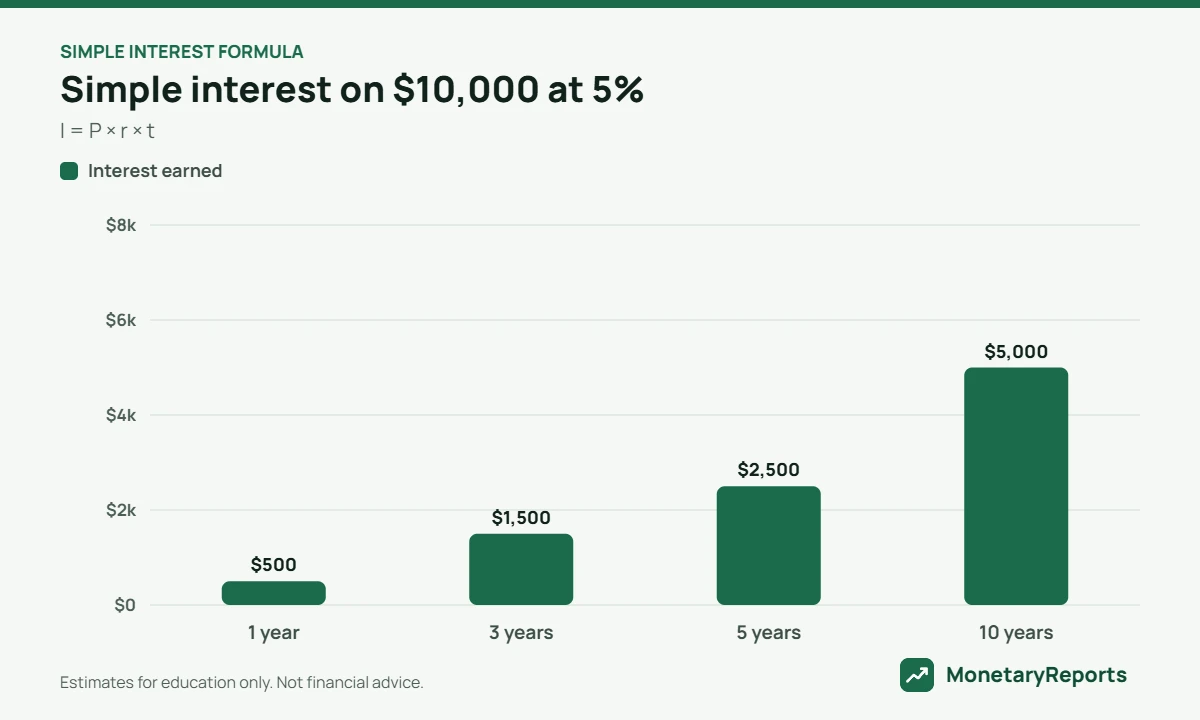
The simple interest formula is I = P × r × t. P is the principal, r the yearly rate as a decimal and t the time in years. Example: $10,000 at 5% for 3 years earns 10,000 × 0.05 × 3 = $1,500. The final amount is A = P × (1 + r × t) = $11,500.
The simple interest formula
Interest:      I = P × r × t
Final amount:  A = P × (1 + r × t)
| Letter | Meaning | Example |
|---|---|---|
| I | Interest earned or paid | The answer |
| P | Principal (starting amount) | $10,000 |
| r | Yearly rate as a decimal | 5% → 0.05 |
| t | Time in years | 3 |
4 worked examples
- Savings: $2,000 at 4% for 2 years → I = 2,000 × 0.04 × 2 = $160.
- Months: $10,000 at 5% for 6 months → t = 0.5 → I = 10,000 × 0.05 × 0.5 = $250.
- Days: $20,000 at 6.5% for 30 days → t = 30 ÷ 365 → I ≈ $106.85.
- Long term: $10,000 at 5% for 10 years → I = $5,000, final amount $15,000.
Solving for rate, time or principal
| To find | Formula | Example |
|---|---|---|
| Rate (r) | r = I ÷ (P × t) | $1,500 ÷ ($10,000 × 3) = 5% |
| Time (t) | t = I ÷ (P × r) | $1,500 ÷ ($10,000 × 0.05) = 3 years |
| Principal (P) | P = I ÷ (r × t) | $1,500 ÷ (0.05 × 3) = $10,000 |
Common mistakes
- Using 5 instead of 0.05 for the rate.
- Forgetting to convert months or days into years.
- Applying simple interest to accounts that compound, such as most savings accounts.
What the simple interest formula means for you
- It is perfect for quick estimates and for loans that charge interest on the remaining balance.
- For savings and investments that compound, use the compound interest formula.
- On loans, paying early reduces t and therefore the interest.
Frequently asked questions
What is the formula for simple interest?
I = P × r × t: principal times rate (as a decimal) times time in years.
How do you calculate simple interest per month?
Divide the yearly rate by 12 and multiply by the principal: $10,000 × 0.05 ÷ 12 ≈ $41.67 a month.
How is simple interest different from compound interest?
Simple interest is only calculated on the principal; compound interest is also calculated on earlier interest, so it grows faster.
What is A in the simple interest formula?
A is the final amount: principal plus interest, A = P × (1 + r × t).
Where is simple interest used in real life?
Many auto loans and some personal loans, some bonds that pay interest out, and short-term loans.
Related guides and calculators
- Simple interest calculator
- Compound interest formula
- Compound vs simple interest
- Loan payment calculator
Sources
This guide is for educational purposes only and is not financial advice. The figures are estimates before taxes, fees and inflation, and real rates, returns and rules change over time.