Debt Snowball vs Debt Avalanche: Pros, Cons and Which to Choose
Debt snowball vs avalanche: two popular ways to pay off several debts. Both pay the minimum on everything and put extra money toward one target debt at a time. The difference is which debt you target first, and that changes how much you save and how motivated you feel.
Quick answer
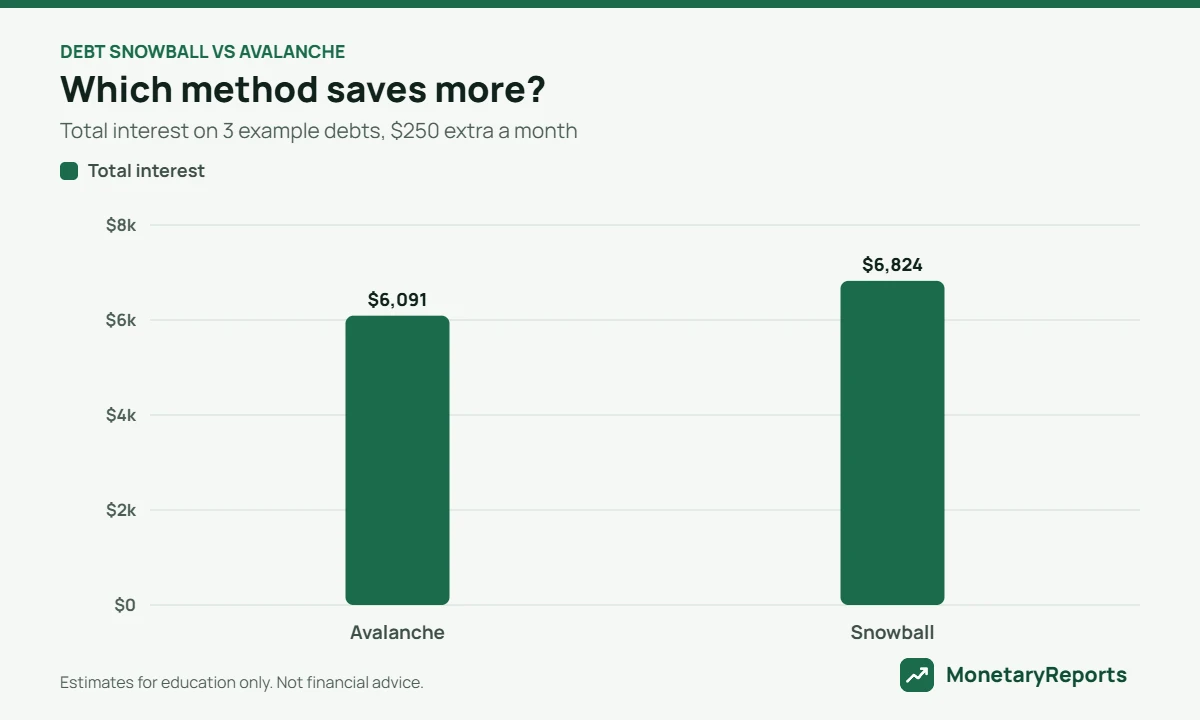
The avalanche pays the highest-APR debt first and usually saves the most interest. The snowball pays the smallest balance first and gives quick wins. In our example with three debts, avalanche costs about $6,091 in interest vs $6,824 for snowball.
Debt snowball vs avalanche: how each method works
| Step | Avalanche | Snowball |
|---|---|---|
| 1 | List debts by APR, highest first | List debts by balance, smallest first |
| 2 | Pay minimums on all | Pay minimums on all |
| 3 | Extra money to the highest APR | Extra money to the smallest balance |
| 4 | When it is paid, roll its payment to the next | When it is paid, roll its payment to the next |
Snowball vs avalanche: pros and cons
| Debt avalanche | Debt snowball | |
|---|---|---|
| Pros | Lowest total interest; fastest when one rate is much higher | Quick first win; fewer bills sooner; easy to follow |
| Cons | First payoff can take a long time; easy to lose motivation | Costs more interest when the smallest debt has a low rate |
| Best for | Disciplined savers with big rate gaps | Anyone who needs momentum to keep going |
Example with three debts
| Debt | Balance | APR | Minimum |
|---|---|---|---|
| Debt 1 | $2,500 | 9% | $75 |
| Debt 2 | $6,000 | 26% | $150 |
| Debt 3 | $11,000 | 18% | $220 |
Avalanche targets Debt 2 (26%) first and saves about $733 compared with snowball, which starts with Debt 1 because it is the smallest. Try your own debts:
Debt snowball vs avalanche in 4 real-life situations
The main example has a big rate gap, so the avalanche wins clearly. In many households the gap is smaller. Here are three more snowball vs avalanche cases, each run with both methods:
| Situation | Debts | Extra | Snowball interest | Avalanche interest | Difference |
|---|---|---|---|---|---|
| Similar APRs | $4,000 at 22%, $1,200 at 21%, $7,000 at 23% | $200 | $4,142 | $4,036 | $106 |
| Cards + student loan | $1,800 at 24%, $15,000 at 5.5%, $3,500 at 29% | $300 | $2,618 | $2,539 | $79 |
| Medical bill + card | $600 at 0%, $5,000 at 25% | $150 | $1,247 | $1,172 | $75 |

Now look at the other side of snowball vs avalanche: motivation. In the same four cases, the snowball clears its first debt much sooner:
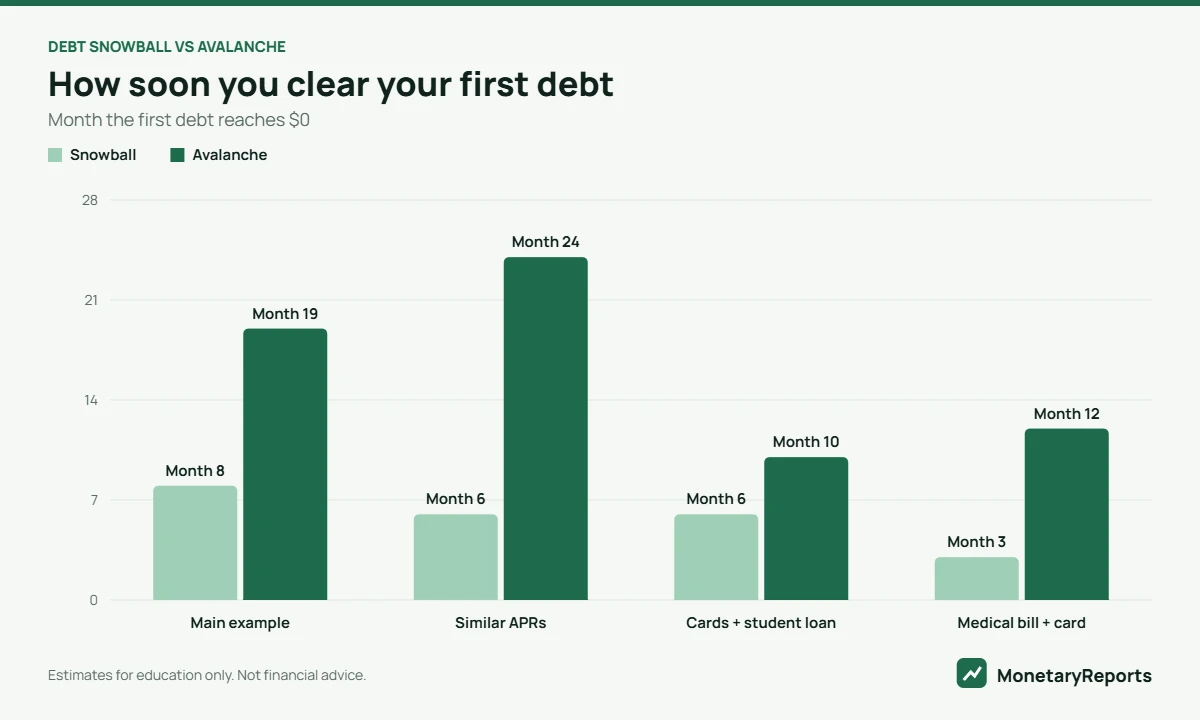
What this means for you: when the interest gap is under about $100 to $200, the snowball’s faster first win is often worth it. When one debt has a much higher rate, the avalanche is worth the wait.
A 5-step debt snowball vs avalanche worksheet
- Write down every debt: balance, APR and minimum payment.
- Add up the minimums and decide the extra amount you can pay every month.
- Sort the list twice: once by APR (avalanche) and once by balance (snowball).
- Run both lists in the debt snowball vs avalanche calculator and note the interest and the month of your first payoff.
- Pick one, set autopay, and review the list every 3 months.
Why the snowball still works
Paying off a whole debt quickly feels good and frees up a payment you can see. That momentum keeps many people on track. A plan that you finish is better than a cheaper plan you abandon.
How to choose
- If your APRs are very different, the avalanche can save a lot: start there.
- If your APRs are similar, the snowball costs little extra and gives faster wins.
- You can also combine them: knock out one tiny debt for motivation, then switch to avalanche.
What debt snowball vs avalanche means for you
- Both methods work if you keep paying and stop adding new debt.
- Run your own numbers with the calculator to see the real difference.
- Celebrate each debt you finish.
Finding the extra money: it matters more than the method
In the main example, choosing avalanche over snowball saves about $733. Raising the extra payment from $100 to $250 a month saves more than $3,000 with either method. Before you settle debt snowball vs avalanche, look for the extra money:
- One subscription audit: cancelling two or three unused services often frees $30 to $60 a month.
- Windfalls: tax refunds, bonuses and cash gifts can go straight to the target debt.
- A temporary side income: even $200 a month for one year is $2,400 off your balances.
- Lower rates: a call to ask for a lower APR, or a balance transfer, makes every payment go further.
How the rollover works, step by step
The “roll” is what makes both methods speed up over time. In the snowball version of the main example:
- Months 1 to 8: you pay $75 + $250 extra on the $2,500 debt, and the minimums on the other two.
- Month 8: the $2,500 debt is gone. Its $75 plus the $250 extra ($325) now goes to the $6,000 debt, on top of its $150 minimum.
- Month 23: the $6,000 debt is gone. Now $475 rolls onto the $11,000 debt with its $220 minimum: $695 a month.
- Month 38: everything is paid off.
The avalanche follows the same rollover, just in a different order: the 26% debt first, then the 18% debt, then the 9% debt.
After you are debt-free
Whichever you chose in the debt snowball vs avalanche decision, the end result is the same: a monthly payment that is suddenly free. Send part of it to an emergency fund first, then to retirement savings, so the next surprise expense does not land on a credit card.
Frequently asked questions
Which saves more, snowball or avalanche?
In a snowball vs avalanche comparison, the avalanche usually saves more interest because it targets the most expensive debt first.
Is the snowball method a mistake?
No. It can cost a bit more, but its quick wins help many people stay committed.
Do I still pay the minimums?
Yes, always pay every minimum to avoid late fees and credit damage.
What about my mortgage and car loan?
Most people focus on high-interest consumer debt and keep paying those loans normally.
How do I find extra money for debt?
Cut one big expense, add side income or put windfalls toward the target debt.
Can I switch from snowball to avalanche halfway?
Yes. Many people start with the snowball for a quick win and switch to the avalanche once the small debts are gone. What matters is that the extra payment always goes to one target.
Does snowball or avalanche help my credit score more?
Neither directly; snowball vs avalanche is about interest and motivation, not credit scoring. Your score improves as total balances fall and you pay on time. Paying off a card completely can help utilization slightly sooner with the snowball, but the effect is usually small.
Related guides and calculators
- Debt snowball vs avalanche calculator
- How to pay off $20,000 of debt in 2 years
- Credit card payoff calculator
- Pay off debt or save first?
Sources
- Consumer Financial Protection Bureau (CFPB)
- Federal Reserve: Consumer credit (G.19)
- MonetaryReports: How we calculate
This guide is for educational purposes only and is not financial advice. The figures are estimates before taxes, fees and inflation, and real rates, returns and rules change over time.