401(k) Employer Match: How It Works (Don’t Leave Free Money)
A 401k employer match is money your employer adds to your 401(k) when you contribute. It is one of the best deals in personal finance: an instant return on your contribution before any investment growth. This guide explains common match formulas, how much they are worth and the rules to watch.
Quick answer
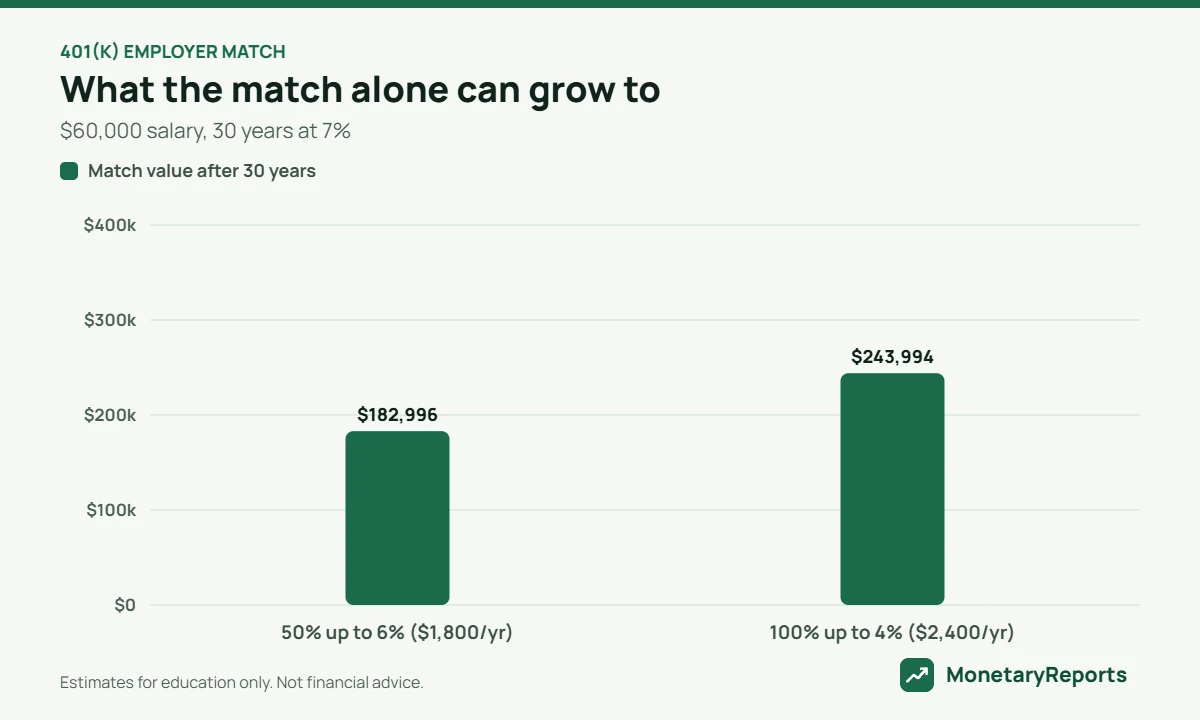
With a “50% up to 6%” 401k employer match on a $60,000 salary, you contribute 6% ($3,600) and your employer adds $1,800 a year. Invested for 30 years at 7%, the match alone could grow to about $182,996.
How a 401k employer match works
You choose a percentage of your pay to put in your 401(k). Your employer adds money based on a formula, usually up to a limit. If you contribute less than the limit, you leave part of the match on the table.
Common match formulas
| Formula | You contribute | Employer adds ($60,000 salary) |
|---|---|---|
| 50% up to 6% of pay | 6% = $3,600 | 3% = $1,800 |
| 100% up to 4% of pay | 4% = $2,400 | 4% = $2,400 |
| 100% of first 3% + 50% of next 2% | 5% = $3,000 | 4% = $2,400 |
What the match is worth
A 50% match is an immediate 50% return on the money you contribute up to the limit. No savings account or typical investment offers that. Over decades, the match plus its growth can add hundreds of thousands of dollars.
Vesting: when the match is yours
- Immediate vesting: the match is yours right away.
- Cliff vesting: you get 100% after a set period, such as 3 years; leave earlier and you lose it.
- Graded vesting: you earn a growing share each year, for example 20% per year.
- Your own contributions are always 100% yours.
What the 401k employer match means for you
- Contribute at least enough to get the full match.
- Check the vesting schedule before changing jobs.
- Ask HR or check your plan documents for the exact formula.
Frequently asked questions
What is a good 401k employer match?
Matches of 3% to 6% of pay are common. Any match is valuable; the key is to contribute enough to get all of it.
Does the employer match count toward the contribution limit?
The employee contribution limit applies to your own contributions; a separate, higher overall limit includes employer money. Check IRS.gov for current figures.
Is the employer match taxed?
Matches to a traditional 401(k) are not taxed now; they are taxed when withdrawn. Some plans now allow Roth matches, which are taxed when made.
What happens to my match if I leave my job?
You keep the vested part. Unvested money goes back to the employer.
Should I contribute more than the match?
If you can, yes. Many guidelines suggest saving 10% to 15% of pay in total for retirement.
Related guides and calculators
- 401(k) growth calculator
- Roth IRA vs traditional IRA
- Retirement savings by age
- How to make compound interest work for you
Sources
This guide is for educational purposes only and is not financial advice. The figures are estimates before taxes, fees and inflation, and real rates, returns and rules change over time.