Time Value of Money: Why $1 Today Beats $1 Tomorrow
The time value of money is the idea that a dollar today is worth more than a dollar in the future, because today’s dollar can be invested and earn a return. It is the foundation of saving, investing, loans and retirement planning, and it is simpler than it sounds.
Quick answer
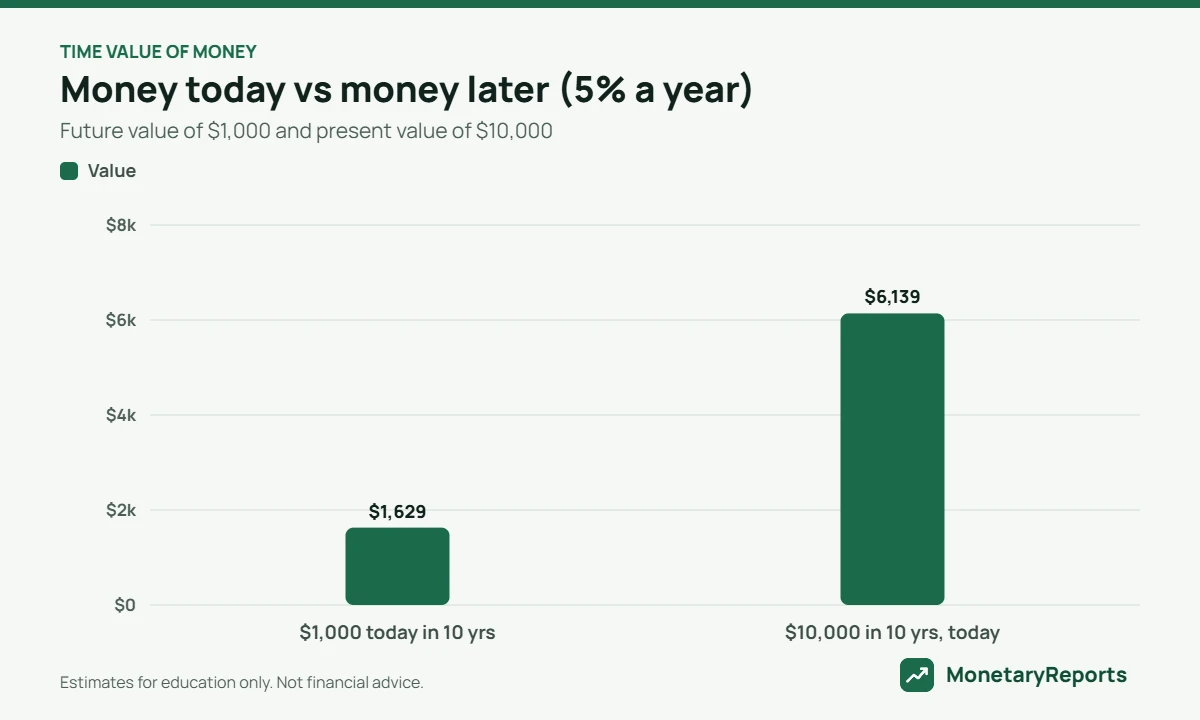
The time value of money says money now is worth more than the same amount later. At 5% a year, $1,000 today grows to about $1,628.89 in 10 years (future value). And $10,000 received in 10 years is worth about $6,139 today (present value).
Why money today is worth more
- It can earn interest or returns starting now.
- Inflation reduces what future money can buy.
- Uncertainty: a payment promised in the future may not arrive.
Future value
Future value = present value × (1 + r)^n
$1,000 × 1.05^10 ≈ $1,628.89. This is the same idea as compound interest.
Present value
Present value = future value ÷ (1 + r)^n
$10,000 ÷ 1.05^10 ≈ $6,139. So if someone offered you $6,139 today or $10,000 in 10 years, and you could earn 5% a year, the two would be roughly equal. Even one year matters: $1,000 next year is worth about $952.38 today at 5%.
Where you use the time value of money in real life
- Saving and investing: starting earlier gives money more time to grow.
- Loans: interest is the price of using someone else’s money now.
- Lottery and settlements: comparing a lump sum with yearly payments.
- Retirement: how much you need today to reach a future goal.
- Business decisions: comparing projects with cash flows at different times.
What the time value of money means for you
- Starting to save early is the most powerful use of this idea.
- Compare offers by their value today, not just the headline amount.
- Inflation and interest rates both change the answer.
Frequently asked questions
What is the time value of money in simple words?
A dollar today is worth more than a dollar later, because today’s dollar can grow.
What is the formula for future value?
FV = PV × (1 + r)^n.
What is the formula for present value?
PV = FV ÷ (1 + r)^n.
What rate should I use?
The return you could realistically earn elsewhere with similar risk, sometimes called the discount rate.
Is the time value of money the same as compound interest?
They are closely related: compound interest is how money grows over time; time value of money also works backwards to value future money today.
Related guides and calculators
- What is compound interest?
- Compound interest formula
- What is inflation?
- How much will $1 million be worth in 30 years?
Sources
This guide is for educational purposes only and is not financial advice. The figures are estimates before taxes, fees and inflation, and real rates, returns and rules change over time.